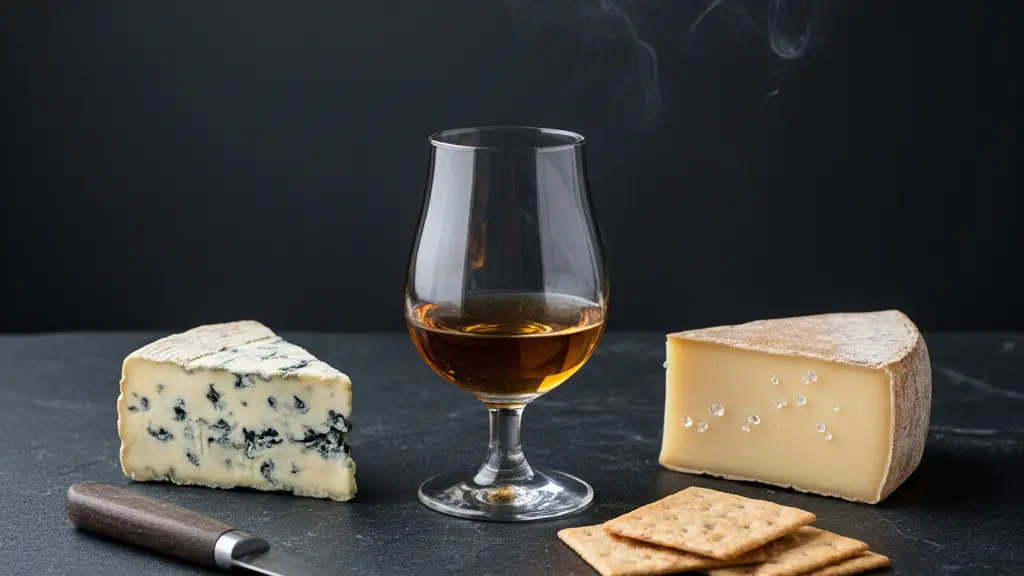
Success in pairing whisky with cheese relies not on flavor matching, but on structural engineering: using fat to buffer the ethanol burn.
- High-proof spirits require dense, crystallized pastes (like aged Comté) or triple-crème fats to prevent palate stripping.
- Spicy or pepper-infused rinds are a critical error, as ethanol chemically amplifies heat to painful levels.
Recommendation: Audit your cheese board for texture first, ensuring a balance of soluble protein crystals and high butterfat to counteract the spirit’s volatility.
We have all experienced the disappointment of a cheese board that collapses under the weight of a strong drink. You select a delicate Chèvre, expecting contrast, only to find it obliterated by the aggressive volatiles of a cask-strength Scotch. Or worse, a fine blue cheese turns metallic when clashing with the tannins of an over-oaked Bourbon. For a host, these missteps are frustrating because the advice available is often generic, borrowing heavily from wine pairing rules that simply do not apply to spirits hovering around 40% ABV or higher.
The standard advice to “match intensity with intensity” is insufficient when dealing with distilled spirits. Wine relies on acidity to cut through fat; whisky, however, relies on ethanol solvency. This fundamental difference changes the architecture of the board entirely. We must look beyond flavor notes and consider the “mechanics of the mouth”—how milk proteins, fat globules, and rinds physically interact with high-proof alcohol.
But what if the key to a successful pairing isn’t about the flavor notes at all, but rather the physical density of the paste? This guide abandons the poetic descriptions of “grassy notes” to focus on the structural reality of affinage and chemistry. We will explore how specific textures, from the tyrosine crystals in aged Cheddar to the sticky rind of an Époisses, physically stand up to the solvent power of whisky, rum, and bourbon.
To navigate this complex landscape, we will dissect the specific interactions between spirit congeners and dairy matrices, guiding you toward a structurally sound cheese platter.
Table of Contents: A Structural Approach to Pairing
- Why Does High-Proof Spirit Cut Through the Creaminess of Triple Crème Brie?
- How to Pair Scottish Cheddar with Highland Malt for a Regional Match?
- Crystalline Parmigiano or Gooey Epoisses: Which Texture Suits Bourbon?
- The Pepper Rind Error: Why Chili-Infused Cheeses Kill the Spirit’s Finish?
- In Which Order Should You Eat the Cheeses to Match a Flight of Rums?
- When to Serve the Cheese Board: Before or After the Dessert Pairing?
- Why Are Spirit Tannins Less Astringent Than Red Wine Tannins?
- How to Pair Cured Meats with Spirits: Balancing Salt, Fat, and Smoke?
Why Does High-Proof Spirit Cut Through the Creaminess of Triple Crème Brie?
When dealing with high-proof spirits, the primary challenge is the solvent nature of ethanol. Unlike wine, which washes over the palate, whisky at 46% ABV or higher actively strips the tongue of its protective mucous layer. This is where the mechanics of a Triple Crème cheese, like Brillat-Savarin or Pierre Robert, become essential. The high butterfat content serves as a sacrificial layer, coating the mouth to buffer the aggressive “burn” of the alcohol.
To visualize this interaction, consider the microscopic level where fat globules meet the spirit. The image below illustrates this contact zone.
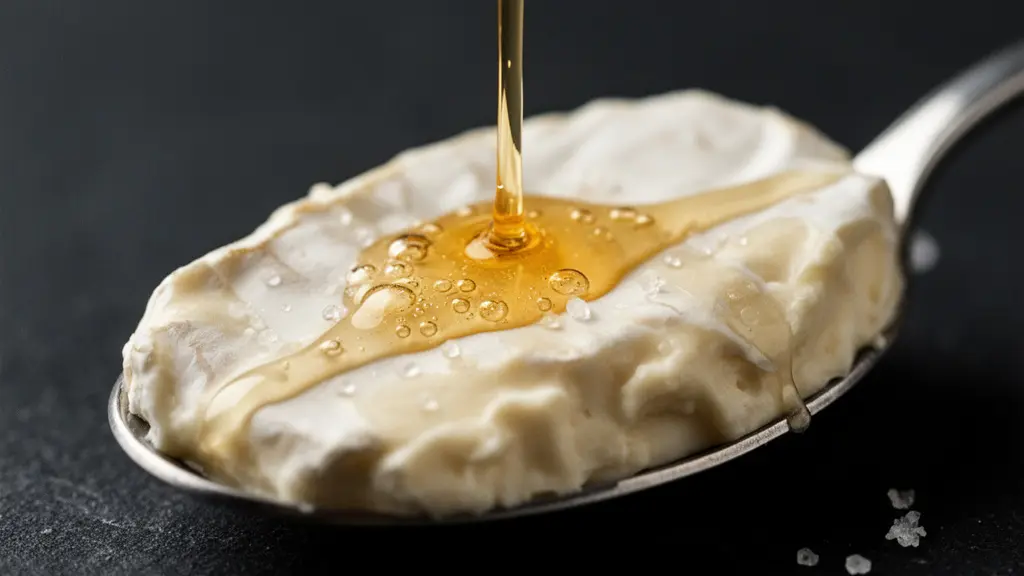
As depicted, the lipid layer creates a barrier. However, it is not just about protection; it is about aroma release. A spirit’s volatiles need a medium to disperse. Research into food matrices suggests that a cheese’s specific composition—its fat phase and protein network—can fundamentally alter how aromas are released and perceived. By providing a dense fat matrix, the cheese slows down the volatilization of the spirit’s congeners, allowing you to taste the fruit and grain notes before the ethanol heat takes over.
Ideally, the cheese should have enough structural integrity to not simply dissolve instantly, but melt at a rate that parallels the finish of the whisky.
How to Pair Scottish Cheddar with Highland Malt for a Regional Match?
Regional pairing is often touted as a golden rule, but in the case of Scottish Cheddar and Highland Malt, the success lies in the science of aging. Specifically, we are looking for “calcium lactate crystals”—those crunchy white bits found in well-aged blocks. These crystals provide a necessary textural distraction and a burst of savory complexity that parallels the heather and honey notes of the malt.
The formation of these crystals is not accidental; it is a result of precise acidification during the cheesemaking process. A doctoral dissertation from Washington State University highlights that soluble calcium was reported as 35% to 41% higher in certain Cheddar treatments, a condition linked to crystal development. This mineral intensity allows the cheese to hold its ground against the malt’s body without requiring the excessive fat content of a Brie.
When selecting a Cheddar, look for cloth-bound varieties aged at least 12 to 18 months. The lower moisture content concentrates the salts and proteins, creating a “sharpness” that cuts through the viscous mouthfeel of a non-chill filtered whisky. The result is a balance where the cheese’s acidity lifts the spirit’s heavier, oily characteristics.
This interplay of texture and acidity makes the humble Cheddar a far more sophisticated partner for single malts than softer, younger cheeses.
Crystalline Parmigiano or Gooey Epoisses: Which Texture Suits Bourbon?
Bourbon, with its intense sweetness from corn and heavy vanillins from new oak, requires a cheese that offers savory contrast (umami) rather than competition. This brings us to the debate between the granular texture of Parmigiano Reggiano and the pungent, sticky rind of a washed-rind cheese like Époisses.
Parmigiano Reggiano is a powerhouse of hydrolyzed proteins. The Parmigiano Reggiano Consortium data shows a dense matrix containing ~32.4 g protein and ~29.7 g fat per 100g. This high protein density, combined with the crystallization of tyrosine, offers a savory “crunch” that contrasts beautifully with the liquid caramel texture of a bourbon. The saltiness resets the palate after each sweet sip.
Conversely, while a ripe Époisses is delicious, its volatile ammonia notes can be disastrous with spirits. As expert Francesco Lafranconi notes regarding “The Charcuterie Board Staple You Should Never Pair With Whiskey” :
a style like Époisses de Bourgogne or other very strong pungent cheeses
– Francesco Lafranconi, Chowhound
The issue is that the funky, sulfurous compounds in the washed rind can amplify the alcohol burn and create a metallic dissonance with the oak tannins. Therefore, the dry, crystalline structure of Parmigiano is the superior structural choice.
Stick to the hard, crystallized cheeses to let the Bourbon’s natural sweetness shine without interference.
The Pepper Rind Error: Why Chili-Infused Cheeses Kill the Spirit’s Finish?
It is a common trend to include chili-infused cheeses or Pepper Jack on a board to add “kick.” When pairing with high-proof spirits, this is a critical tactical error. The chemical interaction between ethanol and capsaicin (the compound responsible for heat in chilies) creates a sensory overload that can ruin the tasting experience.
This phenomenon is visually represented below, where the heat and volatility overwhelm the nuances of the spirit.
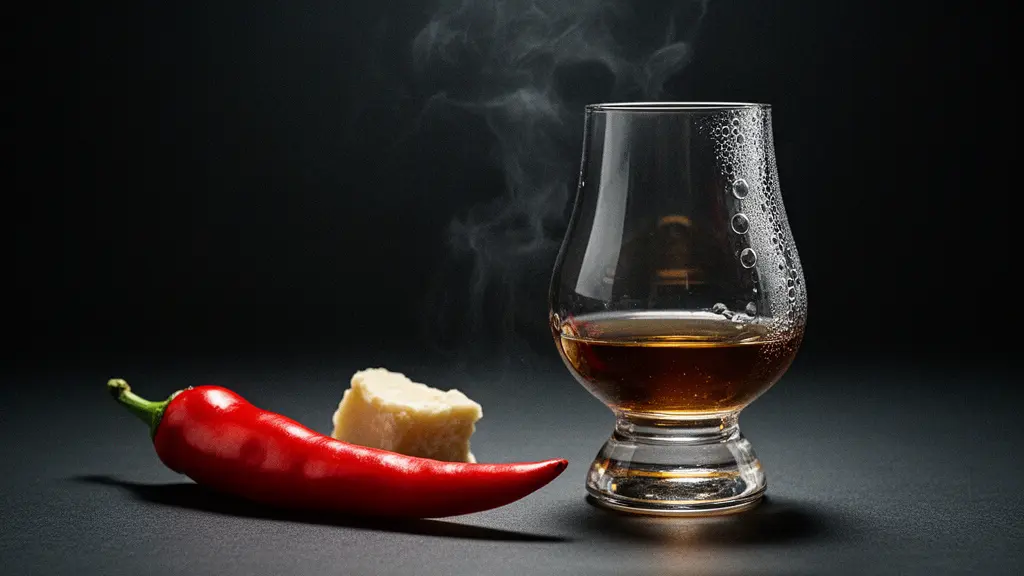
The science behind this is clear. Ethanol acts as a solvent that disperses capsaicin more effectively across the tongue, but it also lowers the temperature at which your pain receptors activate. Research demonstrates that ethanol can lower the TRPV1 (VR1) heat-activation threshold from ~42°C to roughly 34°C. This means your body perceives “burning” at a much lower temperature, turning a pleasant warmth into genuine pain.
This reaction creates a “blind spot” on the palate. The finish of a fine whisky—often the most delicate part—is completely obliterated by the scorching sensation. Instead of a long, smoky tail, you are left with nothing but heat.
If you desire spice, derive it from the rye grain in the whisky, not from the cheese additives.
In Which Order Should You Eat the Cheeses to Match a Flight of Rums?
A rum flight often progresses from lighter, floral styles (like a Spanish-style column still ron) to heavier, ester-rich pot still rums or aged agricoles. Your cheese selection must follow this same trajectory of intensity and texture. Eating a heavy blue cheese too early will coat your palate in a way that masks the delicate cane juice notes of the first rum.
The progression should be visual and textural, as shown in the arrangement below.

Start with a fresh goat cheese or a young sheep’s milk cheese. The acidity primes the palate. Move toward a semi-hard cheese with nutty notes, like an aged Gouda, which bridges the gap to the caramel notes of aged rum. Finish with the most intense cheese, such as a Roquefort, only when you reach the heavy, high-ester Jamaican rums that can fight back against the salt and mold.
Your Cheese Board Audit Plan: 5 Steps
- Inventory Potency: List your cheeses from lowest to highest fat and pungency.
- Check the Rinds: Remove any cheese with added peppers or excessive garlic.
- Assess Texture: Ensure you have at least one “crystalline” hard cheese and one “coating” soft cheese.
- Match the Flight: Align the mildest cheese with the lowest ABV/lightest spirit.
- Bridge the Gaps: If a gap exists between a light and heavy cheese, add a neutral cracker or nut to reset.
Discipline in the tasting order ensures that the final pairing is just as impactful as the first.
When to Serve the Cheese Board: Before or After the Dessert Pairing?
In a whisky dinner, the timing of the cheese course is pivotal. While French tradition often places cheese before dessert, the specific dynamics of spirits suggest a strict adherence to this rule. Serving cheese after a sweet dessert is a palate error when high-proof spirits are involved.
The reason lies in how sugar affects our perception of other flavors. Once the palate is saturated with sucrose from a dessert, dry spirits will taste perceptibly harsher and more astringent. Research into sensory perception indicates that lower sucrose levels can increase perceived bitterness, suggesting that moving from sweet (dessert) back to savory/dry (cheese + whisky) highlights the bitter, tannic elements of the spirit.
Furthermore, the fat in the cheese helps to reset the palate from the savory main course, preparing it for the sweeter finale. If you serve cheese after dessert, the residual sweetness of the pudding will make the cheese taste bland and the whisky taste like firewater. The cheese acts as a bridge, not a closer.
Always serve the cheese flight while the palate is still attuned to savory notes, transitioning to dessert only at the very end.
Why Are Spirit Tannins Less Astringent Than Red Wine Tannins?
When we talk about “tannins” in whisky, we are referring to ellagitannins derived from the oak barrel, not the condensed tannins found in grape skins. This distinction is crucial for cheese pairing. Spirit tannins are generally softer and sweeter (vanillin, lignin) than the drying, mouth-puckering tannins of a young Cabernet. This means you do not need the same level of aggressive protein to “soften” a whisky as you do for a red wine.
The alcohol content itself modifies how we perceive these wood compounds. Sensory studies using model solutions with 0.5% to 15% alcohol (ABV) used show that ethanol concentration fundamentally shifts sensory baselines. In a 40%+ spirit, the ethanol solvency keeps the wood extractives in solution longer, preventing them from binding as aggressively to your saliva proteins as wine tannins do.
Consequently, you can pair whisky with cheeses that might clash with red wine. A slightly bitter, washed-rind cheese that would make a Bordeaux taste metallic can actually harmonize with the wood spices of a rye whisky, because the spirit’s tannins are less reactive. You have more freedom to explore earthier, more complex rinds.
Recognizing this opens up a wider spectrum of cheese styles, including those with slight bitterness that would otherwise be off-limits.
Key Takeaways
- Fat is a Buffer: Use triple-crème cheeses to coat the palate against high-proof burn.
- Texture Matters: Crystalline cheeses (aged Cheddar, Parmigiano) offer necessary contrast to viscous spirits.
- Avoid Heat: Chili-infused cheeses react with ethanol to cause sensory blindness.
How to Pair Cured Meats with Spirits: Balancing Salt, Fat, and Smoke?
The inclusion of charcuterie alongside cheese adds another variable: smoke. When pairing with peated whisky or mezcal, there is a temptation to double down with smoked meats. However, “smoke on smoke” often results in a flat, monochromatic experience where the nuance of the spirit is lost in the campfire flavor of the meat.
A better approach is to use the meat to highlight a different aspect of the spirit. For a salty, maritime Islay whisky, choose a sweeter cured meat like San Daniele prosciutto, where the fat is silky and distinct. The salt in the meat will suppress the bitterness in the spirit, enhancing the perception of sweetness and fruitiness hidden beneath the peat.
Conversely, for a sweet Bourbon, a pepper-crusted salami (where the pepper is distinct from the chili heat mentioned earlier) or a smoky Speck can provide the savory anchor the spirit lacks. The goal is always to fill the “holes” in the spirit’s profile—adding fat where it is lean, salt where it is sweet, and sweetness where it is smoky.
Begin auditing your platter today by removing the spicy cheeses and focusing on the structural interplay of fat and crystals. A well-engineered board does not just accompany the whisky; it elevates it.
Frequently Asked Questions about Cheese and Spirits
Can I pair blue cheese with any whisky?
Not necessarily. Blue cheese works best with sweeter, peatier whiskies or high-proof bourbons that can cut through the mold’s intensity. Delicate Lowland malts will be overwhelmed.
Why does my cheese taste metallic with whisky?
This often happens with washed-rind cheeses (like Taleggio) paired with high-tannin spirits. The ammonia in the rind clashes with the oak tannins. Try a hard, nutty cheese instead.
Should I add fruit to the board?
Yes, dried fruits like apricots or figs concentrate sugars that bridge the gap between the savory cheese and the spirit’s fruit esters.