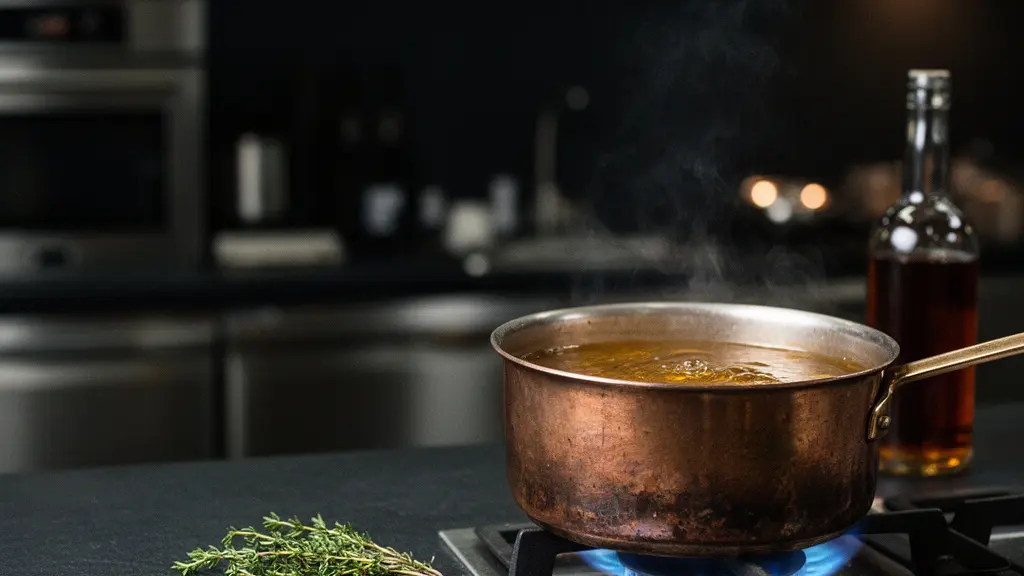
The bitterness in your whisky pan sauce comes from concentrating cheap fusel oils, not from the alcohol itself—which science proves barely burns off during flambé.
- USDA data reveals flambé only removes 25% of alcohol, while marinades retain 70%.
- Quality matters: distillation “tails” contain heavy congeners that turn harsh when reduced.
- Strategic timing—when to add rum to batter and how to deglaze—determines flavor integration versus emulsion stability.
Recommendation: Select your cooking spirits based on congener quality and control heat application to preserve volatile aromatics while eliminating harsh compounds.
You’ve seared the steak perfectly. The fond—that dark, caramelized layer of protein stuck to the pan—promises a sauce of profound depth. You reach for the bourbon, deglaze with a flourish, perhaps even ignite it for dramatic effect, and reduce until syrupy. But one taste reveals the tragedy: harsh, bitter, and solvent-like, the sauce assaults rather than complements. What went wrong?
The home cook faces a paradox when cooking with spirits. Conventional wisdom insists that alcohol burns off during cooking, yet the reality of ethanol retention and flavor chemistry proves far more complex. As a saucier, I observe that the issue rarely lies in the technique of reduction itself, but in misunderstanding how heat interacts with congeners—the flavor compounds in spirits—and how emulsions behave when alcohol enters the mix.
This guide dismantles the “cooking wine” fallacy and examines the science of alcohol retention, from the 75% ethanol remaining after flambé to the tenderizing mechanisms of rum versus wine. You will learn to deglaze with precision, time your additions to cake batter for optimal texture, and pair high-rye whiskey with charcuterie using bridge ingredients that harmonize at the molecular level.
To navigate these techniques systematically, we will explore eight essential principles of spirit cookery, from the physics of alcohol evaporation to the sensory science of chocolate pairing.
Table of Contents: Mastering Whisky and Rum in the Kitchen
- Why Does Flambéing Only Remove 25% of the Alcohol Content?
- How to Deglaze a Steak Pan with Bourbon to Capture the Fond?
- Rum or Red Wine: Which Tenderizes Red Meat Fibers More Effectively?
- The “Cooking Wine” Fallacy: Why Bad Whisky Makes Bad Sauce?
- When to Add Rum to the Batter: Before or After Creaming the Butter?
- How to Melt the Chocolate on Your Tongue Before Sipping the Spirit?
- How to Pair High-Rye Whiskey with Charcuterie for Maximum Spice?
- How to Use “Bridge Ingredients” to Connect Spicy Rums with Savory Dishes?
Why Does Flambéing Only Remove 25% of the Alcohol Content?
Flambé creates a spectacular visual display, but the science of ethanol combustion reveals a counterintuitive truth: the technique is largely aesthetic rather than functional for alcohol removal. When you ignite spirits in a pan, the flame consumes only the alcohol vapor immediately at the surface, leaving the liquid below largely untouched by combustion.
According to 75% retained after flambé, the USDA Nutrient Data Laboratory confirms that flambéed dishes retain approximately three-quarters of their original alcohol content. This retention occurs because the flame requires oxygen and vapor to sustain itself; once the surface layer burns, the heat dissipates quickly, and the remaining liquid never reaches the sustained temperature necessary for significant ethanol evaporation.
The misconception that flames “burn off” alcohol stems from observing the combustion of vapor, not the liquid itself. For meaningful alcohol reduction, sustained simmering provides the only reliable mechanism. Consider the following retention rates based on preparation methods:
| Preparation Method | Approximate Alcohol Retained |
|---|---|
| Stirred into hot liquid, removed from heat | 85% |
| Flambéed | 75% |
| No heat, stored overnight | 70% |
| Baked/simmered, not stirred, 25 min | 45% |
| Baked/simmered, stirred, 15 min | 40% |
| Simmered 30 min | 35% |
| Simmered 1 hour | 25% |
| Simmered 2 hours | 10% |
| Simmered 2.5 hours | 5% |
For the saucier, this data dictates strategy. If you flambé for show, understand that you preserve nearly all the spirit’s original alcohol and flavor intensity. To eliminate harsh alcoholic heat while concentrating desirable flavors, you must simmer gently for extended periods, allowing volatile compounds to escape while preserving the fat-soluble flavor molecules that water alone cannot extract.
How to Deglaze a Steak Pan with Bourbon to Capture the Fond?
The moment of deglazing represents a critical intersection of technique and chemistry. The fond—those caramelized protein bits adhering to the pan—contains hundreds of Maillard reaction products that constitute the soul of your sauce. Water cannot fully dissolve these flavor compounds because many are fat-soluble, but ethanol acts as the perfect solvent, bridging aqueous and lipid environments to liberate these flavors.
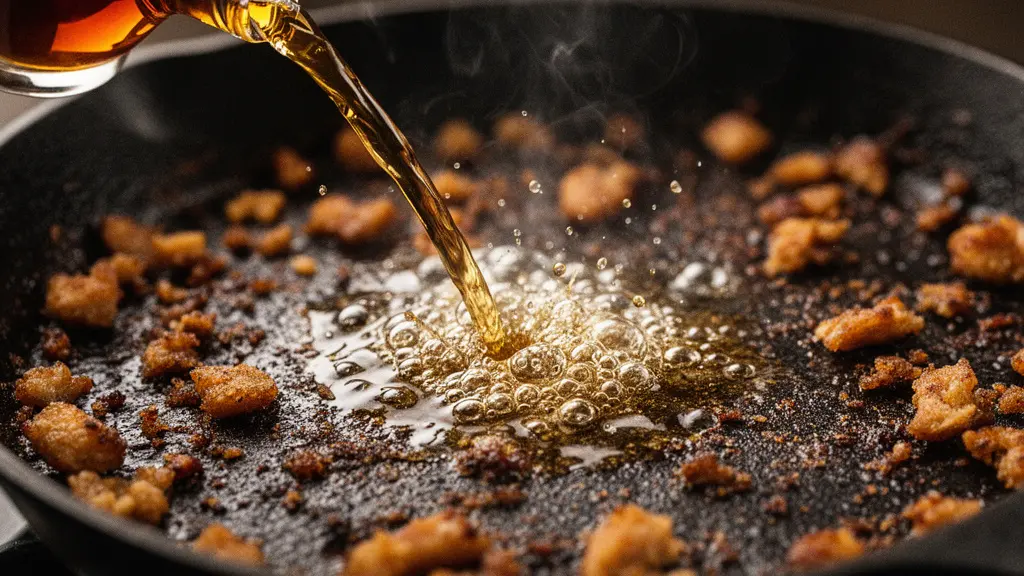
However, the high proof of spirits demands careful heat management. Adding bourbon to a screaming-hot pan creates an immediate fire hazard and volatilizes delicate aromatics before they can integrate into your sauce. The technique requires removing the pan from direct flame when adding alcohol, then returning it to controlled heat.
Selecting the appropriate whisky style determines your sauce’s final character. The mash bill—the grain recipe—creates distinct flavor profiles that pair with specific proteins:
| Whisky Type | Dominant Flavor Profile | Best Paired With | Sauce Character |
|---|---|---|---|
| Bourbon (high-corn mash bill) | Sweet: caramel, vanilla, toffee | Beef steaks, pork chops, root vegetables | Rich, sweet, rounded sauce with caramel depth |
| Rye Whiskey | Spicy: black pepper, clove, cinnamon | Fatty cuts (duck, lamb), rich stews | Peppery, assertive sauce that cuts through fat |
| Non-peated Scotch (blended) | Malty: honey, dried fruit, toasted grain | Chicken, game birds, mushroom dishes | Subtle, malty sauce with elegant depth |
Your 5-Step Plan for Professional Deglazing
- Remove the seared protein from the pan and set aside to rest under foil. Keep the fond (caramelized bits) intact in the hot pan.
- Reduce heat to medium-high — the pan should be hot enough that a drop of liquid sizzles immediately but not so hot that it smokes heavily. This is the temperature sweet spot for deglazing with spirits.
- Remove the pan from the direct flame, add 2-3 oz of bourbon, then return to heat. Scrape the bottom vigorously with a wooden spoon to dissolve all fond. The alcohol acts as a superior solvent for fat-soluble flavor compounds that water alone cannot extract.
- Reduce the spirit by three-quarters volume (au sec) to concentrate flavors and cook off harsh alcohol notes. The liquid should become syrupy.
- Add stock for the second deglaze to build body and volume, then finish by swirling in cold butter (monter au beurre) off the heat for a silky, glossy sauce.
This technique, adapted from professional deglazing technique with spirits, ensures you capture every bit of fond while controlling the reduction process.
Rum or Red Wine: Which Tenderizes Red Meat Fibers More Effectively?
The home cook often reaches for rum or wine in marinades with the hope of tenderizing tough cuts, but understanding the distinct mechanisms of these liquids reveals which tool suits which task. The comparison hinges on chemistry: alcohol denatures surface proteins, while acidity penetrates connective tissue.
Food scientist Harold McGee explains that alcohol serves dual functions in marinades: it denatures surface proteins while acting as a solvent for flavors not easily soluble in water. However, its effects are largely superficial—alcohol primarily affects the outer layer of meat, while wine’s acidity penetrates deeper to break down collagen in connective tissue. This distinction proves crucial when planning your cooking method.
Furthermore, 70% alcohol retained in uncooked marinades means that prolonged marination in rum preserves significant alcohol content while only mildly affecting texture. For deep tenderization, red wine’s tannins and acids provide superior penetration, breaking down muscle fibers over time.
Rum excels, however, in creating surface flavor complexity. The Maillard reaction—the browning process—occurs more effectively on alcohol-treated surfaces because the ethanol helps dissolve and redistribute fat-soluble flavor precursors. For quick-cooking applications where surface caramelization matters more than deep tenderization, rum provides distinct advantages over wine.
Consider your cooking time: for a six-hour braise, wine provides the necessary acid to break down collagen; for a thirty-minute grill session, rum offers superior flavor development on the exterior without excessive moisture that might inhibit searing.
The “Cooking Wine” Fallacy: Why Bad Whisky Makes Bad Sauce?
The grocery store shelf labeled “cooking wine” represents one of culinary culture’s most damaging misconceptions. When it comes to spirits, the quality of your starting material multiplies through reduction. Cheap whisky contains high concentrations of undesirable congeners—chemical byproducts of fermentation and distillation—that transform from minor off-notes into dominant bitter flavors when concentrated.
Congeners are what give whiskey its flavor, both good and bad.
– Margarett Waterbury, The Whiskey Wash — Congeners: So Much More Than Hangovers
During distillation, the “heads” contain light, volatile compounds like acetone, while the “hearts” hold the desirable ethanol and flavor esters. The “tails,” however, contain heavy congeners such as fusel oils, fatty acids, tannins, and phenols. The Bourbon Women Association details how these tail compounds contribute bitter, astringent, solvent-like flavors compared to “wet cardboard” or “oversteeped black tea.” In cheaper spirits with less careful cuts, more of these undesirable tail compounds make it into the bottle.
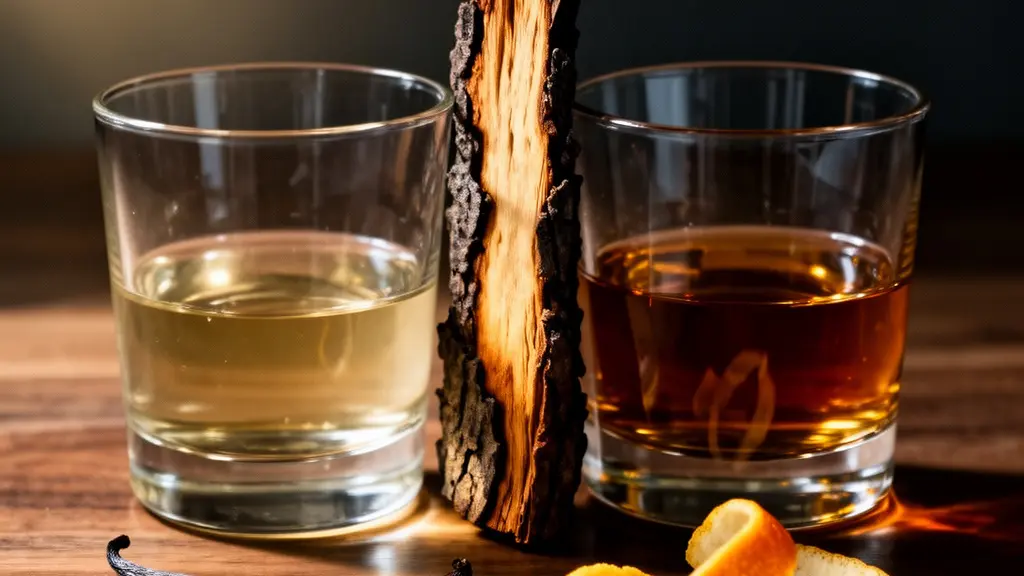
When you reduce a sauce, you apply heat to drive off volatile compounds. Pleasant, light aromatics evaporate first, while these heavier, higher-boiling-point tail compounds concentrate. A whisky that tastes merely rough when sipped neat becomes undrinkably bitter when reduced by half. This explains why bad whisky makes bad sauce: you are not cooking away the impurities; you are distilling them.
Invest in spirits you would willingly drink neat. The vanilla, caramel, and oak notes of quality bourbon or the fruity esters of fine rum survive reduction as pleasant concentrates, while their fusel oils remain minimal and manageable.
When to Add Rum to the Batter: Before or After Creaming the Butter?
The creaming method—beating butter and sugar together to create air pockets—forms the structural foundation of many cakes. Introducing rum into this process requires understanding emulsion chemistry: alcohol can break the butter-sugar emulsion if added carelessly, yet timing the addition determines flavor integration.
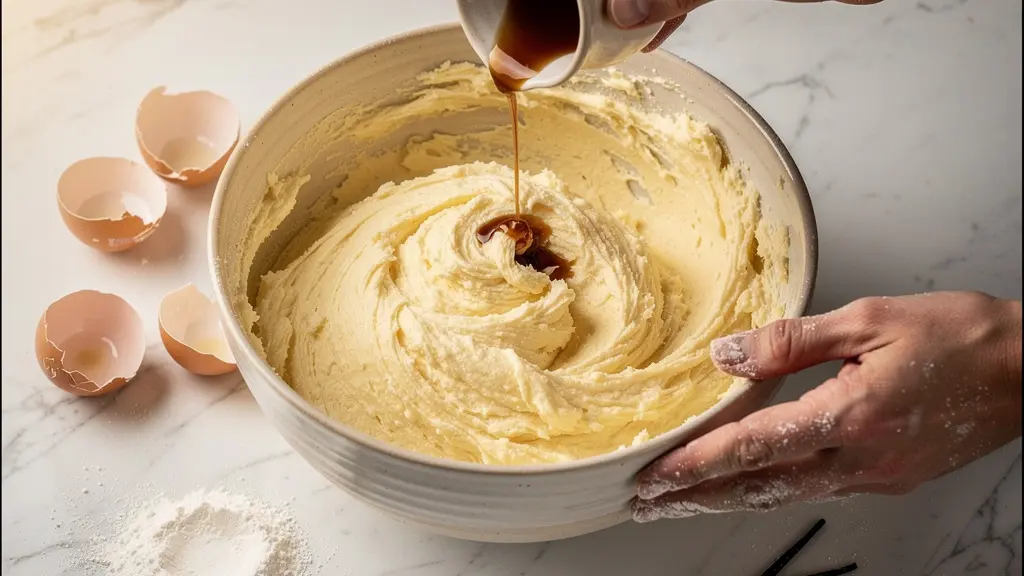
Adding rum during the creaming phase allows the alcohol to extract fat-soluble flavor compounds from the butter itself, creating a deeply integrated taste where the rum’s vanilla and caramel notes bind with the dairy fat. However, the liquid can destabilize the air bubbles you’re creating, leading to a dense crumb if overworked.
Alternatively, adding rum after creaming—alternating with dry ingredients—preserves the emulsion structure but results in less flavor penetration. The alcohol remains more distinct rather than harmonized with the fat phase.
For cakes requiring long baking times, note that baked goods retain approximately 45% of added alcohol after 25 minutes of baking. While most rum flavor remains, a measurable amount of alcohol persists in the finished product.
Volatile aromatic top notes of rum are largely lost during baking. A small addition at the end of mixing—or even brushed onto the finished cake as a soak—preserves these fragrant notes that would otherwise evaporate in the oven’s heat.
How to Melt the Chocolate on Your Tongue Before Sipping the Spirit?
The pairing of chocolate and spirits transcends simple flavor matching; it involves manipulating physical states to alter sensory perception. Cocoa butter melts at approximately 34°C (93°F), just below body temperature, creating a unique opportunity to prepare your palate before introducing high-proof spirits.
When chocolate melts on your tongue, the cocoa butter creates a fat coating across the palate. This lipid layer acts as a physical buffer, taming the alcohol’s heat and allowing subtler flavor notes—vanilla, dried fruit, spice—to emerge clearly without the masking effect of ethanol burn.
The Professional Tasting Sequence
- Select the right chocolate: Choose a quality couverture chocolate (minimum 60% cacao for dark spirits like bourbon or rum, 40-50% milk chocolate for lighter whiskies). The cocoa butter melts just below body temperature (~34°C / 93°F), creating a slow-release flavor base.
- Melt on the palate: Place a small piece of chocolate on the center of your tongue. Press it gently to the roof of your mouth without chewing. Allow 15-20 seconds for the cocoa butter to fully melt and coat your entire palate. This fat layer physically buffers the tongue from the spirit’s initial alcoholic burn.
- Sip the spirit: While the chocolate is still coating your palate, take a small sip of the spirit. Let it rest on your tongue for 5-10 seconds. The fat from the cocoa butter tames the alcohol’s heat, allowing the spirit’s subtler flavor notes to emerge clearly.
- The retro-nasal finish: After swallowing (or spitting), exhale gently and slowly through your nose with your mouth closed. This carries the combined aromatic compounds of both the chocolate and the spirit up into the nasal passage via retro-nasal olfaction, creating a powerful third flavor experience greater than either component alone.
The interaction between chocolate type and spirit profile depends on cacao percentage and the spirit’s congener profile:
| Chocolate Type | Cacao % | Melting Behavior | Best Spirit Pairing | Pairing Logic |
|---|---|---|---|---|
| 70-85% Dark | High | Slow melt, intense bitter-sweet release | Cask-strength bourbon, aged rum, peated Scotch | High cacao intensity matches bold, viscous spirits |
| 55-65% Dark | Medium | Moderate melt, balanced sweetness | Standard bourbon, blended Scotch, cognac | Balanced chocolate complements medium-bodied spirits |
| 35-45% Milk | Low | Quick melt, creamy and sweet | Light Irish whiskey, spiced rum, Japanese whisky | Creamy, quick-melt texture suits delicate, smooth spirits |
| White Chocolate | 0% (cocoa butter only) | Very quick melt, pure fat coating | Vanilla-forward bourbon, coconut rum | Pure fat layer maximizes palate buffering; sweet pairs sweet |
This technique, leveraging congener interactions and palate coating, transforms the tasting experience from harsh to harmonious.
How to Pair High-Rye Whiskey with Charcuterie for Maximum Spice?
High-rye whiskey—defined by a mash bill containing significant proportions of rye grain alongside corn—delivers distinctive spicy characteristics that range from black pepper heat to baking spices like clove and nutmeg. Pairing these spirits with charcuterie requires understanding not just flavor intensity, but the specific type of spice your chosen whiskey emphasizes.
Four Roses bourbon maintains five different proprietary yeast strains that they utilize in creating ten different bourbon recipes, each with a distinct congener and flavor profile. This demonstrates that even within the “high-rye” category, dramatically different spice characters can emerge depending on yeast selection and mash bill ratios. When pairing with charcuterie, understanding which specific spice notes dominate your chosen high-rye whiskey is key to selecting complementary cured meats.
Building the Perfect High-Rye Whiskey and Charcuterie Board
- Deconstruct the spice: Identify whether your high-rye whiskey leans toward baking spices (clove, nutmeg, cinnamon) or sharp pepper spice (black pepper, rye grain heat). This determines your charcuterie direction.
- Match the meat: For baking-spice rye, choose fennel-seed salami or finocchiona. For peppery rye, select soppressata with chili flake or coppa with coarse black pepper. The goal is complementary, not identical, spice notes.
- Use fat as a bridge: Include fatty charcuterie like prosciutto or lardo. The fat coats the palate, taming the whiskey’s proof and allowing the rye grain’s peppery character to emerge cleanly.
- Add a palate ‘reset’: Include cornichons, pickled onions, or grainy mustard. The acidity cleanses the palate between sips and bites, preventing flavor fatigue.
- Echo the grain: Serve slices of dark rye bread or rye crackers. The shared grain foundation ties the entire pairing together, creating a coherent flavor narrative.
The concept of congeners as biomarkers applies here: the same phenolic compounds that create spice in the whiskey find echoes in the spices used to cure the meat. Research by congener analysis specialists confirms that these shared chemical families create perceived harmony on the palate.
Key Takeaways
- Flambé retains 75% of alcohol; only sustained simmering reduces ethanol significantly.
- Quality spirits are essential because reduction concentrates congeners—cheap whisky becomes bitter, quality whisky becomes complex.
- Timing matters: add rum during creaming for flavor integration, after for structural stability.
How to Use “Bridge Ingredients” to Connect Spicy Rums with Savory Dishes?
The challenge of pairing sweet, spicy rum with savory main courses lies in bridging the flavor gap between sugar-forward spirits and salt-forward foods. The solution emerges from molecular gastronomy: introducing “bridge ingredients” that share specific congener families with both the rum and the savory dish, creating chemical harmony that the palate perceives as coherence.
Research by Professor Kilcawley at Teagasc Food Research Centre demonstrates that congeners serve as biomarkers for flavor identity in spirits. In spiced rum, esters (fruity, floral), phenols (spicy, smoky), and aldehydes (nutty, green) are the key congener groups. These same compound families exist naturally in many savory ingredients—esters in tropical fruits, phenols in toasted spices, aldehydes in caramelized alliums. The “bridge ingredient” concept works because it introduces a food element that shares specific congener families with the spirit, creating a molecular overlap.
| Bridge Category | Shared Compounds | Rum Profile | Savory Dish Example | Bridge Ingredient |
|---|---|---|---|---|
| Tropical Fruit | Esters (fruity, floral notes) | Rum with vanilla and orange notes | Grilled pork loin | Mango or pineapple salsa |
| Toasted Spices | Phenols (spicy, warm notes) | Rum spiced with cinnamon and clove | Jerk chicken | Allspice or nutmeg dusting in marinade |
| Caramelized Sugars | Maillard reaction products | Dark aged rum with molasses depth | Slow-roasted pork belly | Brown sugar and soy glaze |
| Negative Space (Contrast) | Textural opposition, cooling fat | High-proof spicy rum | Hot Thai or Caribbean curry | Creamy coconut milk to bridge heat and alcohol |
Applying these bridges requires understanding your rum’s dominant congener profile. A high-ester Jamaican rum pairs naturally with tropical fruit bridges, while a heavily spiced rum demands toasted spice bridges. The technique transforms rum from a dessert ingredient into a sophisticated savory component.
Frequently Asked Questions About Cooking with Spirits
Does alcohol fully bake off in cakes and baked goods?
No. According to USDA data, baked goods retain approximately 45% of added alcohol after 25 minutes of baking. While most rum flavor remains, a measurable amount of alcohol persists in the finished product.
Should I add rum before or after creaming butter and sugar?
It depends on your goal. Adding rum during creaming allows alcohol to extract fat-soluble flavor compounds from the butter, creating deeply integrated flavor. However, adding liquid too fast can break the emulsion. If adding after creaming, do so gradually, alternating with dry ingredients to preserve the emulsion structure.
Can I add a splash of rum at the very end of mixing to preserve aroma?
Yes. Volatile aromatic top notes of rum are largely lost during baking. A small addition at the end of mixing—or even brushed onto the finished cake—preserves these fragrant notes that would otherwise evaporate in the oven.
Having mastered the chemistry of alcohol retention, the techniques of deglazing, and the molecular bridges between sweet and savory, you now possess the theoretical framework to cook with spirits as a saucier would—as an active, controlled ingredient rather than a mere afterthought. The final step lies in applying these principles with intention: taste your reductions constantly, respect the quality of your base spirits, and always consider the thermal journey your alcohol will take. Evaluate your current pantry and cooking habits against these standards, and begin transforming your pan sauces, marinades, and desserts with precision rather than guesswork.