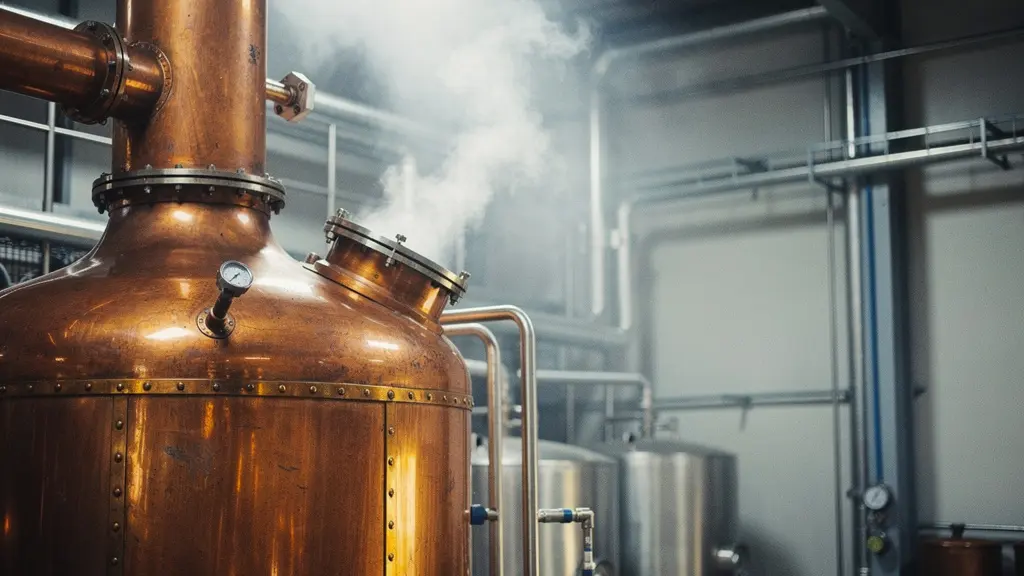
Contrary to common belief, copper in a still is not a passive filter; it’s an active catalytic surface that a distiller must precisely manage to both remove off-flavors and create desirable complexity.
- Copper’s primary role is to catalytically convert volatile sulfur compounds (like those causing rubbery or cabbage-like notes) into non-volatile, odorless copper sulfide.
- The physical state of the copper—its cleanliness, patina, and surface area—directly impacts its effectiveness, making still maintenance a critical part of flavor architecture.
Recommendation: Stop thinking of copper as just a material. Start viewing it as a dynamic control lever for manipulating your spirit’s final flavor profile, from new make to aged product.
For many aspiring distillers, it’s a dreaded rite of passage: a promising batch of spirit comes off the still smelling not of sweet grain or fruity esters, but of burnt rubber or cooked cabbage. The common wisdom is swift to point out the culprit—sulfur compounds—and the hero: copper. The simple explanation is that “copper removes sulfur.” While true, this statement is a profound oversimplification. It’s like saying a chef “uses heat to cook food.” It misses the nuance, the artistry, and the deep chemical understanding required for true mastery.
The reality is that copper is not a simple, passive filter. It is a dynamic catalytic partner in a complex chemical dance. Its interaction with the spirit vapor is a process that the distiller must actively manage to achieve a desired outcome. This management involves not just the presence of copper, but its form, its condition, and its strategic placement within the vapor path. Understanding this relationship moves you from being a mere operator of a still to an architect of flavor, capable of intentionally sculpting the character of your spirit.
This article demystifies that process. We will move beyond the platitudes and dive into the chemical engineering principles that govern copper’s role. We’ll explore how different sulfur compounds are formed, how copper catalytically transforms them, and how you can manipulate variables like still design, cleaning protocols, and reflux rates to control this crucial interaction. By the end, you’ll understand that copper’s job isn’t just to subtract bad flavors, but to actively participate in the creation of great ones.
To fully grasp how you can harness this metallic alchemy, this guide is structured to walk you through the core principles, from the fundamental chemistry to the practical applications in your distillery. The following sections break down each critical aspect of copper’s influence.
Summary: The Distiller’s Guide to Copper Catalysis
- Why Your Spirit Tastes like Rubber: The Critical Role of Copper Catalysis
- How to Clean a Copper Still to Prevent Verdigris Contamination
- Pot Still or Column Still: Which Maximizes Copper Contact for Heavier Spirits?
- The Stainless Steel Mistake That Ruins 30% of Craft Batches
- How to Adjust Reflux Rates to Mimic 20 Years of Traditional Distillation
- How Activated Carbon in Charred Wood Removes Sulfurs from the Spirit
- Light Esters or Heavy Congeners: Which Do You Need for Aging?
- How to Distinguish True Craft Distillation from Industrial Bulk Re-labeling
Why Your Spirit Tastes like Rubber: The Critical Role of Copper Catalysis
That unpleasant “rubbery” note in a spirit is not a sign of a mysterious taint; it’s the direct sensory evidence of a specific chemical compound: Dimethyl Trisulfide (DMTS). This and other volatile sulfur compounds are natural byproducts of fermentation, where yeast breaks down sulfur-containing amino acids found in the grain. While some compounds are scrubbed out during the boil, the most offensive ones are volatile enough to travel with the alcohol vapor into the still. This is where the chemical dance with copper begins.
Copper’s magic lies in its ability to act as a catalyst. When hot, sulfur-rich vapor comes into contact with the copper surface, a chemical reaction occurs. The copper atom donates an electron to the sulfur compound, breaking it down and binding with the sulfur to form copper sulfide. This new compound is a solid, non-volatile salt that remains behind, coating the inside of the still as a blackish layer. It has effectively been removed from the spirit. The impact of DMTS is particularly significant, as research shows humans can detect it at astonishingly low levels. According to a technical analysis, this compound is detectable at concentrations in the parts per trillion, making its removal absolutely critical.
The primary sulfur compounds you must manage are:
- Dimethyl Sulfide (DMS): Imparts aromas of cooked cabbage or canned corn.
- Dimethyl Disulfide (DMDS): Produces onion-like odors, especially during longer distillations.
- Dimethyl Trisulfide (DMTS): The main source of rubber or burnt tire notes.
- Hydrogen Sulfide (H2S): The classic rotten egg or burnt match smell.
Without sufficient copper contact, these compounds pass through the condenser and end up in your final product, masking the delicate esters and other desirable flavors you worked so hard to create. Therefore, understanding copper’s catalytic role isn’t just theory; it’s the fundamental science behind producing a clean, refined spirit.
How to Clean a Copper Still to Prevent Verdigris Contamination
While the black copper sulfide layer is evidence of a job well done, the catalytic surface of your still requires careful management. An uncleaned still presents two opposing problems: a thick sulfide layer can passivate the copper, reducing its effectiveness, while improper cleaning can lead to the formation of verdigris (copper acetate), a toxic green-blue salt that can contaminate your spirit. Therefore, a disciplined cleaning regimen is not just about hygiene; it’s a critical component of flavor architecture and safety.
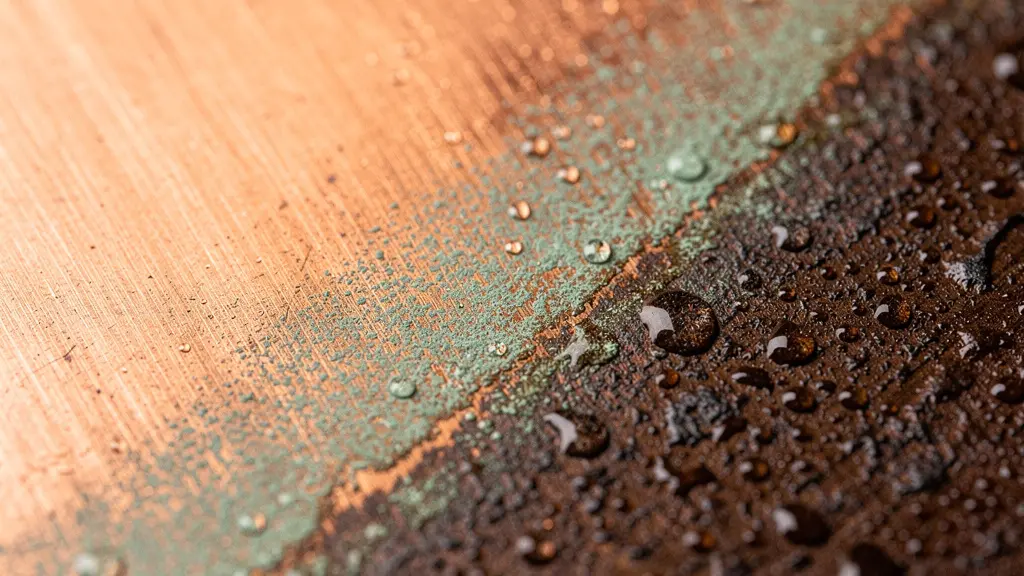
As the image above illustrates, a copper surface is a living environment. After an aggressive cleaning, the raw copper is highly reactive. A desirable, stable patina must be allowed to form, which moderates the catalytic activity. As one study on the topic notes, after a deep clean, “undesirable flavour changes may occur until a patina has built up on the copper surface which changes the properties of the copper as a catalyst.” This is why distillers often run a sacrificial batch after a caustic clean—to rebuild this essential surface layer before a production run. Balancing cleanliness and a functional patina is key.
A professional cleaning schedule prevents both verdigris and excessive sulfide buildup, ensuring the copper surface remains optimally active for sulfur management.
Your Action Plan: Professional Copper Still Cleaning
- After Every Run: Perform a simple water rinse to remove any loose sediment and physical residue from the wash.
- Weekly Maintenance: Conduct a light acid wash (using citric acid or a specialized product) to remove any forming verdigris and light copper oxides, keeping the surface bright and active.
- Quarterly/Annual Deep Clean: Execute a deep caustic clean to strip the heavy, black copper sulfide buildup that accumulates over many runs and can reduce catalytic efficiency.
- Post-Clean Aeration: After rinsing the cleaning agent, allow the still to air dry for 15-20 minutes. This exposure helps any remaining unstable copper salts to flake off before the next run.
- Sacrificial Run: Always run a sacrificial batch of cheap wash or low wines after a deep caustic clean to re-establish a stable patina on the freshly exposed copper surface.
Pot Still or Column Still: Which Maximizes Copper Contact for Heavier Spirits?
The design of the still itself is a primary tool for controlling copper contact and, by extension, the final character of the spirit. The debate between pot stills and column stills often centers on efficiency, but the real difference for a craft distiller lies in their inherent flavor architecture. For heavier, congener-rich spirits like single malt whisky or traditional rum, the pot still is king, largely due to how it manages the chemical dance with copper.
A pot still, by its nature, offers a lower but more impactful surface area of copper—the pot itself, the swan neck, and the lyne arm. The shape and size of these components are not accidental. A taller neck increases passive reflux, cleaning the spirit, while a downward-sloping lyne arm can carry heavier, oilier compounds over. This is exemplified by The Macallan, whose famously small stills are a core part of their identity. According to industry analysis, the small stills at The Macallan produce a heavy, characterful spirit that benefits from the intense, short burst of copper contact and stands up well to long aging. In contrast, a column still contains a series of perforated plates, providing an immense copper surface area. This is ideal for creating very clean, light, high-proof spirits like vodka, as the vapor is repeatedly condensed and re-vaporized on each plate, maximizing sulfur removal.
However, this doesn’t mean a column still can’t make a heavy spirit. By reducing the number of active plates or increasing the run speed, a distiller can limit copper contact time and carry more congeners through. The choice depends entirely on the distiller’s intent.
| Factor | Pot Still | Column Still |
|---|---|---|
| Copper Surface Area | Limited to pot, neck, and condenser | Multiple plates provide extensive surface |
| Contact Time | Depends on vapor speed and reflux | Multiple condensation cycles increase contact |
| Typical Spirit Style | Heavy, congener-rich (rum, single malt) | Lighter, cleaner (vodka, grain whisky) |
| Control Variables | Still height, lyne arm angle, run speed | Number of plates, reflux ratio |
| Best For Heavy Spirits | Large copper helmet and lyne arm design | Reduced plate count with slower run speed |
The Stainless Steel Mistake That Ruins 30% of Craft Batches
In the world of modern distilling, stainless steel offers durability, affordability, and ease of cleaning. It’s an excellent material for fermenters and storage tanks. However, using an all-stainless steel still for the primary distillation run without incorporating copper is one of the most common and costly mistakes a new distiller can make. Because stainless steel is non-reactive, it has zero catalytic effect. The volatile sulfur compounds produced during fermentation simply pass through the still untouched, straight into your final spirit. The result is a harsh, rubbery, and fundamentally flawed product.
This isn’t just a minor quality issue; it’s a significant financial risk. The off-flavors are so potent that they can render an entire batch unsalvageable. While precise figures vary, some industry data suggests this oversight is a major contributor to product loss, indicating that up to 30% of early craft batches can fail due to inadequate sulfur management. This highlights a critical lesson: the cost of incorporating copper into the vapor path is far less than the cost of a ruined batch.
Fortunately, you don’t need a full copper pot still to solve this problem. For distillers with stainless steel columns, there are several effective and scalable modular solutions to ensure adequate copper contact:
- Catalyst Column: Pack a section of the column with copper mesh or structured packing like Raschig rings. This is a highly cost-effective way to create a large catalytic surface area.
- Retrofit a Copper Helmet: Adding a copper helmet or “onion” to the top of a stainless pot still provides significant surface area at a critical point in the vapor path.
- Removable Copper Mesh: Inserting a roll of copper mesh into the column is an easy-to-install and easy-to-clean solution.
- Hybrid Still Design: The most professional solution involves a hybrid still with a stainless steel pot for durability and copper plates or a copper column for catalytic conversion.
The key takeaway is that copper is not optional. It must be present somewhere in the vapor path where hot alcohol vapor can react with it. Ignoring this fundamental principle of distillation chemistry is a recipe for failure.
How to Adjust Reflux Rates to Mimic 20 Years of Traditional Distillation
Beyond still geometry, the single most powerful control a distiller has during a run is the reflux ratio. Reflux is the process where vapor condenses in the still’s neck or column and falls back down to be re-distilled. By controlling the amount of reflux, you control both the purity of the spirit and the amount of time it spends in contact with the catalytic copper surface. A higher reflux ratio means the spirit is essentially distilled multiple times within a single run, creating a lighter, cleaner, higher-proof distillate. A lower ratio allows more of the heavier, flavorful congeners to carry over into the final product.
This is where the distiller’s art truly shines. You are not just making alcohol; you are making decisions that shape flavor. For instance, the famously tall stills at Glenmorangie are designed to maximize passive reflux. This creates their signature light and delicate whisky because the heavier, oilier compounds simply can’t make the long journey to the top of the still and fall back down as reflux. You can mimic this effect in any still by carefully managing temperature and energy input. By lowering the temperature of your condenser (or dephlegmator), more vapor will condense and fall back, increasing the reflux ratio.
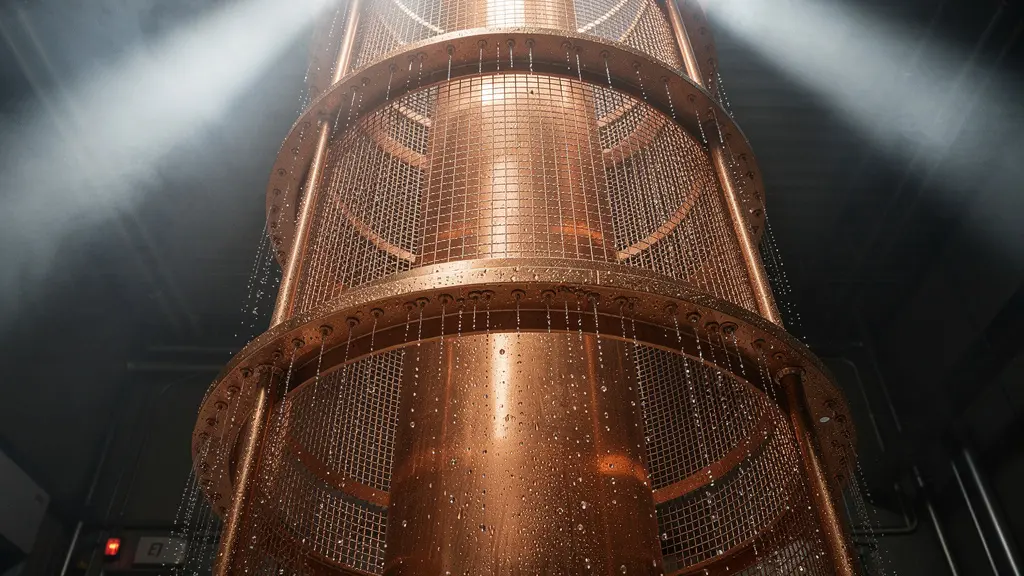
Mastering reflux is like learning to play an instrument. It allows you to dial in the exact spirit profile you want, from a heavy-bodied, oily whisky to a light, fruity Speyside style. A slow run with high reflux can achieve a level of purification and copper contact that, in another era, might have required multiple distillations or years of tradition to perfect.
- Light & Fruity Profile (e.g., Speyside Style): Target a high reflux ratio (e.g., 3:1) to promote ester formation and extensive sulfur removal.
- Heavy & Rich Profile (e.g., Peated Islay): Reduce the reflux ratio (e.g., 1.5:1) to allow more heavy congeners and phenolic compounds to pass over.
- Neutral Spirits (e.g., Vodka): Maximize the reflux ratio (5:1 or higher) for an ultra-clean, neutral profile, ensuring the vapor has the longest possible contact time with copper.
How Activated Carbon in Charred Wood Removes Sulfurs from the Spirit
While copper is the primary tool for sulfur management during distillation, the process doesn’t end there, especially in the world of aged spirits like bourbon and whisky. The inside of a charred oak barrel contains a layer of activated carbon, which provides a secondary, and distinctly different, method of flavor refinement during maturation. It’s crucial to understand that copper catalysis and carbon adsorption are not interchangeable; they are complementary processes that target different compounds at different stages.
Copper catalysis, as we’ve seen, is a chemical process that occurs in the vapor phase. It is highly selective, specifically targeting volatile sulfur compounds. Activated carbon, on the other hand, works via physical adsorption in the liquid phase. The char layer in the barrel acts like a microscopic sponge, trapping larger flavor molecules within its porous structure. This process is far less selective than copper catalysis. While it does a great job of mellowing the spirit by adsorbing certain harsh-tasting compounds, it can also remove desirable flavor congeners if the char is too heavy or the contact time too long.
The bourbon industry provides a perfect example of a dual-method approach. Many bourbon distilleries use column stills that may have fewer copper components. To compensate, they often employ a “doubler” or “thumper,” which is essentially a small, secondary copper pot still that the spirit passes through after the main column. As a detailed overview of the process states, this doubler is where continuous catalytic conversion takes place, ensuring the new make spirit is clean before it even enters the barrel. The subsequent aging in charred oak then further refines the flavor, with the activated carbon handling a different spectrum of compounds than the copper did.
| Mechanism | Copper (During Distillation) | Activated Carbon (During Aging) |
|---|---|---|
| Process Type | Chemical catalysis | Physical adsorption |
| Target Compounds | Small volatile sulfurs (DMTS) | Larger flavor molecules |
| Phase | Vapor phase | Liquid phase |
| Selectivity | Highly selective for sulfur | Less selective, removes various compounds |
| Timing | During distillation run | During barrel aging over years |
Light Esters or Heavy Congeners: Which Do You Need for Aging?
The ultimate goal of a distiller is not simply to remove flaws but to build character. This brings us to the dual nature of copper’s role. While it is essential for removing unwanted sulfurs, it also plays a part in the formation of esters—the compounds responsible for fruity and floral notes in a spirit. This presents a delicate balancing act: you need enough copper contact to clean the spirit, but not so much that you strip it of the very congeners that will develop into complex flavors during aging.
Light esters are formed during fermentation and distillation and provide the immediate fruity character of a new make spirit. Heavy congeners, which include fusel oils and other complex molecules, are less aromatic initially but act as chemical precursors. Over years of maturation in an oak barrel, these heavy congeners will slowly react with oxygen and wood compounds to create a deep, rich tapestry of aged flavors. A spirit destined for long aging needs a healthy supply of these heavy congeners. A spirit intended to be consumed young and fresh, like a gin or a white rum, should be distilled to favor light esters.
This is where your control over the still becomes paramount. Here’s how you can balance copper contact to craft a spirit with optimal aging potential:
- Monitor Copper Exposure: Too little contact leaves masking sulfurs; too much strips the spirit of its body and aging potential.
- Adjust Cut Points: Making an earlier “hearts” cut will preserve more of the light, volatile esters for a fruit-forward profile. Letting the cut run deeper into the tails will capture more heavy congeners needed for long-term maturation.
- Consider Still Design: As discussed, taller stills (like Glenmorangie’s) favor the creation of a light, ester-driven spirit, while shorter, fatter stills (like Macallan’s) produce a heavier, congener-rich spirit.
- Test the New Make: The most important step is to regularly taste your new make spirit. You are looking for a balance between the clean, fruity notes and a pleasant, oily mouthfeel that indicates the presence of heavier congeners.
The art of distillation lies in finding that perfect sweet spot—a new make spirit that is clean and free of sulfur, yet rich with the potential that only time in a barrel can unlock.
Key Takeaways
- Copper is an active catalyst, not a passive filter. Its role is to chemically transform sulfur compounds, a process the distiller must actively manage.
- The physical condition of the copper surface—its patina and cleanliness—is a critical variable in flavor management and requires a disciplined maintenance schedule.
- Still geometry (pot vs. column) and reflux ratio are the primary levers a distiller uses to control copper contact time, thus sculpting the final spirit profile from heavy and rich to light and clean.
How to Distinguish True Craft Distillation from Industrial Bulk Re-labeling
Armed with a deep understanding of copper’s role, you are now equipped not only to be a better distiller but also a more discerning consumer. In a market crowded with brands, the term “craft” is often used loosely. Many so-called “craft” spirits are not distilled by the brand on the label; they are purchased as a bulk neutral spirit from a massive industrial facility and are simply re-labeled, filtered, and bottled. The key difference often lies in the original distillation method.
Industrial ethanol plants are built for maximum efficiency and yield, not flavor. They often use all-stainless steel stills and rely heavily on post-distillation charcoal filtering to clean up the spirit. While this produces a clean, neutral base, it lacks the character and complexity that comes from a carefully managed distillation in a copper still. A true craft distiller, engaging in the chemical dance with copper, is building flavor from the grain up. The sensory markers of this process are often subtle but clear. As one expert notes, the difference is taste: whisky from a copper still simply tastes better because the copper reacts at a molecular level with sulfurs, creating a smoother, non-bitter profile that can’t be replicated by filtration alone.
When you visit a distillery or talk to a brand representative, you can now ask informed questions that cut through the marketing. A true craft distiller will be passionate and knowledgeable about their still’s design, their reflux ratios, their cut points, and their cleaning regimen. Someone who is simply re-labeling bulk spirit will likely be vague on these crucial details. The knowledge of copper catalysis is your key to identifying authentic craftsmanship.
Apply this knowledge on your next distillery tour or tasting. Ask the right questions, taste with a new perspective, and start discerning the subtle but profound impact of the distiller’s chemical dance with copper.
Frequently Asked Questions About Copper’s Role in Distillation
What type of still do you use and where is the copper located?
True craft distillers will provide detailed information about their copper pot stills or copper components in the vapor path. Re-labelers often give vague responses.
How do you manage sulfur removal during distillation?
Legitimate distillers discuss copper contact time, reflux ratios, and specific still design features. Bulk buyers may only mention post-distillation filtration.
What are your typical cut points and why?
Craft distillers can explain their specific heads, hearts, and tails cuts based on their equipment and desired profile. Industrial operations often lack this detail.