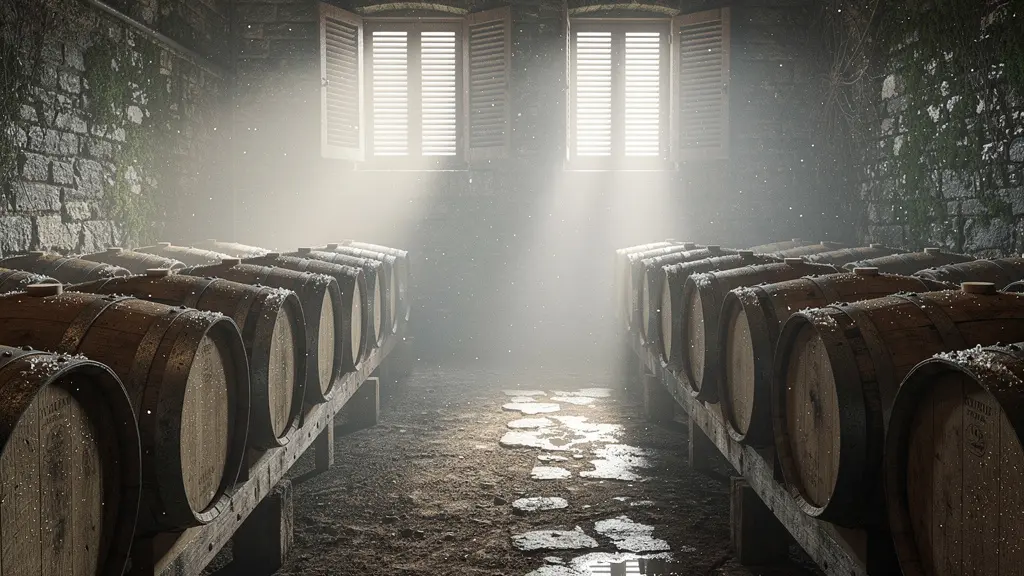
Most people think our whisky gets salty just by breathing in the sea air. The truth is far more complex and violent. It’s a physical battle fought inside every cask against humidity, temperature, and even fungus. That signature brine note in your glass isn’t just absorbed; it’s earned through a constant, punishing process where the warehouse itself is a key ingredient.
You hear it all the time, the romantic notion of a whisky breathing in the salty sea air. Visitors come to Islay, they stand outside the warehouse, feel the sting of the Atlantic spray on their faces, and they think they’ve figured it out. They imagine the salt just drifting through the oak, seasoning the spirit like a chef seasons a steak. It’s a nice story, a simple one. But it’s not the truth. Not the whole truth, anyway.
The reality of coastal maturation is a constant, physical struggle. It’s a drama that plays out in the dark, silent warehouses, day after day, year after year. The sea is an actor, yes, but it’s not the lead. The real story is about pressure, humidity, the very respiration of the wood, and the microscopic life that thrives in this damp, salt-laced environment. The saline character of a true coastal whisky isn’t a gift from the ocean; it’s the hard-won result of a battle waged within the walls of the warehouse itself. It’s about how the building, the location, and the very air conspire to forge a spirit’s soul.
To understand that sharp, briny tang, you have to look past the waves and into the heart of the warehouse. We’ll explore why the casks on the bottom floor carry a different signature, how we fight a constant war against decay, and why the dampness of our air is both a blessing and a curse. This is the real story of the salt in your whisky.
Summary: The Real Story Behind a Whisky’s Saline Soul
- Why Do Casks Stored Closer to the Ocean Floor Have Higher Salinity?
- How to Prevent Hoops from Rusting in Coastal Warehouses?
- Islay Coast or Highland Coast: Which Delivers a Punchier Iodine Note?
- The Humidity Trap: Why Coastal Warehouses Lose More Alcohol Volume?
- When Is a Coastal Whisky “Ready”: 8 Years or 18 Years?
- Why Volcanic Soil Produces Rums with Higher Mineral Content?
- Why A Pinch of Salt Makes Dark Chocolate Pair Better with Smoky Whisky?
- Why Do Saline Notes in Spirits Trigger Hunger and Salivation?
Why Do Casks Stored Closer to the Ocean Floor Have Higher Salinity?
The secret isn’t the floor itself, but what it’s made of. In a proper dunnage warehouse, we don’t use concrete. We have earthen floors, packed down over generations. This isn’t for show; it’s a tool. The earth acts as a giant sponge, maintaining a cool, consistent, and deeply humid environment year-round. While modern racked warehouses can stack casks a dozen high, our traditional dunnage warehouses, like those still maintained at distilleries such as Kilchoman, stack them no more than three high. This method ensures good air circulation and keeps every cask in close contact with that unique, humid microclimate.
That humidity is the key. The air at the bottom of the warehouse, just above the damp earth, is heavy and thick with moisture. This high humidity slows down the evaporation of water from the cask and encourages more of the alcohol to escape—what you call the “Angel’s Share.” But it also means the air that is drawn into the cask during its daily respiration cycle is laden with these maritime compounds. It’s a slow, steady infusion. Casks on the top tier, closer to the roof, experience more temperature fluctuation and slightly drier air, leading to a different maturation profile entirely. The ‘salt’ is strongest where the air is heaviest and most stable. It’s a shame that, for all their quality, traditional dunnage warehouses now store less than 10% of Scotland’s maturing spirit. They are where the real magic happens.
So, the salinity isn’t just about being near the sea; it’s about being held in a specific, earth-bound embrace that forces a deeper interaction with the coastal air.
How to Prevent Hoops from Rusting in Coastal Warehouses?
You can’t. That’s the short, honest answer. The salt in the air is relentless. It’s an agent of accelerated decay that eats away at the metal hoops holding our casks together. You can paint them, galvanise them, but sooner or later, the sea wins. It’s a constant maintenance job, a fight to replace hoops before they fail. But the rust is only the most obvious sign of the war we’re fighting. The same damp, salt-rich air that attacks the metal also feeds something else, a living part of our warehouse terroir.
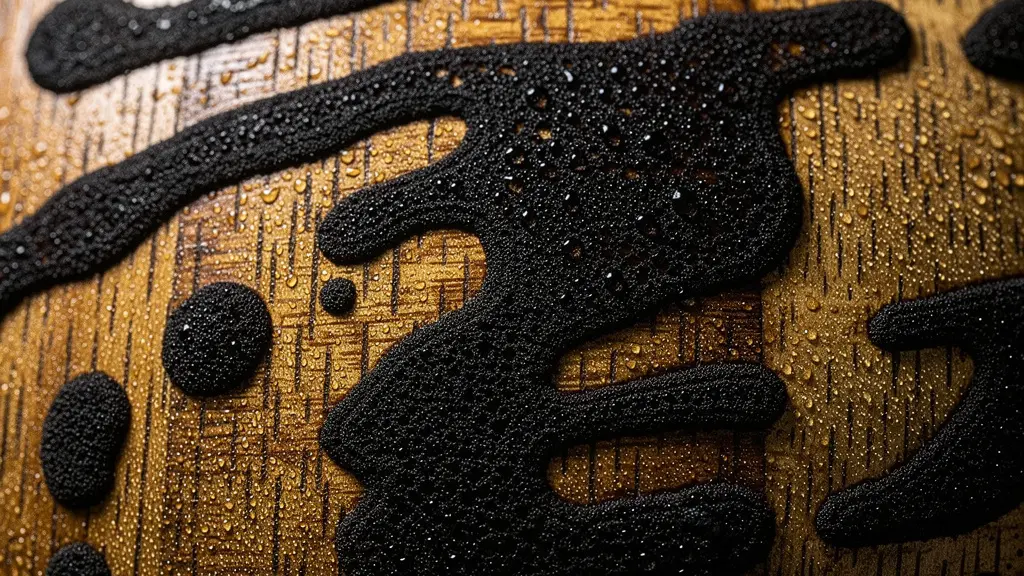
We call it warehouse black, but its scientific name is Baudoinia compniacensis. This is our microbial terroir. It’s a fungus that feeds on the ethanol evaporating from the casks—the Angel’s Share. It covers the walls, the casks, and everything in the vicinity with a black, velvety coat. It’s a sign of a healthy, breathing warehouse. But it’s also a menace. As experts at Wandering Spirits Global note, it’s a stubborn resident to have.
Baudoinia is almost impossible to get rid of as long as there is ethanol present for it to feed off, as it will simply grow back after it is removed.
– Wandering Spirits Global, The Controversial Reason Why Everything Is Black Near Distilleries
This fungus is a signature of distillery country, and some research shows that warehouse fungus can spread in up to a one-mile radius from its source. So, while you worry about rust on the hoops, we see it as part of a larger ecosystem. We don’t prevent it; we manage it. The rust, the black walls—it’s all part of the price we pay for maturing whisky by the sea.
It’s a visual reminder that maturation here isn’t a peaceful sleep; it’s an active, living, and sometimes destructive process.
Islay Coast or Highland Coast: Which Delivers a Punchier Iodine Note?
Not all coasts are created equal. The character of the sea and the land it batters makes all the difference. An Islay warehouse, sitting on the edge of the raw, open Atlantic, is under constant assault from wind and salt spray. It’s a brutal, direct influence. This creates that powerful, phenolic, and distinctly medicinal iodine note that Islay is famous for. It’s not just salt; it’s the whole chaotic soup of the ocean—the seaweed, the peat being washed down to the shore—all aerosolized and thrown against our warehouse walls.
Now, compare that to a coastal distillery in the Highlands, say, along the Moray Firth. The influence is there, but it’s a different beast entirely. It’s more of a gentle sea breeze than an Atlantic gale. The result is a more subtle, delicate brine signature, a hint of salt rather than a punch of iodine. The following analysis, based on work from whisky experts, helps to clarify this distinction.
| Location Type | Example Distilleries | Maritime Influence |
|---|---|---|
| Coastal Speyside | Inchgower, Roseisle, Benromach | Salt air from the Moray Firth as shown by a recent comparative analysis creates brine notes |
| Inland Speyside | Macallan, Tamdhu, Glen Grant | No maritime influence, focus on wood/fruit notes |
So when you ask which is “punchier,” the answer is unequivocally Islay. We’re not just ‘coastal’; we are on the front line. The Highland coast whispers its influence; the Islay coast shouts it through a storm. That intensity is what defines our brine signature and sets it apart from any other coastal whisky in the world. It’s a direct reflection of the violence of our specific geography.
Ultimately, the iodine punch is a fingerprint of place, and no place has a fingerprint quite like Islay.
The Humidity Trap: Why Coastal Warehouses Lose More Alcohol Volume?
This is what we call the osmotic battle. Inside every cask, there’s a constant fight between water and alcohol to escape through the pores of the oak. Who wins this fight is determined almost entirely by the humidity of the air outside the cask. Here in Scotland, especially on the coast, the air is almost always damp. This high humidity means the air is already saturated with water vapor, making it much harder for the water inside the cask to evaporate. Alcohol, however, has no such problem. It escapes, leaving the water behind.
The result? The total volume in the cask decreases, but more importantly, the alcohol by volume (ABV) also drops over time. We lose strength. In Scotland, with its consistently high humidity, studies show that approximately 1-2% of the total inventory is lost to evaporation annually. This might sound small, but it adds up over decades. Now, contrast this with a hot, humid place like Kentucky. As The Glenlivet’s experts point out, their warehouses get incredibly hot, and the humidity means water still leaves the cask first, but the extreme heat accelerates everything, leading to a much stronger spirit in a shorter time. Here, our cool, damp climate means we lose alcohol, not water. It’s a slower, gentler process that allows for decades of maturation without the spirit becoming overpowering.
It’s a trap, yes, but it’s our trap. It’s what allows an 18- or 25-year-old Islay whisky to be complex and elegant, rather than a fiery, high-proof monster. We sacrifice strength for character.
When Is a Coastal Whisky “Ready”: 8 Years or 18 Years?
There’s no single answer to that, and anyone who gives you one is selling something. The idea that a whisky is “ready” is a balance, not a finish line. It’s the point where the character of the original spirit, the influence of the oak cask, and the impact of the maturation environment find their perfect harmony. That balance can be found at 8 years, 18 years, or even 30. The coastal environment adds another layer to this complexity. The maritime influence can be aggressive, imparting that salty, briny character relatively quickly.
An 8-year-old coastal whisky might be vibrant, punchy, and full of that raw, elemental power of the sea. It’s the spirit shouting its youth and its origin. But time in the cask does more than just let in more sea air. Maturation is a deep, transformative process. It’s about oxidation, esterification, and the extraction of complex compounds from the wood itself. It is widely accepted that the oak cask contributes roughly 60-70% to the final flavour of a whisky. That profound wood influence needs time to develop. An 18-year-old might have a more integrated salinity, where the brine has woven itself into a tapestry of oak, spice, and mature fruit notes. The sharp edges have been smoothed, not erased, by two decades of slow warehouse respiration.
So, is it ready at 8 or 18? The question is wrong. The real question is, what kind of conversation do you want to have with the spirit? Do you want the fiery debate of youth or the considered wisdom of age? Both have their place.
Why Volcanic Soil Produces Rums with Higher Mineral Content?
Now, we deal in grain and peat here, but to understand the soul of a spirit, sometimes you have to look at what the earth gives it. Take rums from places like Martinique or the islands around Mount Kanlaon. Their secret starts long before the distillery, in the very soil the sugarcane grows in. Volcanic soil is not like other soils. It’s young, fertile, and incredibly rich in minerals that other agricultural lands have lost over millennia.
These soils are packed with elements like potassium, magnesium, calcium, and phosphorus. When the sugarcane grows, its roots draw these minerals up into the stalk along with the water. The plant doesn’t distinguish; it’s all just nutrients. This mineral-rich cane juice then goes to the distillery. While many compounds are lost or transformed during fermentation and distillation, some of these elemental minerals can carry through into the final spirit. They don’t add “flavour” in the way an ester does, but they contribute to the texture, the mouthfeel, and what many tasters describe as a flinty or saline minerality. It’s a different path to a similar destination: a spirit that tastes of its specific, elemental origin. It’s a powerful reminder that “terroir” isn’t just about the air; it’s about everything the raw ingredient touches, from the ground up.
While our Islay character comes from the sea and the peat, for these rums, it comes directly from the fire and rock of the earth itself.
Why A Pinch of Salt Makes Dark Chocolate Pair Better with Smoky Whisky?
It’s about amplification and balance. Our whiskies, especially the peated ones, are complex beasts. You have the smoky, phenolic notes from the peat, the sweetness from the malted barley, the vanilla and spice from the oak, and that signature coastal brine. Dark chocolate is also complex: it has bitterness from the cocoa, sometimes fruity or earthy notes, and its own sweetness. When you pair them, you’re creating a collision of powerful flavours.
A pinch of salt acts as a bridge. Physiologically, salt is a flavour enhancer. It has the ability to suppress bitterness and amplify other notes, especially sweetness and savoury (umami) characters. When you add a tiny bit of salt to the chocolate, you are taming its inherent bitterness. This allows the sweetness in both the chocolate and the whisky to come forward and find each other. At the same time, that saltiness resonates with the natural brine signature in the whisky, creating a seamless link between the two. It makes the pairing feel intentional, not accidental. But to do this right, you need to understand all the factors at play in the whisky’s flavour. It’s not just about “salt” and “smoke”.
Your Checklist for Deconstructing a Whisky’s Profile
- Points of Contact: List all environmental factors. Is it coastal, inland, near peat bogs? What is the warehouse style?
- Collect Cask Data: What type of oak (American, European)? What was its previous fill (bourbon, sherry)? What is the age?
- Check for Coherence: Do the flavours match the story? Does a “sherry bomb” actually have the expected fruit and spice notes?
- Assess the ‘X-Factor’: Is there a unique note you can’t place? Is it the distillery’s water source, a specific yeast strain, or that unmistakable coastal tang?
- Plan Your Pairing: Based on the dominant flavour pillars (sweet, smoky, fruity, saline), decide whether to complement or contrast with your food choice.
The salt doesn’t add a new flavour; it simply turns up the volume on the conversation that was already happening between the whisky and the chocolate.
Key Takeaways
- The “brine signature” is a result of a complex battle against humidity and temperature, not just passive absorption of sea air.
- Traditional dunnage warehouses with earthen floors are critical for creating the humid microclimate needed for classic coastal maturation.
- The Angel’s Share is different on the coast: high humidity causes more alcohol to evaporate than water, lowering the ABV over time.
- The coastal environment is an active, sometimes destructive force, causing rust and cultivating a unique “microbial terroir” of warehouse fungus.
Why Do Saline Notes in Spirits Trigger Hunger and Salivation?
This is where the romance of the coast becomes pure biology. That feeling of your mouth watering when you nose a glass of our whisky isn’t just in your head. It’s a primal, physiological reaction. Your body is hardwired to respond to the presence of salt. For millennia, salt was a scarce and vital nutrient, essential for bodily function. Our brains evolved to recognise it and to prepare the body for digestion when it is detected.
When the volatile compounds carrying that brine signature hit your olfactory receptors, your brain sends an immediate signal: “Nutrients incoming!” The first step of digestion is salivation. Your salivary glands kick into gear to produce saliva, which contains enzymes that begin breaking down food. This is the very same reason you might feel a pang of hunger. The salivation is your body’s way of getting the digestive system ready for action. It’s a conditioned response. As a study on coastal aging noted, the salty sea air permeates the casks, and that tangible character is what you are reacting to. It’s not an imagined saltiness; it is a real, physical presence in the spirit.
So, the next time you raise a glass of Islay whisky and feel that mouth-watering sensation, know that you are not just tasting a flavour. You are experiencing a direct, physical echo of the Atlantic Ocean, a message passed from the sea, through the oak, and into the spirit, speaking to the most ancient parts of your brain. It’s the final proof that our whisky isn’t just made on Islay—it is Islay.