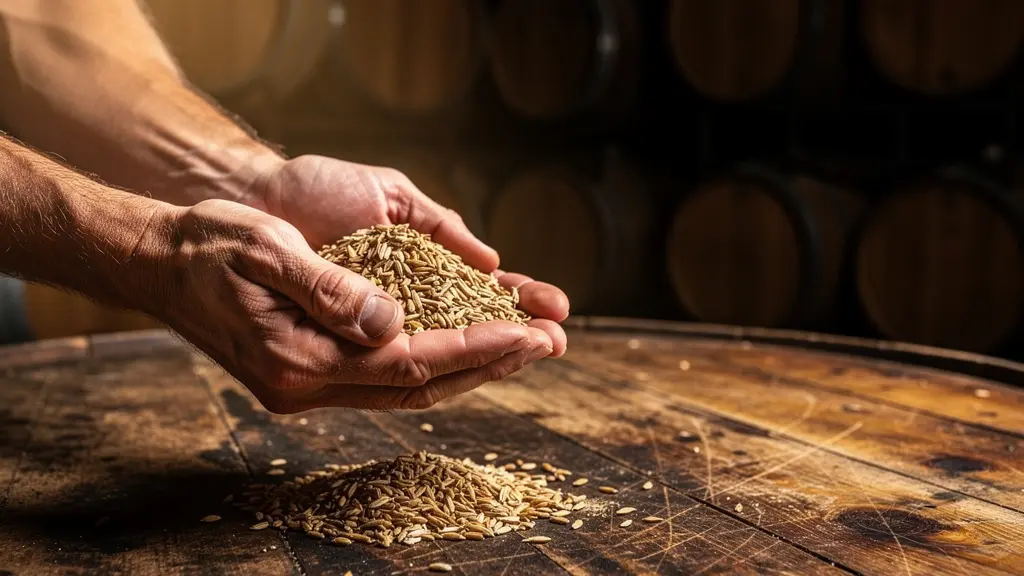
Contrary to popular belief, a high-rye bourbon’s spice isn’t just about the percentage—it’s about the grain’s inherent chemical personality.
- Rye’s signature spice comes from specific phenolic compounds, a chemical fingerprint that corn and wheat lack.
- Corn provides initial sweetness, but its character diminishes with age, allowing rye’s complexity and spice to emerge.
Recommendation: To truly predict a whiskey’s flavor, learn to read its congener profile and mouthfeel architecture, not just the numbers on a label.
As a bourbon enthusiast, you’ve likely stood before a wall of whiskey, trying to decipher the secrets held within each bottle. You see the mash bill percentages—75% corn, 20% rye, 5% malted barley—and you rely on the common wisdom: corn brings sweetness, rye brings spice. While this is a useful starting point, it barely scratches the surface. It’s an oversimplification that ignores the very soul of the spirit, a soul born not in the barrel, but in the field where the grain was grown.
Thinking like a grain merchant or a whiskey historian reveals a deeper truth. The flavor of a whiskey is a direct conversation with the soil and the fundamental chemistry of the grain itself. The “spice” from rye isn’t just a generic flavor; it’s the expression of specific phenolic compounds that are unique to that plant. The creamy texture of a wheated bourbon isn’t an accident; it’s a result of the gluten-forming proteins in the wheat kernel. To truly understand why a high-rye bourbon crackles with pepper and clove, we must move beyond the numbers and explore the agricultural character of the mash bill.
But what if the key wasn’t the percentage, but the nature of the grain? This guide will deconstruct the grain recipe behind American whiskey, exploring why the legal minimums are just a starting point and how distillers use grain to build a foundation for flavor. We will uncover how to estimate a mash bill when it’s kept secret, how different grains influence aging, and how the entire process, from fermentation to distillation, is designed to either highlight or transform the grain’s original voice. It’s time to decode the terroir of the mash bill.
Contents: A Deep Dive into the Grains that Define Whiskey
- Why 51% Corn is the Legal Minimum but Most Bourbons Use 70%?
- How to Estimate a Mash Bill When the Distillery Keep It Secret?
- Wheated or High-Rye: Which Bourbon Style Ages Gracefully into Sweetness?
- The “Single Grain” Myth: Why It Doesn’t Mean Only One Type of Grain?
- How to Pair High-Rye Whiskey with Charcuterie for Maximum Spice?
- Why Volcanic Soil Produces Rums with Higher Mineral Content?
- Light Esters or Heavy Congeners: Which Do You Need for Aging?
- Short vs Long Fermentation: How 48 Extra Hours Change Flavor Forever?
Why 51% corn is the legal minimum but most bourbons use 70%?
The legal definition of bourbon is clear: the mash bill must contain at least 51% corn. This rule anchors the spirit in a distinctly American identity, built on the nation’s most abundant grain. But law is one thing; flavor is another. While a distiller could legally make a 51% corn bourbon, they rarely do. The reason is a simple calculation of character and cost. Corn is efficient. It offers high yields of fermentable sugar, making it an economically sound base. More importantly, it provides the foundational sweetness—notes of caramel, vanilla, and butterscotch—that defines the classic bourbon profile.
By pushing the corn content up to the 70-75% range, distillers create a sweeter, more approachable spirit right off the still. This robust corn base acts as a broad canvas upon which the secondary “flavoring” grains, like rye or wheat, can paint their more assertive strokes. According to the experts at Branch & Barrel Distilling, most bourbons employ between 60 and 75 percent corn, confirming this industry preference for a sweeter foundation. This higher percentage ensures that even a young bourbon has a pleasing roundness and masks some of the harsher notes that can come from a new, charred oak barrel.
Ultimately, the 51% threshold is a legal floor, not a flavor target. Distillers who aim higher are deliberately crafting a spirit where sweetness is the star, creating a profile that is both iconic and broadly appealing. The remaining 25-30% of the mash bill becomes the critical space where a distillery defines its unique identity, choosing between the spicy kick of rye or the soft embrace of wheat to complete the recipe.
How to estimate a mash bill when the distillery keep it secret?
While some distilleries proudly display their mash bills, many others guard them as trade secrets. For the curious enthusiast, this presents a fascinating challenge: reverse-engineering the recipe through sensory analysis. This isn’t guesswork; it’s a trained skill that involves deconstructing a whiskey’s flavor, aroma, and mouthfeel to find the fingerprints left by each grain. It requires a palate calibrated to recognize the distinct signatures of corn, rye, and wheat.
Corn typically presents as sweetness—caramel, vanilla, and sweet corn. Rye, the star of our spicy discussion, announces itself with notes of black pepper, dill, mint, and sometimes a hint of baking spice. Wheat, by contrast, offers a softer, gentler profile with notes of honey, bread dough, and a distinctly creamy or smooth mouthfeel architecture. By tasting a mystery bourbon alongside benchmark whiskies with known mash bills (e.g., Maker’s Mark for wheat, Bulleit for high-rye), you can start to triangulate its composition. A sharp, oily sensation on the palate points toward a significant rye component, while a soft, almost velvety texture suggests wheat is the secondary grain.
Case Study: Four Roses’ Transparent 10-Recipe System
In a world of secrecy, Four Roses stands as a beacon of transparency. The distillery famously uses two distinct mash bills and five proprietary yeast strains to create ten unique bourbon recipes. Their coding system is public knowledge: “B” recipes like OBSK contain a high-rye mash bill (60% corn, 35% rye), while “E” recipes like OESK use a lower-rye mash bill (75% corn, 20% rye). This system not only empowers consumers but also serves as an invaluable educational tool, demonstrating how varying grain percentages, even by just 15%, can dramatically alter a bourbon’s final profile before it even touches a barrel.
Action Plan: Decoding Secret Mash Bills Through Sensory Analysis
- Comparative Lineup: Set up a tasting flight with whiskies of known mash bills (e.g., a wheated, a low-rye, and a high-rye bourbon) to use as reference points.
- Identify Spice Markers: Search for distinct notes of black pepper, clove, and dill. Their strong presence often indicates a rye content above 15-20%.
- Detect Sweetness Levels: Isolate flavors of caramel, vanilla, and butterscotch. A dominant sweetness suggests a corn content likely at or above 70%.
- Note Mouthfeel: Pay close attention to the texture. A creamy, soft sensation points to wheat, while a sharper, more oily feeling is a hallmark of rye.
- Research the Source: Investigate the distillery. Many smaller brands source their whiskey from large producers like MGP, which is famous for its standard 95% rye recipe used in many sourced rye whiskeys.
Wheated or high-rye: which bourbon style ages gracefully into sweetness?
The choice between wheat and rye as the secondary grain is one of the most significant decisions a distiller makes, fundamentally shaping a bourbon’s personality and its journey through time in the barrel. A “high-rye” bourbon, often defined by an industry standard of having around 30-35% or more rye content, starts its life with a bold, spicy, and assertive character. A “wheated” bourbon, which substitutes wheat for rye, is born with a softer, sweeter, and gentler disposition.
The question of which ages more “gracefully” is a matter of taste, but the transformation process is different for each. High-rye bourbons enter the barrel with a powerful spice that can feel aggressive in a young whiskey. Over years of aging, these sharp edges mellow. The intense interaction with the charred oak helps to tame the rye, integrating its peppery notes with the wood’s vanilla, caramel, and toffee flavors. The spice never disappears, but it evolves into a complex, layered spiciness that adds depth and structure to the final product.
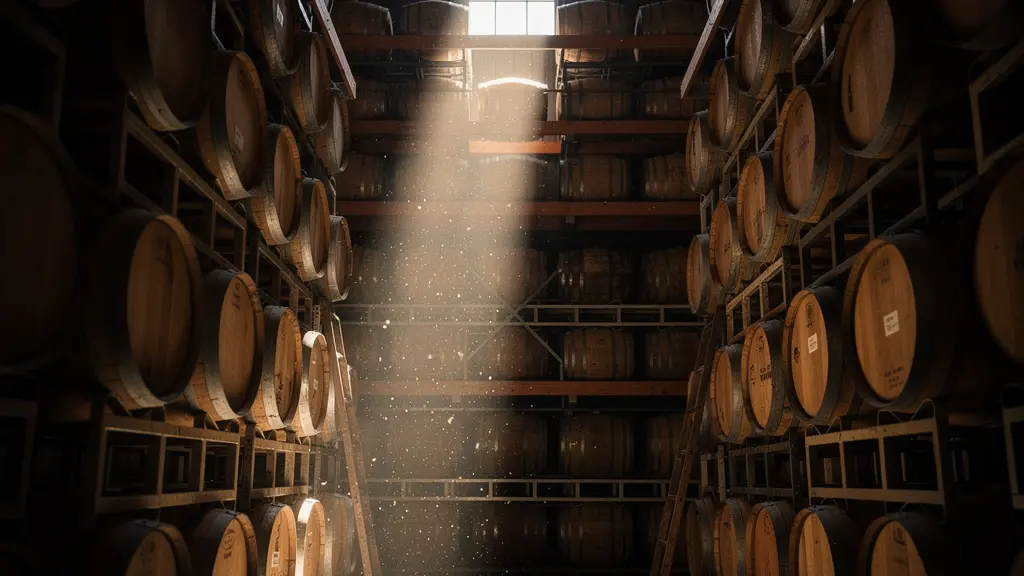
Wheated bourbons, on the other hand, start with a profile that is already soft and sweet. The aging process for them is less about taming and more about layering. The barrel aging adds complexity to their inherent sweetness, building notes of baked bread, honey, and dried fruit. Because they lack rye’s spicy backbone, older wheated bourbons can become exceptionally smooth and sweet, sometimes to the point of being described as “dessert-like.” As one expert notes, the aging process itself changes the perception of the mash bill’s influence.
The longer the whiskey is aged in oak casks, the more the other grains and the characteristics of the oak wood show through, and the corn taste diminishes.
– Branch & Barrel Distilling, Grain Impact on Aging
So, which ages more gracefully? If grace means evolving into complex, integrated spice, then high-rye is the answer. If grace means deepening into a rich, velvety sweetness, then wheated bourbon takes the crown.
The ‘single grain’ myth: why it doesn’t mean only one type of grain?
The term “Single Grain” whiskey is one of the most misunderstood categories in the spirits world. The name logically implies a whiskey made from just one type of grain, but the reality is quite different. In Scotland and many other parts of the world, “Single Grain” simply means a grain whiskey that is produced at a single distillery. It can—and almost always does—contain a mixture of grains, typically corn or wheat, with a small but crucial amount of malted barley.
Why the barley? The answer lies in chemistry. Raw grains like corn and wheat contain plenty of starches, but these starches are not directly fermentable by yeast. They must first be converted into simple sugars. Malted barley is the key that unlocks this potential. The malting process (soaking barley in water to trigger germination, then drying it with heat) creates natural enzymes, primarily amylase. These enzymes are incredibly effective at breaking down the complex starches from all the grains in the mash into the fermentable sugars that yeast needs to produce alcohol. Without malted barley, a distiller would be left with a starchy soup and no whiskey.
Case Study: MGP’s Dominant 95% Rye Recipe
A perfect illustration of this principle is the famous 95% rye, 5% malted barley mash bill from MGP in Indiana. This recipe has been sourced by dozens of popular brands like Bulleit Rye and Templeton Rye. While it is overwhelmingly rye-focused, that 5% malted barley is non-negotiable. It’s the essential enzymatic engine that converts the starches from the massive amount of rye into sugar, making fermentation possible. This demonstrates that even spirits marketed with a heavy focus on one grain still rely on the power of malted barley.
The only major category that truly approaches a single-ingredient profile is “Single Malt” whiskey. In Scotland, this must be 100% malted barley. A similar standard has been proposed in the United States by the American Single Malt Whiskey Commission, which argues for a definition that requires 100% malted barley to be used for the category. This highlights the core distinction: “Single Grain” refers to the distillery, while “Single Malt” refers to the grain itself.
How to pair high-rye whiskey with charcuterie for maximum spice?
Pairing a high-rye whiskey with food is a delightful exercise in flavor dynamics. The goal is not to tame the whiskey’s spice but to amplify it, complement it, and create a conversation between the glass and the plate. Charcuterie, with its rich tapestry of fats, salts, and spices, offers the perfect medium for this exploration. The key is to think in terms of bridges and contrasts.
A “flavor bridge” is created by matching a note in the whiskey with a similar note in the food. High-rye whiskies are packed with phenolic compounds that express themselves as black pepper, clove, and baking spices. Therefore, selecting a cured meat that is also spiced, like a peppery sopressata or a finocchiona salami with its aromatic fennel seeds, creates an echo that heightens the perception of spice in both. The pumpernickel bread, itself made from rye grain, serves as another powerful bridge, connecting the core ingredient of the spirit and the food.
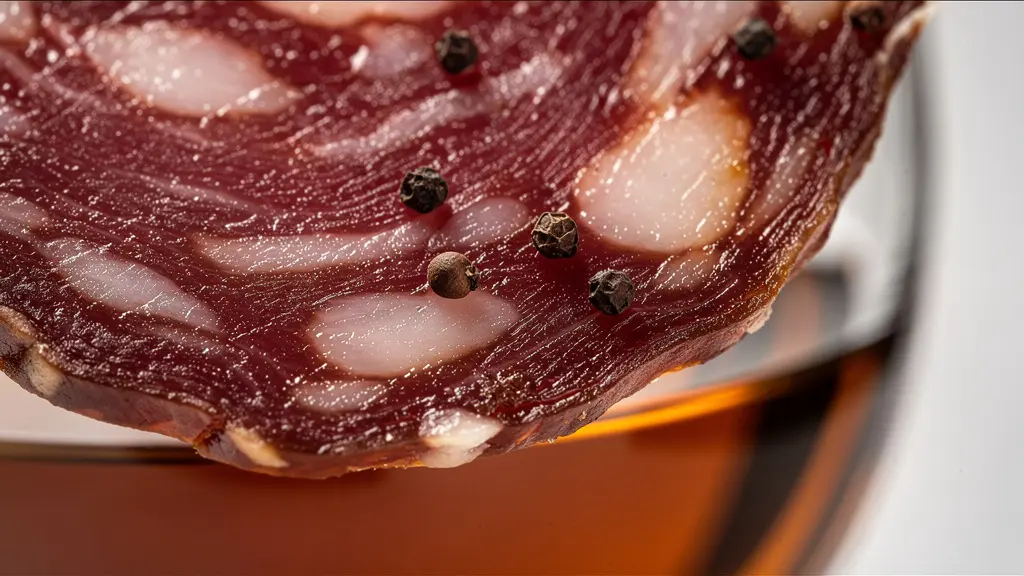
Contrast is equally important. The fat in charcuterie coats the palate, softening the alcohol’s heat and allowing the whiskey’s more subtle flavors to shine through. A sweet element, like a dollop of fig jam or a slice of apple, provides a counterpoint to the rye’s dry spice, making the spicy notes pop in comparison. Finally, an acidic component, such as a sharp cornichon or a pickled onion, acts as a palate cleanser, cutting through the fat and resetting your taste buds for the next sip and bite. A well-chosen aged Gouda can also play this role, with its salty, crystallized protein deposits providing both a textural and flavor contrast that makes the rye’s spice sing.
Why volcanic soil produces rums with higher mineral content?
To fully appreciate the profound impact of a base ingredient on a spirit, it’s sometimes useful to look outside the world of whiskey. Consider rum, a spirit distilled from sugarcane or molasses. Rums from islands with volcanic origins, like Martinique or Guadeloupe, are often prized for a distinct “funk” or savory character that connoisseurs describe as having high minerality. This isn’t marketing jargon; it’s a direct reflection of the spirit’s terroir.
Volcanic soil is incredibly rich in minerals like potassium, magnesium, and calcium. As the sugarcane grows in this soil, it absorbs these minerals through its root system. These compounds become part of the plant’s cellular structure. When the cane is harvested and pressed, those same minerals are transferred into the sugarcane juice. During fermentation and distillation, these non-volatile minerals don’t evaporate with the alcohol but can influence the chemical reactions taking place, contributing to the formation of unique esters and other congeners that create the final flavor profile.
This concept of terroir isn’t limited to sugarcane. It provides a perfect analogy for understanding our grains. The rye, corn, or wheat grown in different climates and soil types carries its own unique mineral and chemical signature into the mash tun. A rye grown in the sandy soils of Poland (as is common for Polish vodka) will have a different character from a rye grown in the clay-heavy soils of Kentucky. While whiskey is not typically marketed by its soil type, the underlying principle is the same: the spirit begins in the earth. The soil’s composition provides the foundational building blocks of flavor long before a barrel is ever filled.
Light esters or heavy congeners: which do you need for aging?
When we talk about flavor in whiskey, we are really talking about congeners. Congeners are the hundreds of chemical compounds produced during fermentation and distillation that are not ethanol or water. They include esters, which are typically fruity and floral; phenols, which can be smoky or spicy; and aldehydes, which can be nutty or grassy. The specific mix of these compounds—the congener profile—is a whiskey’s unique flavor fingerprint. A distiller can aim for a “light” profile, rich in delicate esters, or a “heavy” profile, packed with robust congeners.
The choice depends entirely on the desired aging trajectory. A light spirit, like many Irish whiskeys or wheated bourbons, is often built for shorter aging or immediate drinkability. Its profile is dominated by light, fruity esters that are pleasant and approachable from a young age. Extended aging can sometimes overwhelm these delicate notes. In contrast, a heavy spirit, rich in complex congeners, is built for the long haul. These heavier molecules are the raw material for the magic of maturation. Over many years in a barrel, these compounds interact with each other, with the oxygen seeping through the wood, and with the oak itself, transforming into new, more complex flavors of leather, tobacco, dark fruit, and rich spice.
Case Study: Wild Turkey’s High-Rye Philosophy
Wild Turkey is a prime example of a distillery that deliberately crafts a heavy congener profile for long-term aging. They use a relatively high percentage of rye in their bourbon mash bill specifically to generate these robust congeners. As they state, rye is “spicy, earthy and intense,” providing flavors of black pepper and clove. This assertive character is not meant to be subtle; it’s designed to stand up to many years in a heavily charred barrel, developing deep complexity over time rather than being smoothed into neutrality.
High-rye mash bills are a direct route to a heavy congener profile. The phenolic compounds in rye are robust molecules that provide the spicy backbone needed for a spirit to evolve, rather than fade, during a decade or more in oak. The following table illustrates how different mash bills result in varying congener profiles and aging characteristics.
| Bourbon Brand | Rye % | Congener Profile | Aging Character |
|---|---|---|---|
| Maker’s Mark | 0% (wheated) | Light, sweet esters | Soft, caramel-forward |
| Buffalo Trace | <10% (low-rye) | Moderate congeners | Balanced complexity |
| Bulleit | 28% (high-rye) | Heavy phenolics | Spicy, leather notes |
| Four Roses B | 35% (high-rye) | Very heavy congeners | Bold, tobacco finish |
As this comparative analysis of mash bills shows, a higher rye percentage directly correlates with a heavier congener load, which is the ideal blueprint for a bourbon destined for long and complex aging.
Key Takeaways
- Rye’s spice is not just a flavor, but a chemical signature derived from phenolic compounds inherent to the grain.
- Fermentation and aging are as crucial as the mash bill; they first create and then selectively reveal different flavor compounds over time.
- The concept of “terroir” applies to whiskey; the soil and climate where grain grows provide the foundational building blocks of a spirit’s character.
Short vs long fermentation: how 48 extra hours change flavor forever?
If the mash bill is the blueprint for a whiskey’s flavor, then fermentation is the construction site where the foundational flavors are built. This biological process, where yeast consumes sugar to create alcohol, is also a factory for congeners. The length of fermentation has a monumental impact on which congeners are produced. A short fermentation, typically around 2-3 days, is efficient. The yeast works quickly to convert sugars, producing a clean spirit with a lighter congener profile, often emphasizing the base grain’s character.
Extending fermentation by just 48 hours, however, opens the door to a whole new world of flavor. After the primary fermentation (the rapid conversion of sugar to alcohol) is complete, a secondary, slower phase begins. This is where different yeast strains and even wild bacteria can start to produce a wider array of heavier, more complex congeners. This extended period allows for the creation of more esters, fatty acids, and phenols—the very compounds that add layers of fruit, spice, and texture. A long fermentation, lasting 5 days or more, is a deliberate choice to build a richer, more robust spirit destined for complex aging.
Case Study: Four Roses’ Complex Fermentation Matrix
No distillery showcases the power of fermentation better than Four Roses. By using five proprietary yeast strains across their two mash bills, they create ten unique flavor profiles before the spirit even sees a barrel. Some of their yeast strains, like the “V” strain, are known for producing delicate fruit notes, while the “K” strain is famous for generating robust spice. By combining these different yeasts with extended fermentation times, Four Roses demonstrates that the choice of yeast and the time it’s given to work are as critical as the grain itself in crafting a whiskey’s final identity.
This commitment to complexity takes time. For example, it’s confirmed that the popular Four Roses Small Batch expressions undergo a minimum aging of 6-7 years, allowing the complex congener profile developed during their meticulous fermentation to fully mature and integrate with the oak. This proves that a long fermentation isn’t just a process step; it’s the first investment in a long-term aging strategy, creating the rich tapestry of flavors that only time can unravel.
Now that you can read the story told by the grains, yeast, and fermentation time, you can approach any whiskey not just as a consumer, but as an interpreter. Apply this knowledge on your next tasting journey by analyzing not just the mash bill, but the entire story of the spirit’s creation, from the field to the glass.