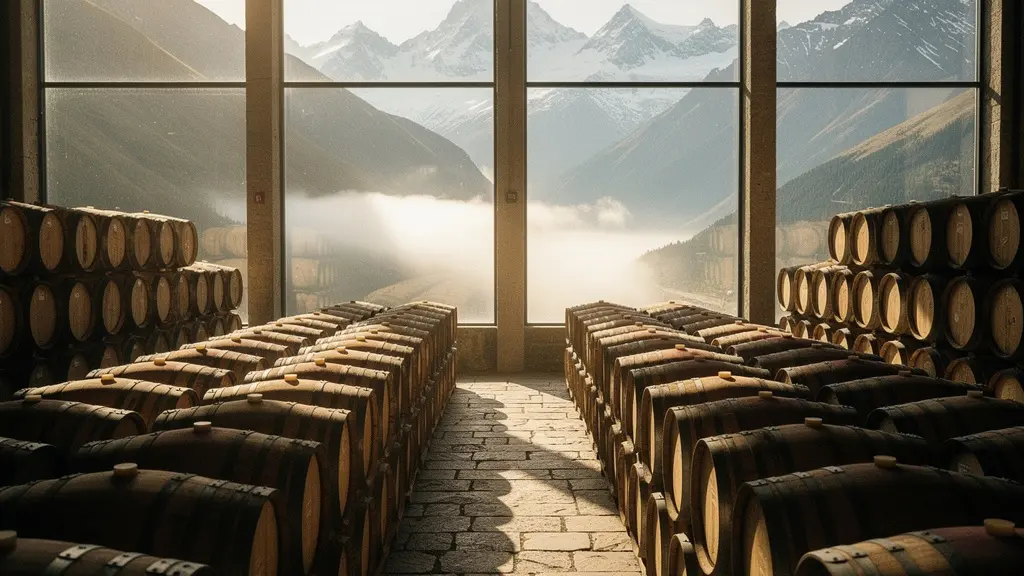
Contrary to the simple idea that cold climates just slow down aging, high-altitude maturation is a dynamic process. It’s not about time, but about the unique, rhythmic ‘breathing’ of the cask, driven by drastic temperature and pressure shifts. This dialogue between wood and spirit doesn’t just add oak flavour; it preserves the delicate soul of the distillate, creating a profound complexity that patient collectors seek.
There’s a common notion in the world of spirits, a kind of simple maths: hot climates mean fast maturation, and cold climates mean slow. We think of tropical rums bursting with oak character in a few short years, and then we picture a Highland whisky, slumbering peacefully for decades in a cool, damp dunnage warehouse. While there’s a grain of truth in this, it misses the beautiful, complex story that unfolds when a spirit is aged not just in the cold, but at altitude. The mountain doesn’t just put the brakes on time; it introduces a different rhythm entirely.
Many will tell you it’s all about the temperature swings, and they’re not wrong. But they often stop there. The real magic lies in understanding what those swings, combined with lower atmospheric pressure, do to the cask itself. It’s less a storage container and more a lung, breathing the spirit in and out, day after day. This process, this dialogue between wood and liquid, is what sets high-altitude aging apart. It’s a method that values patience over pace and complexity over simple extraction.
But if the goal isn’t just to slow things down, what is it? It’s about guiding the spirit’s journey. It’s about protecting the delicate, fruity esters from the initial distillation, allowing them to evolve rather than be overpowered by aggressive wood tannins. This guide isn’t about finding shortcuts. It’s for the patient collector, the enthusiast who understands that the greatest depths of character are found not in speed, but in a slow, deliberate conversation with the elements.
In this exploration, we will walk through the warehouse and the stillhouse to understand the forces at play. We will examine how the mountain air influences everything from the wood’s behaviour to the very act of distillation, revealing why altitude offers a unique path to a spirit’s ultimate expression.
Contents: The Distiller’s Guide to Mountain Maturation
- Why Large Diurnal Temperature Shifts Force Whisky In and Out of the Wood?
- How to Plan a 20-Year Maturation Cycle in a Cold Climate?
- Dunnage Earth Floor or Racked Concrete: Which Maintains Better Humidity?
- The Dormant Cask Risk: Why Some Highland Whiskies Don’t Change for Years
- How to Distill in Winter to maximize Condensation for Highland Styles?
- Continental vs Tropical Aging: Which Method Preserves the Spirit’s Fruitiness?
- First-Fill vs Refill Cask: Which is Better for Long-Term Maturation?
- American Oak or European Oak: Which Wood Profile Suits Your Palate?
Why Large Diurnal Temperature Shifts Force Whisky In and Out of the Wood?
In the Highlands, the weather is a living thing. The difference between the midday sun and the biting cold of night is not just something you feel on your skin; it’s a force that works on the casks day in and day out. In some high-altitude locations, it’s not uncommon to see a daily temperature swing of over 40 degrees Fahrenheit. This is the engine of what I call ‘cask respiration’. It’s a far more active process than the gentle slumber many imagine.
During the day, as the warehouse warms, the spirit inside the cask expands. The rising pressure forces the liquid deep into the pores and capillaries of the oak staves. This is the inhale. The spirit explores the wood, dissolving sugars, tannins, and vanillins. Then, as night falls and a profound chill sets in, the process reverses. The spirit contracts, pulling back out of the wood and bringing those captured flavours with it. This is the exhale. It’s a constant, powerful cycle of extraction and integration.
As Brand Ambassador Rory Glasgow explains, this rhythmic exchange is a key accelerator of interaction. In an interview on the geography of whisky production, he notes, “As the temperature cools in the evening, the wood will contract and push the spirit back into the cask. This rapid flux of expansion and contraction speeds up how the oak influences a whisky over the years.” This isn’t about making a young whisky taste old; it’s about creating a rich, active dialogue between spirit and wood, even in a cold climate.
This daily ‘breathing’ ensures that the maturation is active, not static. It prevents the spirit from becoming listless and allows for a steady, deep integration of character over many years. It is the mountain’s own way of gently stirring the cask.
How to Plan a 20-Year Maturation Cycle in a Cold Climate?
Planning for a spirit to rest for two decades or more is an act of faith. It requires a deep understanding of the slow, quiet work happening inside the barrel. In a place like Scotland, the greatest ally is the cool, damp climate. It allows for a remarkably low rate of evaporation, known as the ‘Angel’s Share’. While a hot climate can lose up to 12% of a cask’s volume per year, industry data reveals an annual evaporation rate of just 1-2% in Scotland. This is the secret to great age.
A lower Angel’s Share doesn’t just mean more whisky in the cask at the end; it means the maturation process itself is fundamentally different. It’s a slow, oxidative process where the spirit’s own character—the delicate esters and aldehydes from distillation—has time to evolve and integrate with the wood, rather than being driven off by heat or masked by aggressive oak extraction. For a long-term maturation, this patience is everything.
This is why the choice of cask is so critical. A fresh, first-fill barrel that might be perfect for a four-year-old bourbon in Kentucky would overwhelm a spirit destined for 20 years in the Highlands. The strategy here leans towards second or third-fill casks, where the wood’s influence is more of a gentle whisper than a loud shout.
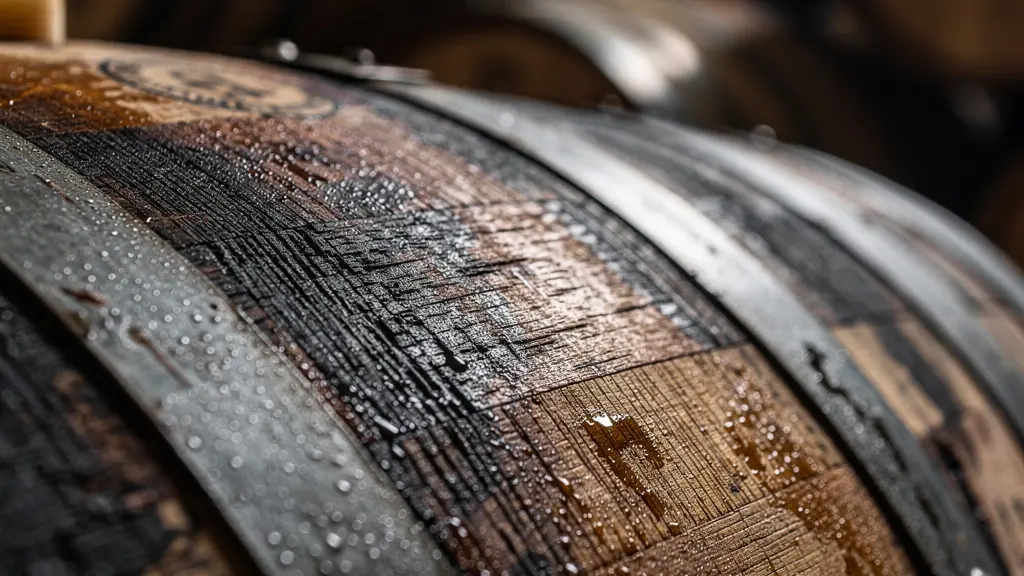
As you can see, these seasoned casks have a story to tell. Their staves have been mellowed by previous fillings, ensuring they will impart flavour with subtlety and grace over the long years. This approach preserves the integrity of the original spirit, allowing its fruitiness and complexity to shine through, framed by the oak rather than buried beneath it. This is the art of planning for time.
Dunnage Earth Floor or Racked Concrete: Which Maintains Better Humidity?
Walk into a traditional dunnage warehouse, and you feel it instantly. The cool, damp air, thick with the scent of aging spirit and earth. This is no accident. The combination of stone walls and a natural earth floor creates an environment of high, stable humidity. For long-term aging at altitude, this is the gold standard. The goal is to manage not just the temperature, but the very nature of the Angel’s Share.
In a low-humidity environment, water evaporates from the cask more readily than alcohol, causing the proof of the spirit to rise over time. This can lead to a spirit that feels harsh or ‘hot’. Conversely, in a high-humidity dunnage warehouse, the air is already saturated with moisture. This slows the evaporation of water from the cask, meaning alcohol and water escape at a more balanced rate. Sometimes, the alcohol evaporates slightly faster, leading to a gentle reduction in proof over decades, resulting in a remarkably smooth and integrated spirit.
Modern racked warehouses with concrete floors offer efficiency, allowing for stacking casks high to the ceiling. However, they struggle to maintain the natural humidity of a dunnage house. They are more susceptible to fluctuations, creating a drier environment that can alter the maturation path. As this comparative analysis of warehouse types shows, the choice of floor is fundamental to humidity control.
| Warehouse Type | Humidity Control | Temperature Stability | Angel’s Share Impact | Best for Altitude |
|---|---|---|---|---|
| Dunnage (Earth Floor) | Natural 70-85% | Very Stable | Lower water loss | Excellent |
| Racked Concrete | Variable 40-60% | More fluctuation | Higher water loss | Challenging |
| Climate Controlled | Precise 60-70% | Fully regulated | Optimized | Good but costly |
For a patient collector seeking the nuanced character of an old spirit, the dunnage warehouse is not just a romantic ideal; it is a functional tool. It creates the perfect conditions for a slow, elegant maturation, where the proof mellows and the flavours deepen in harmony. It is the ideal cradle for a spirit destined for greatness.
The Dormant Cask Risk: Why Some Highland Whiskies Don’t Change for Years
There is a flip side to the coin of slow maturation. In the deep, unwavering cold of a Highland winter, a cask can fall into a state of what we call ‘dormant grace’. The ‘cask respiration’ we spoke of can slow to a near standstill. When the temperature remains consistently low, the spirit and wood cease their daily dialogue. The liquid inside stops expanding and contracting, and the maturation process effectively pauses. For a distiller, this is both a risk and an opportunity.
The risk is obvious: a cask that isn’t changing is a cask that isn’t developing. Some distilleries go to great lengths to prevent this. For example, warehouse management studies show that producers like Macallan and Nikka invest in maintaining consistent year-round temperatures, ensuring the interaction never fully stops. This guarantees a predictable maturation curve. However, embracing the dormancy can lead to extraordinary results. It allows a spirit to age for an incredible length of time without becoming over-oaked.
This period of rest is when the spirit truly comes into its own, with subtle oxidative changes and esterification occurring quietly in the background, independent of wood extraction. Glendronach’s National Brand Ambassador, Rory Glasgow, sees this as a distinct advantage, stating it “allows us to release such exceptionally aged expressions such as our 50-year-old that would have enjoyed the slower pace of maturation in the cooler valley where our dunnage warehouses sit.”
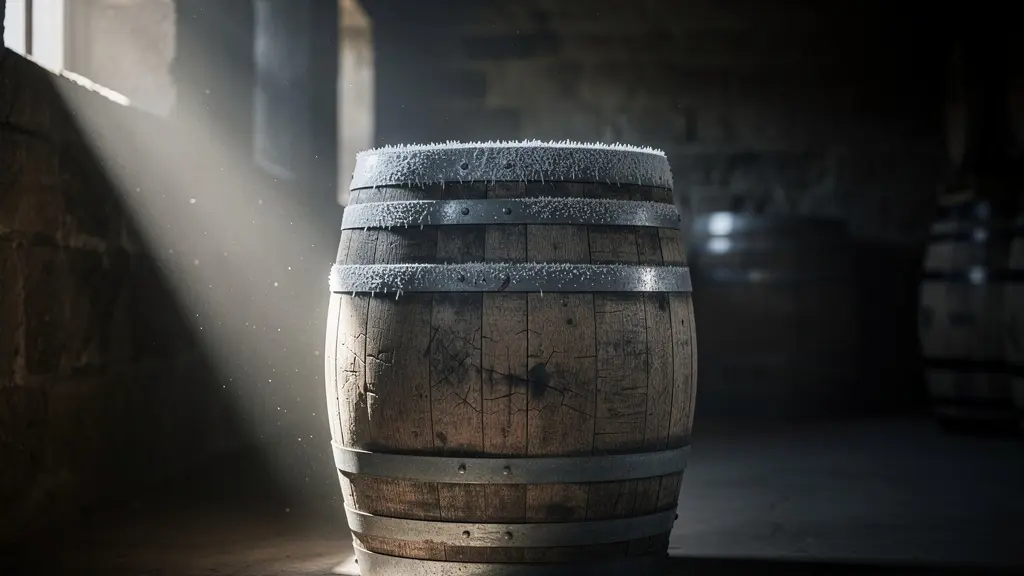
This image captures the essence of a dormant cask. It is not dead, but resting. It is a state of suspended animation that makes it possible to achieve profound age. It demands a distiller who is not watching the clock, but who understands the seasons of the cask and has the patience to wait for it to reawaken.
How to Distill in Winter to maximize Condensation for Highland Styles?
The influence of altitude begins long before the spirit ever touches wood. It starts in the stillhouse, with the fundamental physics of boiling points. As you climb higher, atmospheric pressure drops, and with it, the temperature at which liquids boil. The rule of thumb is that for every 300-metre elevation increase, water’s boiling point decreases by approximately 1°C. This might seem like a small change, but it has a profound effect on distillation.
A lower boiling point means the distiller must use less energy to bring the wash to a boil. This can lead to a gentler distillation, preserving more of the delicate, volatile flavour compounds. However, it’s the external environment that truly shapes the spirit. Distilling in the sharp cold of a Highland winter is a deliberate choice. The frigid air outside creates a significant temperature differential with the hot vapour inside the still’s lyne arm and condenser. This leads to more efficient and increased copper contact and condensation.
This increased condensation causes more reflux within the still—vapour turning back into liquid and falling back to be re-distilled. This process strips out heavier, sulphurous compounds and results in a lighter, cleaner, and often fruitier new make spirit. It is the foundational step in creating a spirit that is destined for a long, slow maturation. Master Distiller Michael Myers of Distillery 291 in Colorado Springs, a distillery at high altitude, speaks directly to this challenge and opportunity.
When you’re this high, the boiling point differs. At 6,035 feet, water boils at 200 degrees instead of 212 degrees. When you mash in you bring your mash to a boil, so I had to adjust from the typical methods.
– Michael Myers, Master Distiller at Distillery 291
Furthermore, weather systems and shifting barometric pressure can add variability, sometimes extending distillation times. This is not an industrial process; it is a constant negotiation with the mountain, using its cold breath to refine the spirit from its very inception.
Continental vs Tropical Aging: Which Method Preserves the Spirit’s Fruitiness?
The ultimate goal of a patient distiller is to create a spirit of layered complexity, where the character of the distillate is in beautiful harmony with the influence of the cask. One of the most prized characteristics is fruitiness, derived from esters created during fermentation and distillation. The climate in which the spirit is aged plays the deciding role in whether these esters are preserved, transformed, or obliterated.
In a tropical climate, the intense heat and high Angel’s Share accelerate every aspect of maturation. Wood compounds are extracted rapidly and aggressively. While this can create a bold, rich spirit in a short time, it often comes at the cost of the delicate fruity notes, which are quickly masked by heavy tannins and intense oak. The spirit’s original identity can be lost.
In a continental or alpine climate, the opposite is true. The slow, gentle maturation and lower rate of evaporation give the esters time to evolve. They interact with each other and with acids in the spirit, undergoing a slow transformation that can develop notes of baked apple, dried apricot, or marmalade over many years. The wood provides a frame, not a curtain. This comparative table illustrates the trade-offs between climate zones.
| Climate Type | Angel’s Share | Maturation Speed | Flavor Profile | Fruitiness Preservation |
|---|---|---|---|---|
| Tropical (Taiwan) | 8-12% annually | Very Fast | Bold, intense oak | Masked quickly |
| Continental (Scotland) | 2-3% annually | Slow | Delicate, complex | Gradually transformed |
| Alpine (High Altitude) | 4-6% annually | Very Slow oxidation | Preserved esters | Excellent preservation |
As the table shows, an alpine or high-altitude environment offers an exceptional middle ground. The active ‘cask respiration’ provides interaction with the wood, while the overall cool temperature and slow oxidation rate provide an excellent environment for preserving and evolving fruitiness. It is the ideal climate for a collector who cherishes the nuanced, spirit-driven character of a well-aged dram.
First-Fill vs Refill Cask: Which is Better for Long-Term Maturation?
The power of the cask is undeniable, but that power must be wielded with care, especially when planning a maturation over decades. A first-fill cask, having held no spirit before (or only a single filling of bourbon or sherry), is bursting with active compounds. It will impart colour, flavour, and tannins with great speed and intensity. In a hot climate, this can be overwhelming, as Jared Himstedt, Head Distiller at Balcones in Texas, notes: “First-fill barrels of Balcones single malt peak before they are even 2 years of age.”
For long-term maturation in a cool, high-altitude climate, such an active cask would be a disaster. It would dominate the delicate spirit, stripping it of its unique character and replacing it with one-dimensional, woody notes. The secret to great age lies in the humble refill cask. A second, third, or even fourth-fill barrel has had its most aggressive tendencies tamed. It gives its gifts slowly, over many years, allowing the spirit’s own character to remain the star of the show.
This does not mean first-fill casks have no place. They are a powerful tool for ‘finishing’ a whisky. A spirit might spend 15 or 18 years in a quiet refill hogshead, developing its core identity, before being transferred to a more active first-fill cask for its final year or two to gain an extra layer of richness or a specific flavour profile. This sequential approach offers the best of both worlds: deep, spirit-led complexity married with a final, vibrant flourish of wood influence.
Your Action Plan: A Sequential Casking Strategy for Alpine Aging
- Years 1-15: Begin maturation in second or third-fill casks to slowly develop the core spirit character without overwhelming wood influence.
- Monitor Quarterly: Conduct regular sampling to check for signs of either excessive wood extraction or dormancy, ensuring the dialogue between spirit and wood continues.
- Years 15-17: Consider transferring the spirit to a first-fill cask for a carefully controlled finishing period to add a layer of richness.
- Final 3-5 Years: For added complexity, introduce specific cask finishes, such as those from Port, Sherry, or Rum, to build final layers of flavour.
- Temperature Control: Aim to maintain the warehouse between 10-15°C (50-59°F) to find the balance between preventing dormancy and avoiding over-extraction.
This patient, multi-stage process is the hallmark of crafting a truly great and well-aged spirit. It requires foresight, careful monitoring, and a respect for the gentle power of time.
Key Takeaways
- High-altitude aging is defined by ‘cask respiration’—a daily breathing cycle driven by large temperature shifts, not just slow, cold maturation.
- The goal is not speed, but the preservation and slow evolution of the spirit’s delicate fruity esters, which is best achieved in cool, humid dunnage warehouses.
- A successful long-term maturation plan relies on using less active refill casks for the majority of the aging, reserving potent first-fill casks for short, controlled finishing periods.
American Oak or European Oak: Which Wood Profile Suits Your Palate?
Even within the world of refill casks, the choice of wood species is a fundamental decision that shapes the spirit’s final character. The two titans of the industry are American White Oak (Quercus alba) and European Oak (Quercus robur). They are not interchangeable. Each brings a distinct set of flavours to its long conversation with the spirit, a difference rooted in their very chemistry.
American Oak is the backbone of the bourbon industry and, by extension, much of Scotch whisky maturation. It grows relatively quickly, resulting in a grain that is less dense and porous. Chemically, its defining feature is a high concentration of lactones and vanillin. As wood chemistry analysis reveals, American oak (Quercus alba) contains higher vanillin concentrations than its European counterpart. Over time, this imparts classic notes of vanilla, coconut, caramel, and sweet spice. It tends to create a sweeter, softer profile.
European Oak, often sourced from Spain or France and traditionally used for sherry casks, grows more slowly. This creates a tighter grain. It is richer in tannins, which can impart a drier, spicier character to the spirit. Instead of overt vanilla, European Oak lends notes of dried fruit, clove, incense, and a robust, structured mouthfeel. It is a bolder, more savoury influence that requires a robust spirit to stand up to it.
For a patient collector, neither is inherently ‘better’. The choice depends on the desired outcome. For a spirit where you wish to highlight a delicate, floral, and sweet character, American Oak is a superb choice. For one where you seek a rich, spicy, and complex structure with deep, savoury notes, European Oak is the path. Often, the greatest whiskies are a marriage of both, vatted together after decades of separate maturation to create a harmony that is greater than the sum of its parts. As Andy Watts of South Africa’s Three Ships distillery notes, the key to aging in any climate is movement and selection, because “Ten years in South Africa is not the same as ten years in Scotland.” The same is true for the wood itself.
Understanding these subtle forces—the breathing of the cask, the humidity of the air, the soul of the wood—is to understand the heart of mountain maturation. It is an invitation to slow down and appreciate that the most profound spirits are not made, but guided. For those willing to wait, the rewards are a depth and complexity that time alone cannot create.