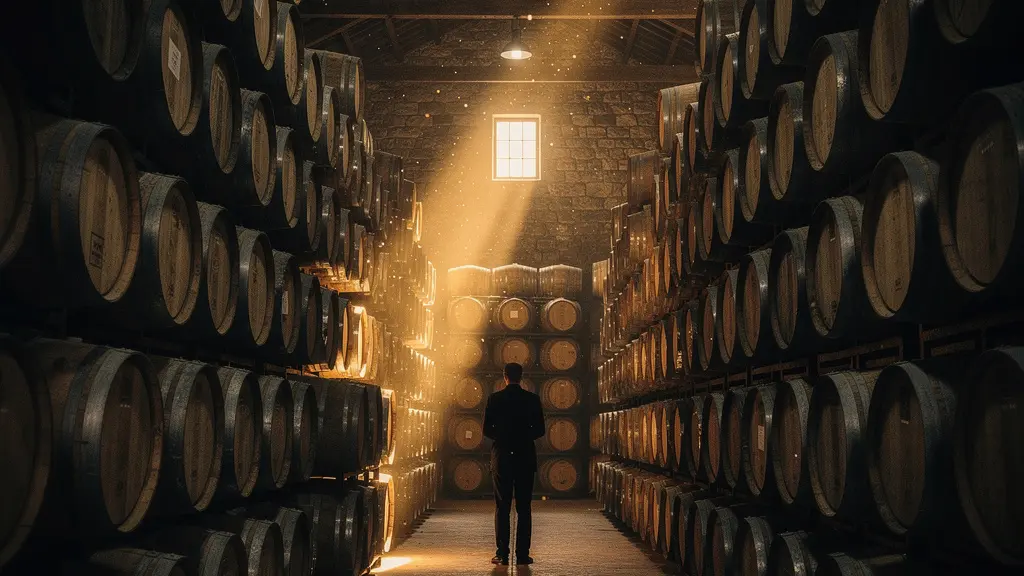
Creating a complex, consistent blend isn’t about finding perfect casks; it’s about orchestrating an imperfect conversation between them.
- True complexity arises from the dialogue between different spirits, where a tiny percentage of a “flawed” or powerfully characterful cask can provide essential depth.
- The inherent “distillery character” of a new make spirit is a more crucial foundation for flavour than its final age statement.
Recommendation: Approach blending as an act of composition. Focus on how each cask contributes to a larger sensory story, not just on its individual profile.
As a whisky collector or an aspiring independent bottler, the ultimate prize often seems to be the discovery of a single, perfect cask—a liquid masterpiece that tells a complete story on its own. The industry is built on this romantic notion. We hunt for that one-in-a-million barrel that delivers an unparalleled symphony of flavour. But as a Master Blender, I can tell you a secret that has taken me decades to fully grasp: the most profound and consistent complexity is rarely found. It is composed.
Many understand the basic mechanics of blending—the talk of a “base” for structure, a “body” for heart, and “top notes” for aromatic lift. Yet, this is like describing painting as simply putting colours on a canvas. It misses the art, the philosophy, and the sensory intuition involved. What if the secret wasn’t in the perfection of a single voice, but in the harmony of a well-conducted choir, complete with its baritones, tenors, and even the challenging, off-key notes that create tension and resolution?
This is the true art of blending. It is a dialogue between casks, an orchestration of individual personalities to create a single, coherent narrative that is greater than the sum of its parts. It’s about understanding that a spirit’s soul is defined by its distillery character long before an age statement is stamped on the bottle, and that even a flawed cask can be the very element that perfects a blend.
This guide will take you inside the blender’s mind. We will deconstruct the architecture of a great blend, explore the nuanced dance between consistency and creativity, and reveal how to unlock the hidden layers of flavour that only emerge when spirits are allowed to converse.
Summary: The Blender’s Guide to Composing Flavour Complexity
- Why Adding 2% of a “Flawed” Cask Can Perfect a Premium Blend?
- How to Structure a Blend Pyramid: Base, Body, and Top Notes Explained
- Single Malt vs Blend: Which Offers More Complexity for the Price?
- The Oxidation Error That Flattens Complex Profiles Within 24 Hours
- In Which Order Should You Taste to Unlock the Hidden Tertiary Notes?
- Why Is “Distillery Character” More Important Than Age Statement?
- Why Resting Spirits in Open Vats Softens Harsh Ethanol Notes?
- How Do Master Blenders Maintain Brand Character Across 50 Different Batches?
Why Adding 2% of a “Flawed” Cask Can Perfect a Premium Blend?
In the world of blending, perfection is often a paradox. While the goal is a harmonious and flawless final spirit, the path to achieving it sometimes involves embracing imperfection. A cask that is deemed “flawed” on its own—perhaps too aggressively smoky, overly tannic, or possessing a funky, sulphurous note—can become a powerful tool in the hands of a blender. Think of it not as a flaw, but as a concentrated point of character.
Adding just a tiny percentage, sometimes as little as 1% or 2%, of such a whisky can introduce a layer of complexity that was previously missing. It can provide a bass note that grounds lighter, fruitier spirits, or a sharp accent that cuts through a cloying sweetness. For instance, Emma Walker, a renowned Master Blender, explains how certain grain whiskies are used to balance and emphasize the light, fruity characters of malts. The grain acts as a canvas that allows the more subtle notes of the malt to shine, proving that a “simpler” component can elevate a more complex one.
This is where art meets science. In the cask, research demonstrates three types of reactions are always at play: additive (new compounds from the wood), interactive (oxygen’s role), and subtractive (loss of harsh notes). A “flawed” cask might bring an overabundance of one type of compound. When blended, it interacts with the other whiskies, creating new aromatic pathways and a more intricate, multi-dimensional profile. It’s the pinch of salt that makes a dish savoury, or the dissonant chord that makes a musical resolution so satisfying.
Therefore, a blender’s library must contain these challenging casks. They are the secret weapons used to add a signature touch and build a level of complexity that a blend of “perfect” casks alone could never achieve.
How to Structure a Blend Pyramid: Base, Body, and Top Notes Explained
The concept of a “blend pyramid” is the foundational architecture for composing a spirit. It’s a mental model for layering flavours, ensuring the final whisky has structure, depth, and aromatic lift. It’s not just about mixing, but about building a stable and compelling sensory experience. Each layer has a distinct role in the final composition.
The structure is typically visualized in three parts:
- The Base: This is the foundation of your blend, often making up the largest percentage. Typically, this layer consists of lighter, smoother whiskies, such as grain whiskies. Their role isn’t to dominate but to provide a solid, palatable canvas. The base carries the other flavours, supports them, and adds a subtle grain sweetness or creamy texture that underpins the entire structure.
- The Body (or Heart): These are the flavouring whiskies, used in smaller quantities but with a much greater impact on the palate. This is the heart of the blend, where the core character is defined. These malts might bring rich sherry notes, deep fruitiness, or a robust spiciness. They are chosen to enhance one another and form the central theme of the whisky’s story.
- The Top Notes: This is the smallest and often most aromatic layer. These are the highly characterful, and sometimes volatile, whiskies. A drop of a peated Islay malt for a whisper of smoke, or a fragrant, floral Speyside for a bright, high-toned lift. These notes are the first thing you smell in the glass and provide the initial intrigue.
Visualizing this structure helps in understanding how to build a balanced flavour profile. The base provides the stage, the body delivers the main performance, and the top notes add the dramatic flair.

As this visualization suggests, each layer supports the next. Changing just one component, especially in the base or body, can dramatically alter the final character of the blend. A blender must understand how different fills (first-fill vs. second-fill casks) create step changes in flavour intensity, allowing for precise control over the final architecture of the spirit.
Ultimately, the pyramid is not a rigid formula but a guiding philosophy that ensures a blend is more than a simple mixture—it’s a deliberately constructed experience.
Single Malt vs Blend: Which Offers More Complexity for the Price?
The debate between single malts and blends is often clouded by misconception. Many consumers assume “single malt” is inherently superior, but this misunderstands the very nature of each category. As one expert puts it, the terminology itself is often a point of confusion:
Most people naturally assume that ‘single malt’ means a single whisky from a single barrel. In fact, Scottish single malt means only malt whisky, prepared traditionally, produced by a single distillery.
– Whisky Analysis Expert, Understanding Whisky Production
This is a crucial distinction. A single malt is a vatting of multiple casks from *one* distillery, designed to express that distillery’s specific character. A blended whisky, on the other hand, is a composition of malts and grains from *many* distilleries. The question isn’t which is “better,” but which type of complexity you are pursuing. A single malt offers vertical complexity: a deep dive into a single house style. A blend offers horizontal complexity: a broad, harmonious tapestry woven from diverse sources.
When considering the price-to-complexity ratio, blends often have an edge. The Master Blender has a vast palette of flavours to draw from, allowing them to create a multi-layered and balanced profile at a more accessible price point. The following table breaks down the key differences in their creation and complexity:
| Aspect | Single Malt | Blended Whisky |
|---|---|---|
| Production Method | Single distillery, multiple casks vatted | Multiple distilleries, grain + malt |
| Typical Batch Size | Dozens to hundreds of barrels | Hundreds to thousands of barrels |
| Consistency Challenge | Natural cask variation within distillery | Variation across multiple distilleries |
| Master Blender Role | Maintain house style from single source | Create harmony from diverse sources |
| Price/Complexity Ratio | Higher price for vertical complexity | Lower price for horizontal complexity |
A great blend is a testament to the blender’s art—the ability to create harmony from disparate elements. While a great single malt is a beautiful expression of a place and a process, a blend is a deliberate composition. For the price, it’s hard to argue with the sheer breadth of flavour that a well-constructed blend can offer.
The choice ultimately depends on the drinker’s preference: do you want to explore the singular soul of one distillery, or appreciate the orchestrated symphony of many?
The Oxidation Error That Flattens Complex Profiles Within 24 Hours
As a blender, time is both an ally and an enemy. In the cask, years of slow, controlled oxidation help mature the spirit, but once the whisky is out and being blended, uncontrolled exposure to oxygen becomes a significant threat. A common and devastating error is excessive aeration during the blending process, which can irrevocably flatten a complex flavour profile in less than a day.
Oxidation is a chemical reaction that strips electrons from the molecules in the whisky. This process leads to a loss of aromas and flavours as delicate esters and other volatile compounds break down. The most noticeable effect is the reaction between ethanol and oxygen, which produces acetaldehyde. Over time, this further transforms into acetic acid—essentially vinegar. This is why a bottle of whisky left half-empty for years will taste dull, lifeless, and slightly sour. The same process happens, but at a vastly accelerated rate, when blending in open containers with a large surface area.
Imagine the intricate tapestry of flavours you’ve carefully woven. Uncontrolled oxidation is like leaving that tapestry out in the sun; the vibrant colours pale, and the fine details wash out. Delicate floral notes disappear first, followed by fruity esters, leaving behind a dull, monolithic profile dominated by wood and grain notes.
This molecular transformation, while beautiful at a macro level, represents the death of complexity. To prevent this, blenders work quickly, often using closed systems or even inert gases like nitrogen or argon to blanket the whisky and protect it from oxygen. Every moment the blend is exposed to air is a moment it is losing some of its soul. For a collector creating a personal blend, this means working in smaller batches, using narrow-necked vessels to minimize air contact, and bottling the final product promptly.
The character you spent so long composing can be erased in a matter of hours if the fundamental enemy—oxygen—is not respected and controlled.
In Which Order Should You Taste to Unlock the Hidden Tertiary Notes?
Tasting for blending is a far more analytical process than tasting for pleasure. The goal is not just to enjoy the spirit, but to deconstruct it, understand its components, and predict how it will interact with others. The order and method of tasting are critical for unlocking the full spectrum of flavours, especially the subtle tertiary notes—those deep, earthy, or rancio notes of leather, old wood, and forest floor that only emerge with time and patience.
A professional tasting sequence is structured to reveal the spirit layer by layer. It’s a process of gradual dilution and focused assessment. Rushing this process or tasting at only one strength means you will miss a huge part of the whisky’s potential. The key is to start neat and slowly add water, paying close attention to how the profile evolves at each stage.
This disciplined approach allows you to assess the core structure before peeling back the layers to reveal the more delicate and complex aromas hidden within. It’s a journey from the bold primary character to the subtle whispers of its history.
Your Action Plan: Professional Tasting Sequence
- Establish a Baseline: Start by formally tasting the core range of the whiskies you intend to blend. This helps establish the foundational flavours and aromas you’ll be working with.
- Build the Foundation: Begin your blend creation with a base, perhaps around 50% grain whisky. From there, build towards your target profile (e.g., adding malts with vanilla and honey notes for a bourbon-aged style), always mindful of potent notes like peat.
- Assess the Core Structure (Neat): Your first taste of the trial blend should always be neat, at cask or bottling strength. This reveals the spirit’s fundamental structure, its weight on the palate (mouthfeel), and the primary notes from the wood and distillate.
- Release the Primary Esters (First Dilution): Add just a few drops of water. This is a crucial step that triggers a chemical reaction, releasing the primary fruity and floral esters. The nose will open up dramatically. Assess how these newly released aromas integrate.
- Unlock Tertiary Notes (Final Dilution): Add more water to bring the proof down to around 20-25% ABV. At this lower strength, the aggressive ethanol “burn” is gone, allowing the heavier, less volatile tertiary notes (leather, tobacco, earth, rancio) to finally emerge on the palate.
By following this sequence, you are not just tasting a whisky; you are having a conversation with it, allowing it to reveal its secrets one layer at a time.
Why Is “Distillery Character” More Important Than Age Statement?
In the consumer’s mind, age is often the primary measure of a whisky’s quality. An 18-year-old is assumed to be better than a 12-year-old. But for a Master Blender, the age statement is one of the least interesting things about a whisky. The true foundation of flavour, the soul of the spirit, is its “distillery character”—the unique chemical fingerprint of the new make spirit before it ever touches wood.
This character is determined by dozens of variables in the production process: the type of barley, the milling of the grist, the shape of the stills, the speed of distillation, and the cut points of the spirit run. All these factors create a unique New Make spirit with a specific composition of phenols, esters, and other compounds. This is the raw potential, the DNA of the final whisky. While distillers believe the cask is responsible for 60-80% of the final flavour, it can only work with the material it is given. The cask can’t create fruitiness where there is none; it can only amplify, transform, or subdue the inherent character of the distillate.
Master Blender Sandy Hyslop’s approach highlights this long-term vision. He explains that blending is a team effort across generations. A blender must lay down the right stock with the right distillery character for the next Master Blender, who might be crafting a blend decades in the future. This emphasizes that the intrinsic quality of the young spirit is the most critical long-term asset. You can’t fix a flawed distillate with a great cask; you can only mask it. But you can elevate a great distillate to legendary status with the right maturation.
Therefore, when building a blend, the first question should not be “How old is it?” but “What is its character?” A vibrant, complex 8-year-old from a distillery known for its fruity profile is often a more valuable component than a tired, woody 20-year-old from a less distinguished source.
Why Resting Spirits in Open Vats Softens Harsh Ethanol Notes?
After the precise, mathematical work of measuring and combining different whiskies is complete, one of the most crucial and seemingly passive stages begins: marrying. This is the process of allowing the newly created blend to rest and integrate in a large vat, often for weeks or even months. Far from being an idle period, this is when the blend truly becomes a single, cohesive entity. It’s the moment the conversation between the casks settles into a unified voice.
One of the primary benefits of this resting period, particularly in traditional open-topped vats (though now more commonly in large, closed stainless-steel tanks), is the softening of harsh ethanol notes. When different whiskies are combined, their chemical components can clash. The overall spirit can feel disjointed, with alcohol “burn” being more prominent. The marrying process allows for a series of slow chemical reactions to occur. Esters, phenols, and aldehydes from the different whiskies interact, bond, and find a new equilibrium. This creates a more rounded, integrated mouthfeel where the alcohol is better woven into the flavour profile, rather than sitting on top of it.
Furthermore, this period allows for a very slow, controlled micro-oxidation and evaporation (the “angels’ share” on a macro scale). This helps the most volatile and aggressive alcohol compounds to dissipate, resulting in a smoother, softer spirit. According to established industry practice, this marrying or vatting process is what allows top-tier distilleries to create a whiskey with recognizable depth and character, year after year. While some industrial producers may rush this stage to save time and money, premium blends are defined by the patience afforded during marrying.
It is in this quiet time that the individual components cease to be a simple mixture and are reborn as a true, harmonious blend.
Key Takeaways
- Embrace Imperfection: A small amount of a “flawed” or intensely characterful cask is often the secret ingredient for adding profound complexity and a unique signature to a blend.
- Character Over Age: The inherent DNA of the new make spirit—its “distillery character”—is a more critical determinant of final quality and flavour potential than its age statement.
- Patience in Marrying: Allowing a finished blend to rest and “marry” for several weeks is a non-negotiable step to integrate flavours, soften harsh alcohol notes, and create a cohesive, rounded spirit.
How Do Master Blenders Maintain Brand Character Across 50 Different Batches?
The final, and perhaps most challenging, aspect of the blender’s art is maintaining absolute consistency. A customer buying a bottle of a famous blend today expects it to taste identical to the one they bought last year, and the one they will buy next year. This is a monumental task when you consider that a blend can be composed of 20 or more different whiskies, and the stock of casks is constantly changing. No two casks are ever truly alike. So how is this consistency achieved?
The answer lies not in a fixed recipe, but in a deep, encyclopedic knowledge of the distillery’s cask inventory and an unwavering sensory memory. The Master Blender doesn’t work from a formula like “X liters of Cask A + Y liters of Cask B.” Instead, they work towards a target flavour profile—a golden standard that exists in their memory and on their palate. Their job is to recreate that specific profile using the casks they have available *at that moment*.
This is where the concept of a “component library” is crucial. The blender has a mental map of thousands of casks, each categorized by its character: some are the fruity backbone, some provide the sherry-cask richness, others the wisp of smoke. If a particular component cask runs out, the blender must find a replacement, or a combination of other casks, that perfectly replicates its contribution to the final blend. It’s like a painter whose favourite shade of blue is discontinued; they must learn to mix other colours to recreate it flawlessly. This requires tasting hundreds of samples a day, building a new batch that is sensorially indistinguishable from the last.
To truly understand this art, begin to think of your own collection not as a series of individual bottles, but as a potential palette. Start small. Pour two whiskies together and see how they converse. Your journey into the art of composition has just begun.