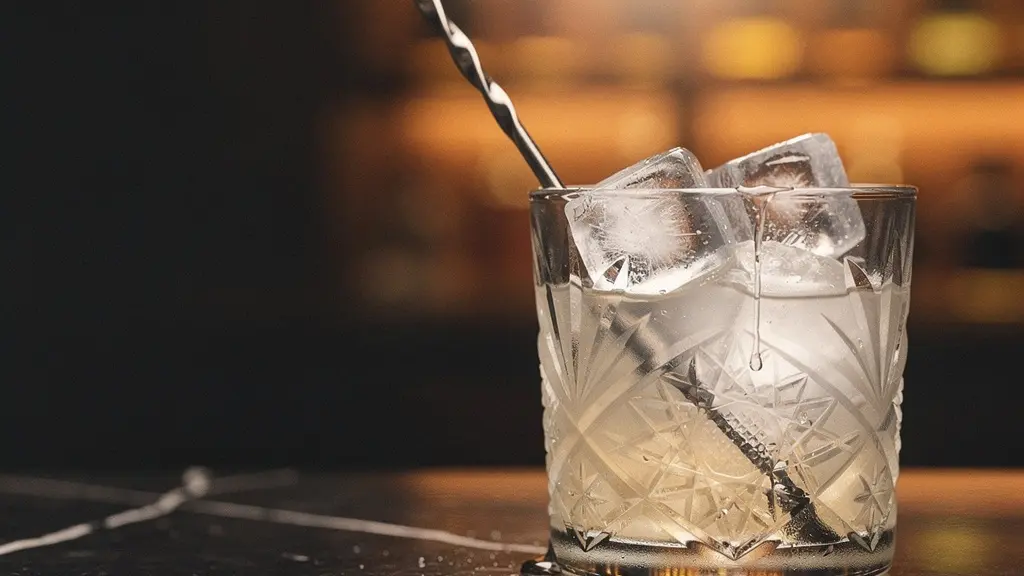
Achieving perfect cocktail dilution is not a matter of timing or taste, but a predictable problem of physics governed by heat transfer and phase change.
- The vast majority of chilling comes from the energy required to melt ice (latent heat of fusion), not the ice’s initial temperature.
- Stirring and shaking are fundamentally different methods of heat transfer that result in different dilution rates, temperatures, and textures.
Recommendation: Control dilution by treating your ingredients, ice, and glassware as a closed thermodynamic system. Pre-chill all components and measure by weight, not volume, to account for all variables.
The pursuit of the perfect Martini is often framed as an art, a ritual of personal preference. Bartenders speak of “feel,” of intuition honed over thousands of pours. While experience is invaluable, the core of consistency lies not in mysticism, but in physics. The final alcohol by volume (ABV) and texture of a cocktail are direct results of a thermodynamic exchange between spirit and ice. Water is not merely an afterthought; it is a critical ingredient introduced via a controlled, or uncontrolled, melting process.
Conventional wisdom offers simple rules: stir for 30 seconds, use large ice, chill your glass. These are not incorrect, but they are incomplete. They are the “what” without the “why.” They fail to account for the ambient temperature, the thermal mass of a warm mixing glass, or the fundamental difference in energy transfer between stirring and shaking. To truly control dilution, one must move beyond rote memorization and begin to think like a physicist, treating the cocktail as a system where heat energy is moved, and phase changes are precisely managed.
This analysis will deconstruct the physical principles governing dilution. We will examine the mechanics of heat transfer, the dominant role of phase change energy, the impact of equipment temperature, and the quantifiable methods for achieving replicable results, whether mixing a single drink or preparing a large batch. The objective is to replace approximation with calculation, enabling the perfectionist to engineer the ideal balance of temperature, strength, and texture with scientific certainty.
Summary: The Physics of Cocktail Dilution
- Why Stirring for 30 Seconds Dilutes Less Than Shaking for 10 Seconds?
- How to Account for Melt Rate in an Old Fashioned Over 20 Minutes?
- Wet Ice or Dry Ice: Which Cools the Drink Faster Without Over-Diluting?
- The Temperature Error: Why a Warm Mixing Glass Ruins Dilution Control?
- How Much Water to Add to a Pre-Batched Bottle to Mimic Stirring?
- How to Dilute 60% ABV Spirit Down to 40% for Home Bottling?
- Cube or Sphere: Which Shape Minimizes Surface Area for Whiskey?
- When to Stir and When to Shake: The Physics of Texture in Mixology?
Why Stirring for 30 Seconds Dilutes Less Than Shaking for 10 Seconds?
The difference in dilution between stirring and shaking is fundamentally a matter of heat transfer efficiency. Stirring relies primarily on conduction and gentle convection. As ice melts, it creates an insulating ‘boundary layer’ of cold water around its surface. Stirring disrupts this layer, but only gently, allowing for a slow and controlled exchange of heat. Shaking, conversely, is an act of violent forced convection. The ice and liquid are thrown against each other, obliterating the insulating boundary layer and maximizing the surface area contact between the warm spirit and the ice.
This dramatic difference in energy transfer rate is why shaken drinks hit thermal equilibrium at -4°C to -5°C in under 15 seconds, while stirred drinks require significantly more time to reach a similar temperature. Shaking is brutally efficient at transferring heat from the liquid into the ice, causing rapid melting (dilution) to achieve its chilling. Stirring is a less efficient, more deliberate process, resulting in less dilution for a given amount of chilling time.
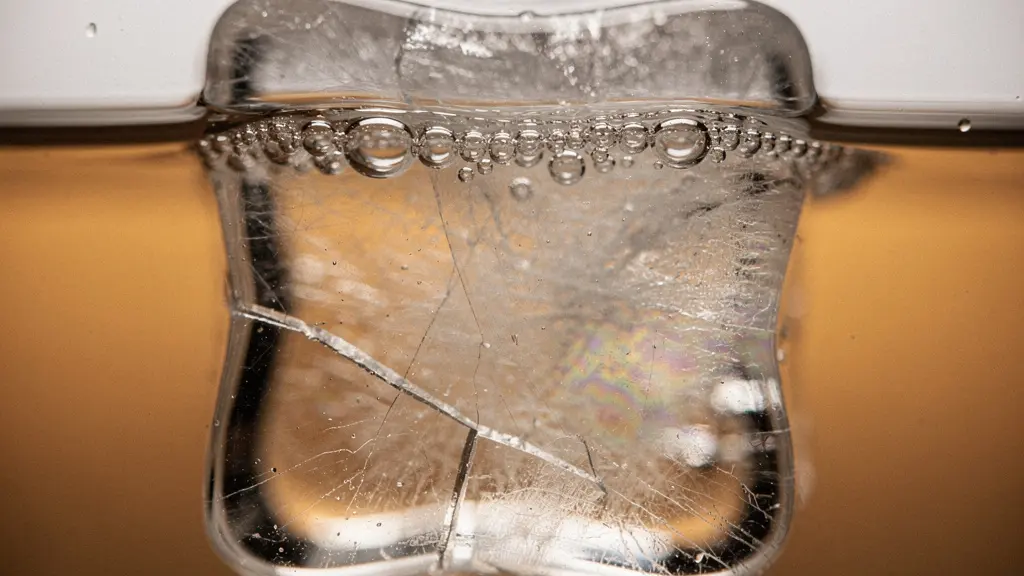
The image above visualizes the crucial boundary layer—the thin film of meltwater that insulates the ice. In a stirred drink, this layer remains largely intact, slowing down heat transfer and dilution. In a shaker, this layer is instantly destroyed, exposing the entire ice surface to the warmer spirit and accelerating the melting process. Therefore, a 10-second shake can easily introduce more meltwater than a 30-second stir because it is a far more aggressive method of achieving thermal equilibrium.
How to Account for Melt Rate in an Old Fashioned Over 20 Minutes?
The longevity of a drink served on the rocks, like an Old Fashioned, is governed by a single, dominant physical principle: the latent heat of fusion. This is the thermal energy required to change a substance from a solid to a liquid state without changing its temperature. The common misconception is that a “colder” piece of ice from the back of the freezer provides significantly more chilling. In reality, the vast majority of cooling power does not come from the ice’s temperature, but from the energy it absorbs from the drink during the act of melting.
The numbers are stark. According to a scientific analysis of ice in cocktails detailed in SevenFifty Daily, melting just one gram of ice at 0°C absorbs 333.5 joules of energy from the surrounding liquid. By contrast, raising the temperature of that same gram of ice by 1°C (e.g., from -2°C to -1°C) only absorbs about 2 joules. The phase change from solid to liquid is over 150 times more powerful as a cooling mechanism than the sensible heat of the ice itself. This is the engine that keeps a drink cold over time. As the drink absorbs ambient heat from the room and the drinker’s hand, that energy is consumed by melting the ice, not by raising the drink’s temperature.
This principle was articulated perfectly by Dave Arnold, a leading authority on cocktail science. His observation encapsulates the entire dynamic:
There is no chilling without dilution, and there is no dilution without chilling.
– Dave Arnold, Liquid Intelligence, cited in SevenFifty Daily
To account for the melt rate in an Old Fashioned, the goal is to provide enough ice mass (an “energy reservoir”) to absorb ambient heat for the expected 20-minute consumption time, using a shape that minimizes surface area to slow the rate of that energy exchange. The drink’s dilution over time is not a flaw; it is the unavoidable physical cost of keeping it cold.
Wet Ice or Dry Ice: Which Cools the Drink Faster Without Over-Diluting?
The question of “wet” (tempering, 0°C) versus “dry” (freezer-cold, sub-zero) ice is a common point of debate among bartenders. The intuition is that colder ice should be more effective. However, the physics of latent heat of fusion demonstrates that this advantage is almost negligible. The energy required to melt ice is so immense that the small amount of energy absorbed by warming sub-zero ice to its melting point is trivial in comparison.
As thermodynamics experiments on Cooking Issues have demonstrated, the energy needed to melt 1 gram of ice (the phase change at 0°C) is equivalent to the energy required to raise that same gram of ice’s temperature by about 160°C. In other words, melting a single gram of ice provides the same chilling power as taking a gram of ice from the temperature of deep space to 0°C. This illustrates the overwhelming dominance of the melting process.
A “wet” ice cube, already at its 0°C melting point, begins to chill and dilute the moment it contacts the liquid. A “dry,” sub-zero ice cube will first chill the liquid slightly by absorbing some heat to raise its own temperature to 0°C, and only then will it begin to melt and provide the significant cooling effect. This initial warming phase provides minimal chilling and no dilution. In practice, the difference is minuscule. A physics analysis by Perlage Systems confirmed that the extra chilling from using 150g of ice at -10°C versus 0°C is equivalent to melting just 9.5 additional grams of ice. The vast majority of the work is done by the phase change.
Therefore, wet ice is arguably more efficient. It begins its primary job—chilling via melting—immediately. A dry, frosty ice cube may stick to a mixing glass or shaker, and its surface can momentarily refreeze dilution water, slightly slowing the initial process. For speed and consistency, ice at its melting point is ideal.
The Temperature Error: Why a Warm Mixing Glass Ruins Dilution Control?
Every object in your bar possesses thermal mass—the capacity to store thermal energy. A room-temperature mixing glass or shaker is a reservoir of heat. When you add ice and spirit, a portion of the ice’s finite cooling capacity must be “spent” to chill the vessel itself before it can effectively chill the liquid. This is a thermal tax that results in unintended, excess dilution.
Consider a heavy, 500-gram glass mixing beaker at 22°C (72°F). To cool it to 0°C (32°F), a significant amount of energy must be removed. This energy can only come from one place: the latent heat of fusion of your ice. The ice must melt not only to chill your cocktail ingredients but also to pay the thermal tax of the warm glass. This forces you to stir or shake longer, or it simply results in a warmer, more diluted final drink as the system struggles to reach equilibrium. For a perfectionist, this introduces an unacceptable variable that ruins consistency.
The solution is to eliminate this variable entirely through a strict pre-chilling protocol. By bringing all equipment to the target temperature *before* mixing, you ensure that 100% of the ice’s melting energy is dedicated to chilling and diluting the cocktail’s liquid ingredients. This is the only way to achieve a predictable and repeatable outcome. The difference is not trivial; it can easily account for 5-10 grams of extra meltwater, pushing a perfectly balanced Martini into the realm of being watery.
Action Plan: Pre-Chill Protocol for Thermal Consistency
- Store mixing glasses, shakers, and service coupes in a freezer for a minimum of 15 minutes before service to eliminate their thermal mass.
- Calibrate your target dilution: For stirred drinks, aim for 20–25g of water per 100g of spirit; for shaken drinks, target 45–60g.
- Use a digital scale to periodically weigh your mixing vessel before and after making a drink to quantify the actual meltwater and refine your technique.
- Store ice in a dedicated, insulated cooler at or below −18°C. Avoid storing it in environments that can impart off-odors.
- For optimal thermal integrity, replace ice in commercial settings every 48 hours and at home every 72 hours.
How Much Water to Add to a Pre-Batched Bottle to Mimic Stirring?
Pre-batching cocktails for service offers unparalleled consistency, but only if the dilution is calculated correctly. The goal is to replicate the exact amount of meltwater that would be added during a live stir or shake. This cannot be done by simply adding a fixed volume of water, as individual technique, ice shape, and ambient temperature all affect the outcome. The gold standard, pioneered by Dave Arnold, is an empirical method: weigh, mix, and weigh again.
The process is simple: place your mixing glass with all spirit ingredients on a digital scale and tare it to zero. Add ice, stir or shake to the desired temperature and texture, then strain the finished cocktail into a new vessel. Weigh the original mixing glass with the remaining ice. The negative number displayed is the exact mass of the water that melted into your drink. This measurement can then be used to precisely scale up a large batch. For example, if a single 100g cocktail requires 25g of water, a 1-liter batch (1000g of spirits) will require exactly 250g of filtered water.
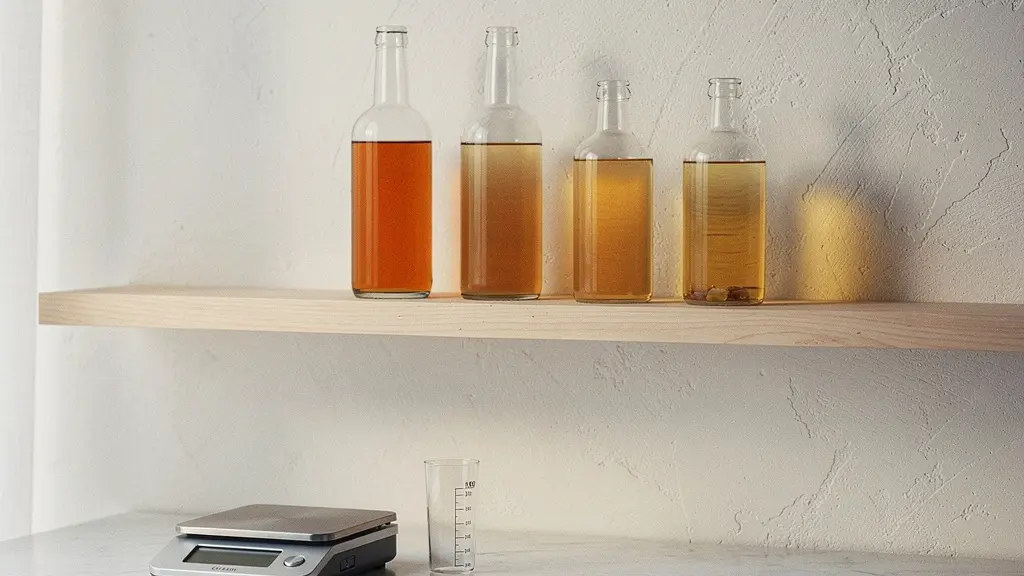
However, another physical phenomenon must be accounted for at this stage: ethanol-water volume contraction. When alcohol and water are mixed, the hydrogen bonds between molecules pull them closer together, resulting in a final volume that is less than the sum of its parts. As confirmed by AlcoDens blending calculations, this contraction can lead to a volume “loss” of 2-4%. Mixing 10 gallons of high-proof spirit with 14.4 gallons of water might yield only 23.75 gallons, not the expected 24.4. For this reason, professional batching should always be done by mass (weight), not volume, to ensure absolute precision.
How to Dilute 60% ABV Spirit Down to 40% for Home Bottling?
Proofing a spirit down—for example, from a cask strength of 60% ABV to a bottling strength of 40% ABV—seems like a straightforward dilution problem. However, as with batching cocktails, the phenomenon of volume contraction can introduce significant errors if calculations are based on volume alone. As explained by Distillique’s guide for craft distillers, when you mix 50ml of pure ethanol and 50ml of water, the resulting solution measures only 96-97ml, not 100ml. The molecules have packed together more efficiently.
This means that simple volumetric formulas are inherently inaccurate. For hobbyists, the error may be acceptable, but for commercial or precise applications, more rigorous methods are required. The industry standard in the United States is to use the official tables provided by the Alcohol and Tobacco Tax and Trade Bureau (TTB), which account for contraction and temperature. For a modern digital workflow, software calculators that use the same underlying data are the most reliable option.
The following table compares the common methods for proofing, highlighting their accuracy and ideal use cases. As the data shows, methods that fail to account for volume contraction are suitable only for rough estimates.
| Method | Accounts for Contraction | Accuracy | Best For |
|---|---|---|---|
| Pearson’s Square | No | Low — overestimates final volume, requires additional correction | Blending wines of similar strength |
| TTB Table No.6 | Yes | High — industry standard used for 100+ years by American distillers | Commercial distillery proofing |
| AlcoDens Calculator | Yes | High — results identical to TTB Table No.6 | Digital workflow for any distiller |
| Approximate Calculation + Correction | Partially (manual adjustment) | Medium — requires measuring ABV post-dilution and adding small water increments | Home and hobby distillers |
For consistent results, it is also crucial to control the temperature of the components. Using room-temperature water (around 20°C/68°F) is a professional standard, as it provides a stable baseline for calculations and prevents the cloudiness (louche) that can occur when proofing down with very cold water.
Cube or Sphere: Which Shape Minimizes Surface Area for Whiskey?
The choice of ice shape for a spirit served neat or on the rocks, like whiskey, is a strategic decision to control the rate of dilution over time. The governing principle here is the surface-area-to-volume ratio. For any given volume, a sphere is the geometric shape with the minimum possible surface area. A cube is the next most efficient common shape.
Since chilling and dilution occur at the surface of the ice, a shape with less surface area will necessarily melt—and therefore dilute the drink—more slowly. This is ideal for sipping spirits where the intention is to keep the drink cold with minimal watering down over an extended period. A large, clear sphere or cube provides a substantial thermal reservoir (due to its mass) while minimizing the rate of heat exchange (due to its low surface area).
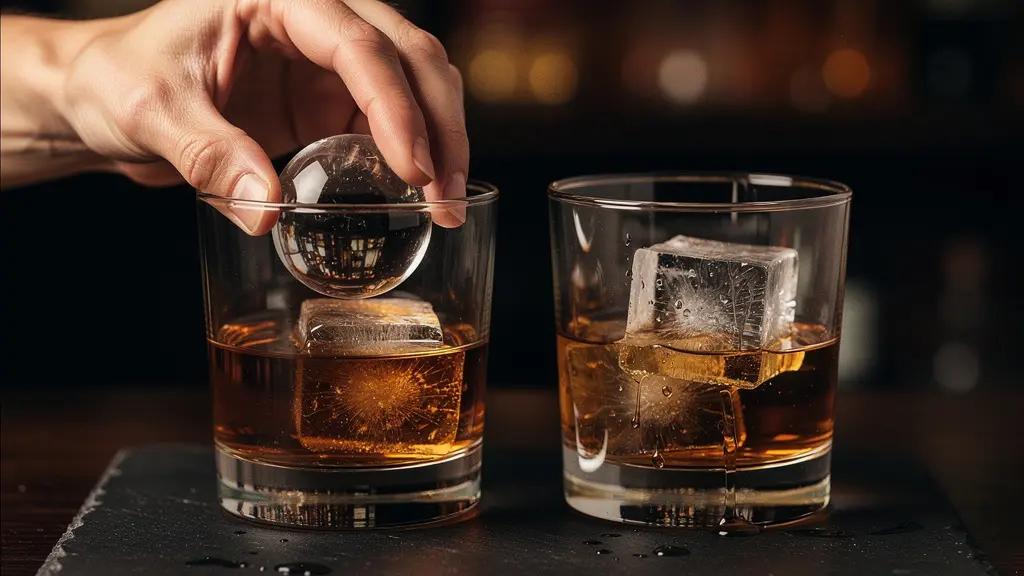
The geometric difference translates into a significant performance gap. A spherical ice cube melts approximately 20-40% slower than a traditional cube of the same volume. For example, a standard 1-ounce (by volume) cube has a surface area of about 2.16 square inches, whereas a 1-ounce sphere has only about 1.74 square inches. This represents a nearly 20% reduction in the contact surface through which heat can be transferred and meltwater can be released.
Conversely, smaller forms of ice like crushed, pebbled, or standard freezer crescent shapes have a massive surface-area-to-volume ratio. They are designed for maximum, rapid chilling and dilution, making them perfect for drinks like a Mint Julep or a Cobbler, but entirely unsuitable for slowly sipping a fine whiskey.
Key Takeaways
- Chilling and dilution are inseparable physical processes governed primarily by the energy of phase change (melting ice), not the ice’s temperature.
- The rate of dilution is a function of heat transfer efficiency; shaking (forced convection) is faster and more dilutive than stirring (gentle convection).
- Uncontrolled variables like warm glassware (thermal mass) and molecular packing (volume contraction) are significant sources of error that must be managed for precision.
When to Stir and When to Shake: The Physics of Texture in Mixology?
The decision to stir or shake is the final application of all these principles, but it adds two more critical variables: aeration and oxidation. Stirring is a gentle technique intended only to chill and dilute. It creates a silky, viscous, and dense mouthfeel, preserving the pure character of the spirits. Shaking is a violent act that intentionally introduces texture by shearing tiny air bubbles into the liquid, creating a lighter, more effervescent, and colder-perceived drink.
On average, stirring might contribute about 20% dilution, while shaking adds closer to 25%, but the key difference is textural. In blind tastings conducted by Dave Arnold with expert bartenders, the panel was universally able to distinguish shaken from stirred Manhattans and Negronis based on mouthfeel alone. The micro-bubble aeration from shaking was found to be a distinct and lasting textural element.
However, this aeration comes at a chemical cost. Research highlighted by the Discovery Place Science Museum explains that vigorous shaking exposes the spirit to oxygen, which can promote the oxidation of alcohol groups into aldehydes. These compounds are often associated with a bitter, sharp, or “bruised” taste. This chemical change is precisely why spirit-forward cocktails composed entirely of alcoholic ingredients (like the Martini, Manhattan, or Negroni) are traditionally stirred. Shaking would compromise their delicate aromatic integrity. Cocktails containing juice, cream, or egg white, on the other hand, require the emulsification and aeration that only shaking can provide; the bright flavors of citrus also help to mask any minor oxidative effects.
The rule is therefore a matter of chemistry and physics: stir when a drink contains only spirits, liqueurs, and bitters to preserve its weight and aromatic purity. Shake when a drink contains non-alcoholic, opaque ingredients like juice or dairy to create a homogenous, aerated texture.
Frequently Asked Questions on Cocktail Dilution and ABV
How much water does stirring add to a cocktail compared to shaking?
Generally, stirring a cocktail for 30-60 seconds will add approximately 40-60ml of water. Shaking is more aggressive and typically adds 50-80ml of water due to the more vigorous agitation and disruption of the ice’s boundary layer. Blended or frozen cocktails, which pulverize the ice, can add 100-150ml or more.
Why does ice shape matter for dilution rate in spirit-forward cocktails?
Large ice cubes and spheres possess a lower surface-area-to-volume ratio. This means less of the ice’s surface is in direct contact with the spirit at any given moment. This geometric property results in a slower rate of melting and thus more controlled, gradual dilution, which is ideal for sipping drinks like an Old Fashioned or neat whiskey where flavor preservation is key.
How do you calculate the final ABV of a cocktail after dilution?
To calculate final ABV, you must determine the volume of pure alcohol and divide it by the final total volume. First, for each ingredient, multiply its volume by its ABV percentage (e.g., 60ml of 40% ABV gin is 24ml of pure alcohol). Sum the pure alcohol volumes from all ingredients. Then, divide this total by the total final liquid volume of the drink (which includes the original ingredients plus the estimated meltwater from chilling) and multiply by 100 to get the final ABV percentage.