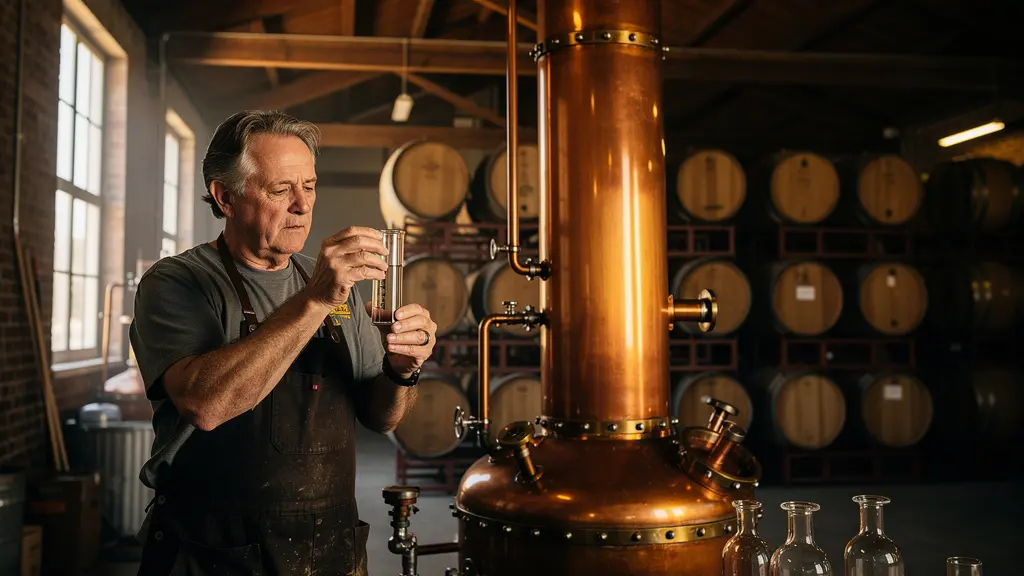
The vast majority of ‘craft’ spirits are a marketing illusion, but you can identify authenticity by ignoring the label story and instead reading the ‘production fingerprint’ left by costly, inefficient, and flavour-centric distilling choices.
- True craft is defined by narrow ‘heart’ cuts, which drastically increase cost but remove harsh chemical notes.
- The type of still (copper pot vs. stainless column) and the words “Distilled By” (not “Bottled By”) are non-negotiable indicators of origin.
Recommendation: Prioritize spirits that provide transparent details on distillation cuts, still type, and their specific Distilled Spirits Plant (DSP) number over those relying on vague terms like ‘handmade’ or ‘artisanal’.
Let’s be brutally honest. The term “craft spirit” has been hijacked. It’s a marketing buzzword slapped onto bottles of industrially-produced bulk spirits, dressed up with a folksy story and a high price tag. You, the consumer who values authenticity, are being sold a lie. You’re told to look for words like “handmade” or “small batch,” but these terms have no legal definition and are often meaningless. You’re trying to support a genuine artisan but are instead funding a corporate marketing department.
The good news is that true craft leaves clues. Not in the romantic story on the back label, but in the liquid itself and in the non-negotiable facts of its production. These clues form a ‘production fingerprint’ that is impossible to fake. Industrial spirits are built for efficiency and consistency; true craft spirits are the result of deliberate, costly inefficiencies that prioritize one thing above all: flavour. Forget the marketing; it’s time to learn how to read the evidence.
This guide will not give you a list of “approved” brands. It will give you something far more valuable: the insider’s toolkit to deconstruct any bottle on the shelf. We’ll explore the chemical and economic realities that separate the authentic from the fraudulent, from the precision of distillation cuts to the very metal of the still. You’ll learn to spot the red flags and identify the subtle signs of true quality that marketers hope you’ll overlook.
To navigate the complex world of spirits, we will break down the key indicators that separate true artisans from industrial giants in disguise. This article provides a structured path to becoming a more discerning consumer, empowering you to see past the marketing and taste the truth.
Summary: Decoding the Truth in Your Spirit Bottle
- Why Tight “Heart” Cuts Reduce Yield but Exponentially Increase Quality?
- How to Decode “Distilled By” vs “Bottled By” on Spirit Labels?
- Pot Still Batch or Continuous Column: Which Produces More Texture?
- The “Handmade” Lie: How to Spot Marketing Fluff on a Bottle?
- How to Find High-Quality Spirits from “Underrated” Distilleries?
- The Stainless Steel Mistake That Ruins 30% of Craft Batches
- The “Batch Drift” Phenomenon: Why Your Grandfather’s Whisky Tasted Different?
- How Do Master Blenders Maintain Brand Character Across 50 Different Batches?
Why Tight “Heart” Cuts Reduce Yield but Exponentially Increase Quality?
Here is the single most important, and most invisible, sign of true craft: the “cut.” During distillation, the alcohol that comes off the still is separated into three parts. First come the “heads,” full of volatile compounds like acetone that smell like nail polish remover. Last come the “tails,” oily, greasy, and full of fusel alcohols that cause headaches. In between is the “heart,” the clean, sweet, and desirable spirit. An industrial producer, focused on volume, will take a very wide heart cut, including some of the heads and tails to maximize their yield.
A true craft distiller does the opposite. They make a ruthlessly tight heart cut, sacrificing a significant portion of their potential product to ensure absolute purity. This is not an artistic choice; it’s a massive financial one. According to distillation experts, the economic trade-off of quality cuts demonstrates that narrowing the heart cut from 70% to 60% of the run can double the cost of the raw spirit. This is the first fingerprint of authenticity: a willingness to sacrifice profit for quality. An industrial re-bottler using cheap Grain Neutral Spirit (GNS) has no control over this; they are given a finished, wide-cut product.
Your Action Plan: How to Inquire About Distillation Cuts
- Discard the Foreshots: Ask if the distiller discards the initial 50-200ml of foreshots, which contain the most harmful compounds like methanol. This is a non-negotiable safety and quality step.
- Monitor by Temperature: The heart of the run for most spirits comes off between 190°F and 205°F (87-96°C). A distiller who tracks this meticulously is focused on precision.
- Rely on Sensory Evaluation: The best distillers don’t just use temperature; they use their nose. The transition from heads to hearts and hearts to tails is identified by smelling for sharp chemical notes or oily, vegetal aromas.
- Collect in Small Jars: True artisans often collect the run in a series of small, 300ml jars. This allows them to make extremely precise micro-decisions about where the heart truly begins and ends, rather than using one large collection tank.
- Define the Tails Point: The cut to tails isn’t just about temperature; it’s about taste. A quality-focused distiller stops collecting the heart as soon as they detect the first hint of vegetal or wet cardboard notes, even if it means a lower yield.
How to Decode “Distilled By” vs “Bottled By” on Spirit Labels?
The back label of a bottle is a legal document, and it’s where the marketing lies often fall apart under scrutiny. The most critical phrase to find is “Distilled By.” This means the company whose name is on the bottle actually operated the still and made the spirit. This is the gold standard of transparency. Anything else is a red flag. If you see terms like “Bottled By,” “Produced By,” or “Crafted By,” you should be deeply suspicious. These phrases often mean the company simply bought bulk, industrially-produced spirit from a massive factory (like MGP in Indiana) and then bottled it, perhaps filtering it or adding flavour before putting their own “craft” label on it.
This isn’t a small distinction; it’s everything. The scale of production reveals the truth. Fresh data shows the vast difference in the market: an analysis from the American Craft Spirits Association reveals that 89.2% of craft distilleries produce an average of only 657 cases annually, while a handful of “large craft” operations average 178,000 cases each. If a brand is available in every liquor store across the country, it is almost physically impossible for it to be the product of a small, hands-on operation. Look for the Distilled Spirits Plant (DSP) number on the label. A true distiller will be proud of theirs and often display it clearly. If it’s missing, or if a quick search of the DSP number leads you to a giant industrial park, you’ve found a fake.
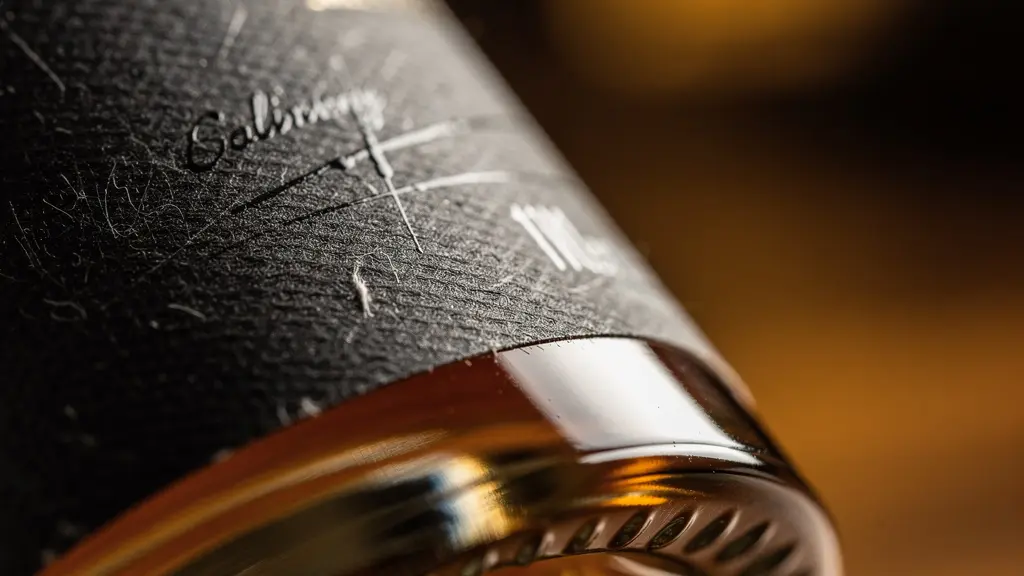
This visual detail is your first checkpoint. The presence and clarity of production information on the label often correlate directly with the authenticity of the spirit inside. Vague language is a shield for a sourced product.
Pot Still Batch or Continuous Column: Which Produces More Texture?
The hardware a distiller uses leaves an indelible mark on the spirit’s final character, particularly its texture and flavour complexity. The two main types of stills are the traditional pot still and the industrial column still. A pot still works in individual batches and is relatively “inefficient.” It allows a large number of flavour compounds, known as congeners, to pass over into the final spirit. This results in a liquid that is richer, oilier, and has a fuller body and more complex character. Think of Irish whiskey or single malt Scotch.
A column still, by contrast, is a model of industrial efficiency. It operates continuously, stripping out almost all congeners to produce a very high-proof, neutral spirit. This is perfect for making vodka or creating a blank canvas (GNS) to be sold to re-bottlers. While it’s technically “purer” from a chemical standpoint, this purity comes at the cost of character and texture. A spirit made in a column still will be lighter, cleaner, and significantly less complex. One is not inherently “better” than the other—a column still is essential for certain spirits—but if a brand claims to be a rich, “old-style” whiskey and you discover it’s made in a giant column still, you’re looking at a contradiction. The tool doesn’t match the story.
The differences are not subtle; they define the fundamental style and potential of a spirit. The following table, based on information from industry experts like those at Spirit of York Distillery, breaks down these core distinctions.
| Characteristic | Pot Still | Column Still |
|---|---|---|
| Production Scale | Small batch, artisanal | Large-scale, industrial |
| Material | Traditional copper | Often stainless steel |
| Congener Retention | High – preserves flavor compounds (the flavor and aroma compounds that give a spirit its character) | Low – strips for neutrality |
| Texture Result | Fuller-bodied, oily, complex | Lighter, cleaner, neutral |
| Speed | Slow, allows precise separation | Fast, continuous operation |
| Copper Catalysis | Removes sulfur compounds | Limited copper contact |
The “Handmade” Lie: How to Spot Marketing Fluff on a Bottle?
Now we enter the fog of war: marketing language. Words like “artisanal,” “handmade,” “small batch,” and “handcrafted” are the four horsemen of the craft apocalypse. They have no legal definition in the spirits world. A company can legally buy a million gallons of factory-made vodka, have a single employee push a button to start the bottling line, and call the result “handmade.” It’s a marketing Trojan horse designed to prey on your desire for authenticity.
So, how do you see through it? You look for what’s missing. A true craft producer is usually a nerd. They are obsessed with their process. Their website and bottle won’t be filled with vague, romantic stories about a founder’s dream. Instead, it will be packed with technical details: the specific grain varietals in their mash bill, the type of yeast used in fermentation, the exact char level of their barrels, and whether the spirit is non-chill filtered. This is the language of passion. Marketing fluff is the language of concealment. The more flowery the prose, the more likely it is that there’s nothing of substance to talk about.
The economic reality of the market backs this up. The 2023 Craft Spirits Data Project shows that while craft spirits achieved $7.9 billion in sales, the smallest 89% of distilleries only account for 11.3% of total craft production. The lion’s share is made by a few large players, many of which are owned by massive corporations. Here are some key red flags:
- Vague Terms: “Handmade” and “Artisanal” are unregulated marketing terms. Ignore them completely.
- Omission of Details: Authentic craft often avoids flowery language, focusing on technical specifications instead.
- Missing DSP Number: Real craft distilleries proudly display their Distilled Spirits Plant number. If it’s hidden, they’re hiding something.
- Lack of Batch Information: A true small batch should include specific batch and bottle numbers (e.g., ‘Bottle 87 of 210’). A generic “small batch” label on a million-case brand is a lie.
- Hidden Parent Company: Do a quick search for the brand’s owner. Many “craft” brands are just subsidiaries of giants like Diageo, Pernod Ricard, or Sazerac.
How to Find High-Quality Spirits from “Underrated” Distilleries?
So, if you can’t trust the labels on the main shelf, where do you find the good stuff? The answer is to think local and look for gatekeepers. The best, most authentic spirits often have limited distribution precisely because their production is so small. They aren’t on every shelf in every state. This is a feature, not a bug. Data from the American craft market illustrates this point well; ACSA data shows that the top 5 states by distillery count contain only 32.4% of US craft distilleries, meaning over two-thirds are scattered across smaller, “underrated” markets waiting to be discovered.
Your best strategy is to find a trusted human curator. Go to a dedicated craft spirits shop—not a giant warehouse store—and talk to the staff. Ask them, “What are you excited about right now?” or “What’s a local distillery that’s doing something amazing?” These people taste hundreds of spirits and have a vested interest in finding true gems. Similarly, find a good cocktail bar, not a dive bar that slings well drinks. Look at their back bar. Do you see bottles you don’t recognize? Ask the bartender about them. A passionate bartender is one of the best resources for discovering high-quality, under-the-radar spirits.

Finally, embrace distillery tourism. The growth of direct-to-consumer engagement, with distillery tourism growing significantly, shows a clear path. Visiting a distillery allows you to see the still, meet the distiller, and taste the product at its source. It’s the ultimate way to verify authenticity and connect with the person who actually made what’s in your glass. You replace marketing narratives with firsthand experience.
The Stainless Steel Mistake That Ruins 30% of Craft Batches
Let’s dig deeper into the pot still versus column still debate. The difference isn’t just about tradition or shape; it’s about fundamental chemistry. Most traditional pot stills are made of copper, and this is not for aesthetic reasons. Copper is a reactive metal that acts as a crucial catalyst during distillation. As the alcohol vapor rises inside the still, it interacts with the copper surface. This interaction chemically removes unwanted, foul-tasting sulfur compounds (like dimethyl sulfide) that are a natural byproduct of fermentation. These compounds can impart sharp, rubbery, or cabbage-like notes to the spirit.
Many modern stills, especially large industrial column stills, are made from stainless steel for its durability and lower cost. However, stainless steel is non-reactive. It does nothing to clean up the spirit. A spirit distilled entirely in stainless steel will retain these sulfur compounds, resulting in a harsher, less refined final product. This is why even in massive column still operations, they often incorporate copper plates or sections to try and replicate this effect, but it’s not the same as the total surface area contact in a traditional pot still.
This is what an expert from a still manufacturer has to say about the process. As noted by Fine Lyne Stills in their technical breakdown:
The crucial catalytic role of copper in pot stills chemically reacts with and removes unwanted, sharp-tasting sulfur compounds created during fermentation. This is a key reason for the rounder, richer texture of pot-stilled spirits, a reaction that stainless steel columns cannot perform.
– Fine Lyne Stills, Understanding the Heads, Hearts, and Tails of Distillation
This “chemical honesty” is a core tenet of craft. The choice of material is a production fingerprint that directly impacts the smoothness and palatability of the spirit. A distiller who invests in an all-copper still is making a clear statement about their commitment to quality over cost-cutting.
The “Batch Drift” Phenomenon: Why Your Grandfather’s Whisky Tasted Different?
Industrial spirits are obsessed with absolute consistency. The goal is for a bottle of Jack Daniel’s purchased in Tokyo to taste identical to one bought in Texas ten years from now. To achieve this, master blenders mix hundreds or even thousands of barrels together, using science and technology to engineer out any variation. True craft, on the other hand, embraces a concept we can call “batch drift.” This is the natural, subtle variation that occurs from one batch to the next.
Why does this happen? Because a craft distiller is not trying to erase the influence of nature. One batch might use barley harvested in a slightly warmer year. A fermentation might run a degree hotter. But most importantly, every single barrel is its own unique ecosystem. A barrel aged on the hot top floor of a rickhouse will mature differently than one on the cool, damp ground floor, developing deeper, oakier notes. Industrial producers blend these differences away into a homogenous whole. A craft distiller celebrates them, often by releasing them as “single barrel” bottlings. When you buy a single barrel spirit, you are tasting a unique snapshot in time, a product of a specific tree, a specific location in the warehouse, and a specific aging cycle.
This is why your grandfather’s favorite whisky might taste different today. Over the decades, even large brands experience “brand drift” as production methods change, but on a micro scale, batch-to-batch variation is a sign of authenticity. It’s the spirit equivalent of “terroir” in wine. If every bottle from a so-called “craft” distillery tastes exactly the same, year after year, it’s a strong indicator that they are either sourcing a hyper-consistent industrial spirit or are large enough to be blending away the very character they claim to be preserving.
Key takeaways
- Authenticity is proven by production choices (cuts, still type, origin), not by marketing words (“handmade”).
- “Distilled By” is the most important phrase on a label; “Bottled By” is a major red flag for sourced industrial spirits.
- True craft spirits often exhibit “batch drift,” or slight variations between batches, which is a sign of minimal intervention and should be seen as a feature, not a flaw.
How Do Master Blenders Maintain Brand Character Across 50 Different Batches?
If craft distilling embraces variation, industrial distilling wages war on it. The dominance of major brands, which industry analysis shows command 75% of the market share, is built on the promise of unwavering consistency. A master blender at a large distillery is less of an artist and more of a scientist, tasked with ensuring millions of bottles have the exact same flavour profile.
Their secret weapon isn’t a refined palate, but advanced laboratory technology. The process is highly technical and removes all guesswork. It’s a world away from the sensory-driven methods of a small-scale distiller. This is a crucial distinction that separates the two philosophies of spirit production.
Large producers use lab tools like gas chromatographs to create a precise chemical ‘fingerprint’ of their flagship product. Blenders use this data map to select barrels that will combine to hit the target profile exactly, removing guesswork.
– Matt Strickland, Spirits & Distilling – Demystifying Distillation Cuts
This approach is the antithesis of craft. It’s about re-creating a formula, not expressing the character of a specific batch. They start with a target flavour profile and blend backward, selecting from a vast library of barrels to hit their marks. A craft distiller starts with a unique batch and works forward, aiming to showcase its inherent qualities. One method prioritizes predictability for a mass market; the other prioritizes uniqueness for a discerning consumer. Understanding this difference in methodology is the final piece of the puzzle. It clarifies that craft and industrial are not just different in scale, but in their fundamental goals.
Now that you are armed with the knowledge to see past the marketing, the next step is to put it into practice. Start questioning the bottles on your shelf and in your local store, and seek out the producers who proudly share the details of their process.
Frequently Asked Questions on Craft Distilling
How does barrel location affect batch drift?
The exact location of a barrel in a rickhouse (hot top floor vs. cool ground floor) creates unique maturation profiles. Industrial producers blend these away for consistency; craft distillers celebrate them through single barrel releases.
Is batch variation a flaw or a feature in craft spirits?
In craft spirits, batch-to-batch variation is considered a feature akin to ‘vintages’ in wine. It’s a sign of minimal intervention, natural barrel influence, and lack of industrial homogenization—the essence of craft.