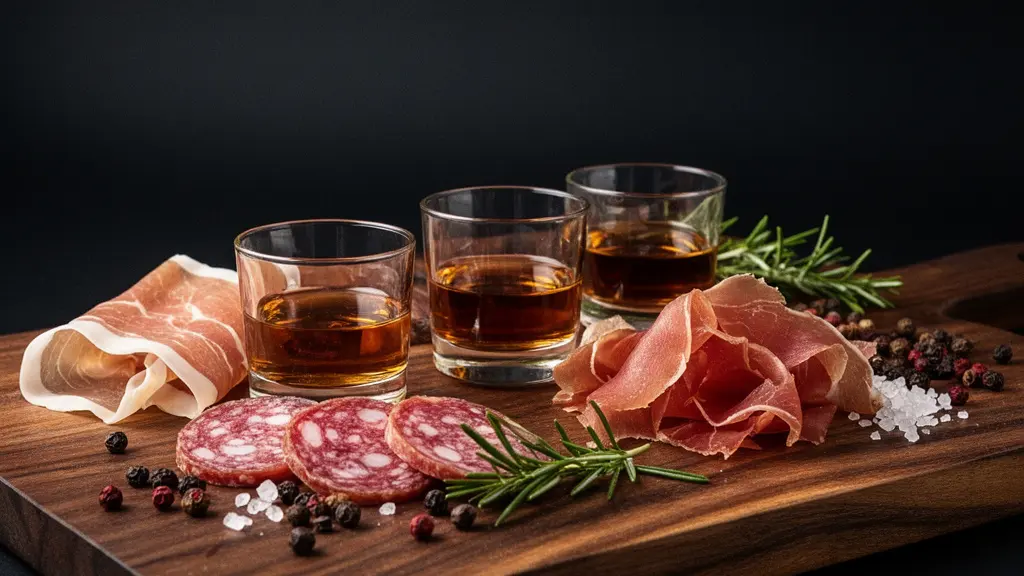
A successful pairing relies not on personal preference, but on the chemical interaction between lipids, ethanol, and salinity.
- High-proof spirits require high-fat meats to prevent palate numbness and release aromatics.
- Salt suppresses bitterness in spirits, enhancing perceived sweetness and fruitiness.
Recommendation: Always bring your charcuterie to room temperature (21°C) before serving to ensure fats are soft enough to emulsify with the spirit immediately upon contact.
The ritual of the aperitivo is often reduced to a simple assembly of “things that taste good together.” We pile prosciutto, salami, and chorizo onto a board, pour a drink, and hope for the best. While wine has held the monopoly on these pairings for centuries, the complexity of cured meats—with their intense salinity, oxidized fats, and fermentation funk—often finds a far more intriguing partner in high-proof spirits. A robust rye or an aged rum can cut through lipids in ways that a delicate Pinot Noir simply cannot.
However, navigating high-ABV pairings is a high-stakes game. The burn of alcohol can obliterate the nuance of a 24-month aged ham, just as the garlic in a saucisson can destroy the finish of a fine cognac. The conventional wisdom of “red with meat” ignores the structural reality of curing. To truly elevate the experience, we must look beyond tradition and understand the molecular mechanics at play: how salt alters our perception of bitterness, how ethanol acts as a solvent for fats, and how temperature dictates texture. It is time to treat the charcuterie board with the precision of a science lab.
This guide breaks down the physics of flavor to transform your next board into a masterclass of sensory balance.
text
Table of Contents: The Science of Savory Pairings
- Why Does Salty Prosciutto Enhance the Sweet Notes in Rye Whiskey?
- How to Slice Salami Paper-Thin to Maximize Surface Area for Pairing?
- Spicy Chorizo or Garlic Saucisson: Which Pairs Better with Dark Rum?
- The Garlic Trap: Why Heavily Seasoned Meats Can Ruin a Delicate Cognac?
- When to Take Charcuterie Out of the Fridge to Release the Fat Flavors?
- The Flavor Clash: Why Salty Spirits Taste Bitter with Red Meat?
- How to Pair High-Rye Whiskey with Charcuterie for Maximum Spice?
- Why Do Saline Notes in Spirits Trigger Hunger and Salivation?
Why Does Salty Prosciutto Enhance the Sweet Notes in Rye Whiskey?
The interplay between salt and sugar is one of the most fundamental principles in culinary science, yet it is rarely applied to spirit pairings. When you pair a slice of Prosciutto di Parma with a glass of spicy rye whiskey, you are not just mixing flavors; you are altering your brain’s perception of the spirit. Rye whiskey naturally carries aggressive, sometimes bitter, herbal notes alongside its caramel undertones. The intense salinity of the cured ham acts as a filter.
To visualize this interaction, consider the texture and composition of the meat itself.
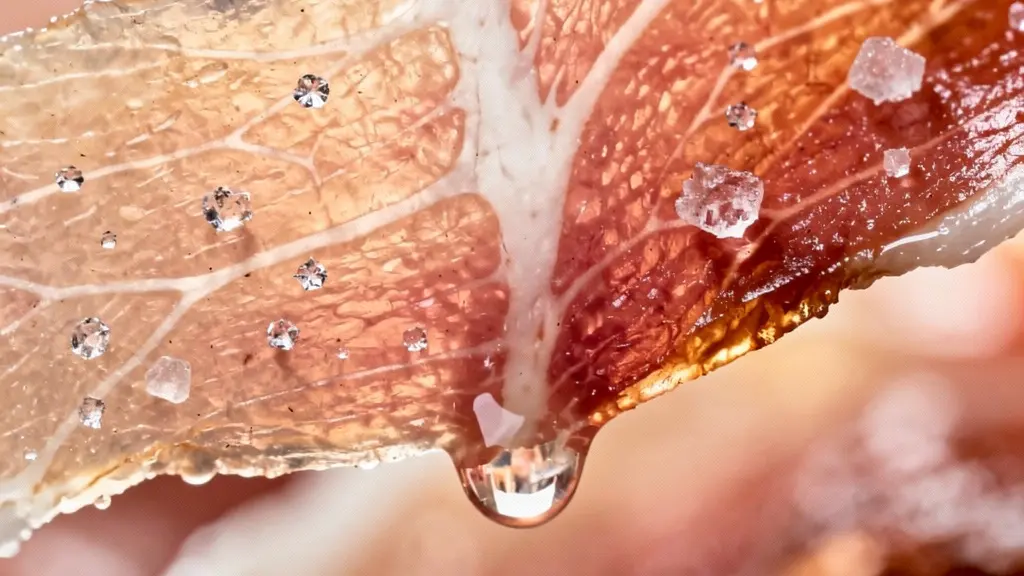
The crystalline structures visible in high-quality cured meats are not just texture; they are chemical tools. When these salt crystals dissolve on the tongue, they selectively suppress the bitter receptors. With the bitterness dialed down, the brain suddenly perceives the rye’s underlying sweetness—vanilla, honeycomb, and fruit—much more intensely. In fact, according to research from Rutgers University on sodium and bitter taste interaction, sodium salts can cause over 70% bitterness suppression in complex mixtures. This turns a potentially harsh spirit into a rounded, sweet companion to the savory meat.
How to Slice Salami Paper-Thin to Maximize Surface Area for Pairing?
As a salumiere, the most common error I witness is the “chunk” approach. Slicing salami into thick discs is a disservice to both the meat and the spirit. The goal of pairing is immediate emulsification. A thick piece of meat requires prolonged chewing, during which the spirit may be swallowed long before the fats are released. You want the fat to melt the instant it hits the tongue, creating a coating that protects the palate from the alcohol burn.
This is where the physics of surface area becomes critical. By slicing salami paper-thin—translucent, if possible—you exponentially increase the surface area exposed to oxygen and the warmth of your mouth. This allows the volatile aromatics trapped in the fat to release instantly. Furthermore, ethanol is a solvent. When a sip of spirit meets a thin film of fat, it dissolves flavor compounds that water cannot touch. However, balance is key; as research on alcohol’s dose-dependent sensory effects shows, at low to moderate concentrations, alcohol enhances flavor perception, but excessive ABV without enough fat surface area to buffer it will simply numb the receptors.
Spicy Chorizo or Garlic Saucisson: Which Pairs Better with Dark Rum?
When dealing with heat, such as the pimentón found in Spanish Chorizo, the choice of spirit must be strategic. Alcohol naturally amplifies the sensation of heat (capsaicin burn). Pairing a high-proof, dry spirit with spicy meat can lead to an unpleasant, fire-breathing experience. This is where Dark Rum enters the equation. Its production process, often involving molasses or sugarcane juice, leaves it with perceived—and sometimes actual—residual sweetness.
Sugar is the antidote to heat. It creates a coating on the tongue that mitigates the aggressive prickle of chili peppers. Therefore, spicy Chorizo finds a harmonious partner in Dark Rum. The sweetness of the rum tames the heat, allowing the smoky paprika notes to shine without scorching the palate. Conversely, a garlic-heavy saucisson would clash with the vanilla and caramel notes of the rum, creating a dissonant flavor profile. The science backs this up: as demonstrated in Penn State University research on capsaicin-sweetener interactions, sucrose has a masking effect on pungency that artificial sweeteners simply cannot replicate. Real sugar or perceived sweetness is non-negotiable when heat is involved.
The Garlic Trap: Why Heavily Seasoned Meats Can Ruin a Delicate Cognac?
Cognac is a spirit of finesse, characterized by volatile esters that provide notes of jasmine, iris, and dried apricot. These compounds are fragile. Heavily seasoned cured meats, particularly those laden with garlic, are the arch-nemesis of such complexity. Garlic contains sulfur compounds (specifically allyl methyl sulfide) that are incredibly persistent and cling to the olfactory receptors.
The visual contrast below illustrates this sensory conflict.
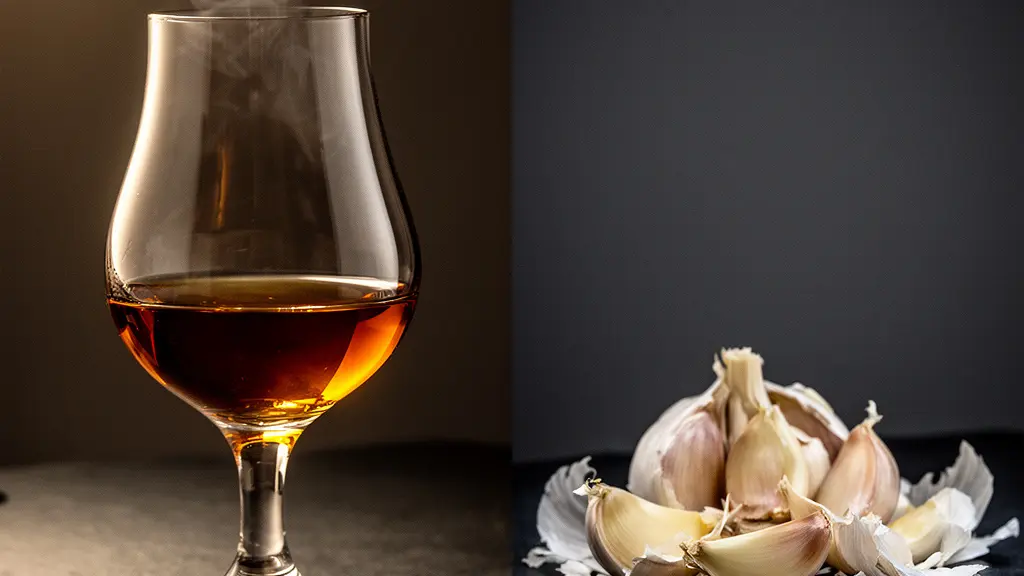
Once the palate is coated in sulfur, the brain struggles to perceive the delicate floral signals of the Cognac. The spirit ends up tasting flat, hot, and one-dimensional, while the garlic flavor seems to mutate into something metallic. This is why lighter, sweeter meats like a Finochiona (fennel salami) or a simple Prosciutto San Daniele are superior choices for brandy and Cognac. They offer fat and salt without the olfactory blockade of sulfur.
When to Take Charcuterie Out of the Fridge to Release the Fat Flavors?
Temperature is the invisible ingredient in charcuterie. Served straight from the fridge (approx. 4°C), pork fat is a waxy solid. In this state, it coats the tongue like candle wax, preventing the spirit from interacting with the taste buds and trapping the meat’s flavor molecules inside a cold lipid matrix. For a pairing to work, the fat must be near its “slip point”—the temperature where it begins to glisten and soften.
To ensure your board is chemically primed for the spirit, follow this thermal staging protocol.
Temperature Optimization Protocol: Charcuterie Preparation
- Timing: Remove meats from refrigeration 30–45 minutes prior to serving to reach ~21°C.
- Visual Cue: Wait for the “sweat” (glistening surface) indicating mobile unsaturated fats.
- Palate Check: Meat should be cool but soft; cold fat creates a barrier against alcohol.
- Thermal Sync: Aim for meat and neat spirits to be within a 4°C range (18–22°C).
- Proof Adjustment: If serving colder meat, use a lower proof spirit to avoid thermal shock.
By allowing the meat to reach room temperature, you facilitate the release of oleic acid and other flavor carriers. When this softened fat meets the alcohol, it creates a creamy emulsion rather than a waxy separation.
The Flavor Clash: Why Salty Spirits Taste Bitter with Red Meat?
We established that salt on meat can suppress bitterness in a spirit. However, the equation changes when the spirit itself is saline—think of a Manzanilla-cask finished whiskey or a coastal Islay scotch. When you pair a highly salty meat (like Bresaola or Cecina) with a saline spirit, you risk crossing the threshold into salt saturation. Instead of suppressing bitterness, an excess of sodium chloride can actually amplify astringency and metallic tastes.
This is particularly true with red meats that have high iron content. The combination of iron, high salt, and the tannins often found in barrel-aged spirits creates a perfect storm on the palate. The salt strips away the protective protein film in the mouth, exposing the delicate tissues directly to the tannins and alcohol. As demonstrated in a study published in the Journal of Agricultural and Food Chemistry, NaCl only reduces activation of specific bitter receptors; when overloaded, the mechanism fails, and the pairing collapses into a harsh, drying sensation.
How to Pair High-Rye Whiskey with Charcuterie for Maximum Spice?
High-rye whiskey is defined by its baking spice notes—cinnamon, nutmeg, and black pepper. To elevate these, you need a partner that resonates with that frequency rather than fighting it. A peppercorn-crusted salami or a coarse country pâté is ideal. But the real secret lies in the “Proof Scaling” method. A standard 40% ABV whiskey might be overwhelmed by a rich, fatty salami, tasting watery. Conversely, a 50%+ ABV Bottled-in-Bond whiskey needs substantial fat to be palatable.
The Proof Scaling Method
The ‘proof scaling’ method, documented by pairing specialists, dictates that higher-proof whiskey requires fattier meat substrates. High-proof rye bourbon demands rich pâté or fatty salami because the dense lipid layer dilutes the alcohol intensity on the palate. This dilution releases the rye’s herbal complexity (dill, mint, caraway) rather than just the heat. Matching Bottled-in-Bond whiskeys with coppa or lardo creates the optimal conditions for resonance pairing.
This interaction is captured in the moment of consumption.
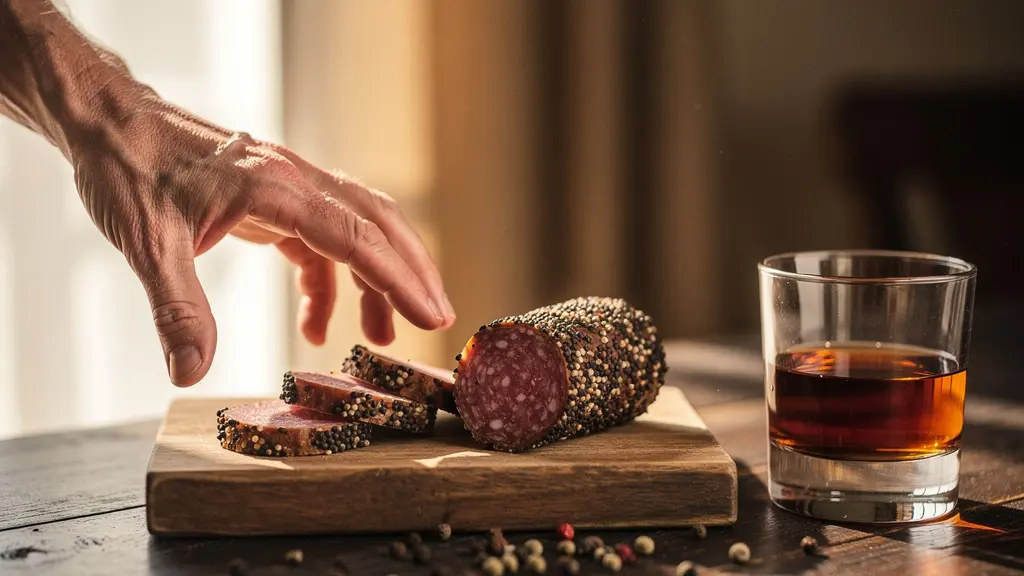
The fat from the meat coats the tongue, protecting it from the alcohol burn, while the ethanol cuts through the grease, cleansing the palate. This back-and-forth reset allows you to taste the spice in both elements with every bite.
Key Takeaways
- Salt suppresses bitterness, making spirits taste sweeter.
- Slice meats translucent to maximize flavor release.
- Match high-proof spirits with high-fat cuts (Proof Scaling).
Why Do Saline Notes in Spirits Trigger Hunger and Salivation?
The best aperitivo pairings do not just taste good; they physically prepare your body for the meal to come. Spirits with faint saline notes—common in island whiskies or gins using coastal botanicals—trigger a biological reflex. Salt signals the presence of electrolytes and nutrients, which the digestive system interprets as “food is incoming.” This stimulates the salivary glands.
Saliva is the unsung hero of tasting. It is the medium in which flavor compounds dissolve and reach our receptors. Without adequate salivation, dry spirits and dry cured meats would form a paste in the mouth. A saline spirit promotes a juicy, mouth-watering sensation that makes the dry-cured meat feel richer and more succulent. Furthermore, according to a 2025 comprehensive review on mouthfeel physiology, saliva plays an essential role in maintaining the protective protein film in the mouth, ensuring comfort even with high-ABV drinks.
Frequently Asked Questions about Pairing Cured Meats with Spirits
Why does a sip of saline-noted spirit make you want to eat more charcuterie?
Saline notes in spirits simulate electrolyte intake, signaling the digestive system to prepare for food processing. This triggers increased saliva production, which is essential for dissolving and transporting taste compounds to receptors. The result is a heightened state of gustatory readiness that makes subsequent bites of cured meat taste more intense.
How do saline spirits act as a palate cleanser between bites of rich charcuterie?
Salinity in spirits like Manzanilla-cask finishes or coastal gins disrupts the lipid film that fat from cured meats deposits on oral surfaces. Research shows that this disruption restores sensitivity to salt and umami within seconds, making each subsequent bite feel fresh rather than heavy.
What is the umami synergy between saline spirits and cured meats?
Trace minerals (salinity) in the spirit interact with the free glutamates naturally present in aged cured meats. Sodium is known to potentiate flavor by suppressing bitterness while enhancing desirable sweet and umami tastes, creating a savory feedback loop that compels continued eating and drinking.
Experiment with your next board by systematically varying the fat content of your meats against the proof of your spirits to find your perfect equilibrium.