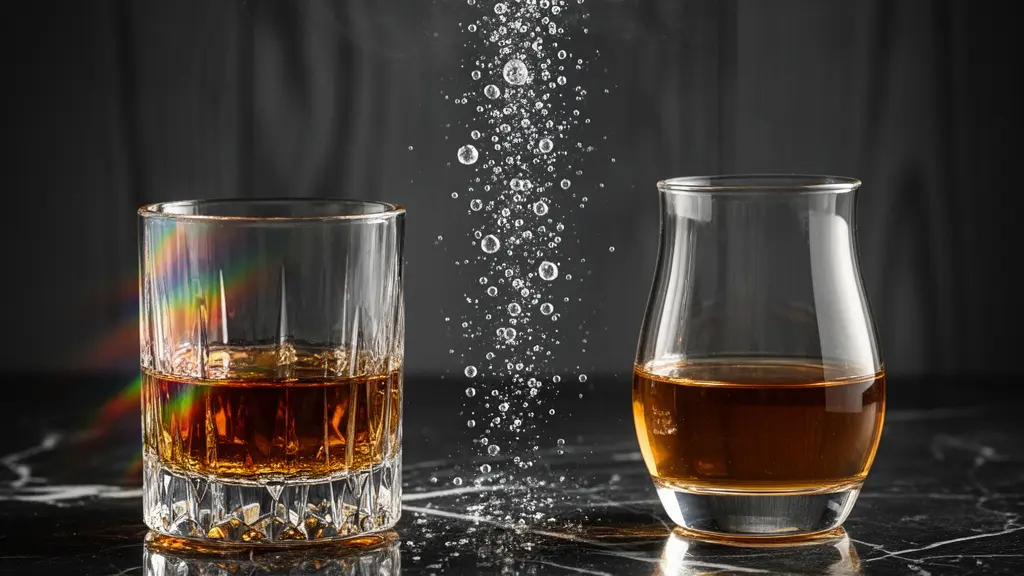
Contrary to popular belief, the superiority of lead crystal is not just about tradition or sparkle; it’s a matter of micro-physics that measurably alters the spirit’s aroma profile.
- The rough surface of crystal increases volatilization, releasing more aromatic compounds than smooth borosilicate.
- The weight of crystal triggers a psychological bias, making us perceive the same liquid as higher quality.
Recommendation: Choose lead-free crystal for enhanced aeration and haptic satisfaction, but use borosilicate or standard glass for long-term storage and daily use to avoid lead exposure.
For any serious spirits collector, the question of glassware is a constant, lingering debate. You hold a heavy, intricately cut crystal tumbler in one hand and a sleek, modern borosilicate glass in the other. The received wisdom whispers that the crystal is unequivocally “better,” a vessel worthy of the finest single malt. But is this superiority a tangible reality, or just a romantic notion passed down through generations? Most discussions focus on aesthetics—the dazzling “fire” of crystal versus the clinical clarity of lab glass—or devolve into a simple debate over the shape of the bowl.
These conversations, however, miss the most fascinating part of the story. The truth isn’t just in the shape or the sparkle; it’s etched into the very material at a microscopic level. What if the key to unlocking a spirit’s full bouquet wasn’t about tradition, but about the measurable physics of surface tension, fluid dynamics, and even the psychology of weight? As a glassblower and sensory scientist, I can tell you that the material itself is an active participant in the tasting experience, not a passive container.
This is where our analysis begins. We will move beyond the surface-level arguments and delve into the science. We’ll explore how the microscopic landscape of crystal interacts with a spirit, why the heft of a glass can trick your brain into perceiving better taste, and what the precise thickness of a rim means for the delivery of liquid to your palate. By the end, you won’t just have a preference; you’ll have a profound understanding of why your choice of glass truly matters.
This guide breaks down the essential factors—from the science of aeration to the psychology of perception—that determine how a glass material can enhance or alter your tasting experience. Explore the topics that matter most to you.
Summary: The Definitive Material Showdown for Spirit Connoisseurs
- Why Does the Rough Surface of Crystal Help Aerate the Spirit?
- How to Wash Lead Crystal Without Leaving Soap Residue or Water Spots?
- Weight or Thinness: Which Enhances the Psychological Perception of Quality?
- The Lead Danger: Is It Safe to Store Spirits in Crystal Decanters Long-Term?
- How Thin Should the Rim Be to Direct Liquid to the Right Part of the Tongue?
- Why Does Whisky Taste Better in a Heavy Crystal Glass?
- Standard ISO or Riesling Glass: Which Gives a Better Bouquet?
- How to Create a Sensory Sanctuary for Distraction-Free Sipping?
Why Does the Rough Surface of Crystal Help Aerate the Spirit?
The primary advantage of lead crystal over borosilicate or standard soda-lime glass lies in its invisible micro-topography. While borosilicate glass is prized for its perfectly smooth, non-porous surface, lead crystal is, at a microscopic level, a jagged landscape of peaks and valleys. This isn’t a flaw; it’s a feature. When you swirl a spirit in a crystal glass, this textured surface creates more agitation and friction against the liquid than a smooth one.
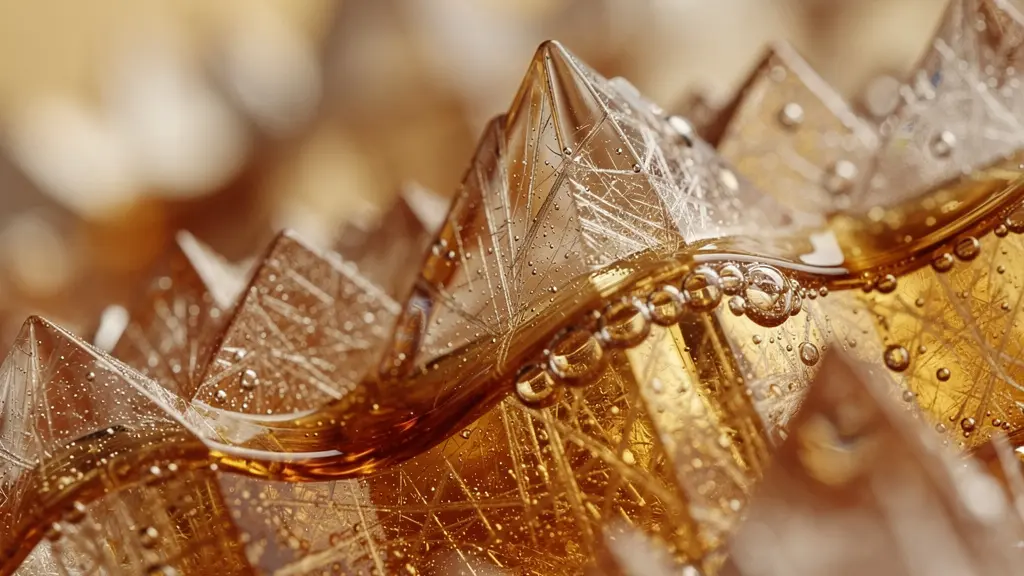
This increased friction directly impacts the volatilization rate of the spirit’s aromatic compounds. The rough surface effectively increases the liquid’s surface area that is in contact with the air. In fact, studies on specialized whisky glasses have shown that engineered textures can lead to a 15-30% increase in effective surface contact, allowing more ethanol and congeners to evaporate and reach your nose. This is why a spirit can seem more “open” and expressive in a crystal glass. Furthermore, lead crystal possesses a higher refractive index than borosilicate. According to Glass Materials Research, this property creates more spectral dispersion, or ‘fire,’ which splits light into its component colors, making the whisky appear richer and deeper in hue, adding a powerful visual component to the nosing experience.
This physical aeration is the core scientific reason, beyond aesthetics, that crystal has been the preferred material for connoisseurs for centuries.
How to Wash Lead Crystal Without Leaving Soap Residue or Water Spots?
Properly caring for lead crystal is a delicate balance between cleanliness and preservation. The porous, textured nature that makes it great for aeration also makes it prone to holding onto residues and susceptible to damage. The cardinal rule is to never use a dishwasher. The high heat and harsh detergents are disastrous for lead crystal. They can cause microscopic cracks (crazing), permanently cloud the glass, and accelerate the erosion of the surface.
This isn’t just an aesthetic concern. As a case study from the FDA highlights, this surface erosion can increase the potential for lead to leach into beverages in subsequent uses. The agency specifically warned against dishwasher use for lead crystal and even advised that it not be used for daily consumption, particularly for women of childbearing age, due to these risks.
The correct method is gentle and manual. Use lukewarm water—never hot or cold extremes, which can cause thermal shock and cracking. Use a very small amount of mild, fragrance-free dish soap or, better yet, no soap at all if you’re just rinsing after use. Wash one piece at a time in a plastic basin or a sink lined with a towel to prevent chips. Use a soft sponge or a non-abrasive bottle brush for cleaning. To prevent water spots, the drying process is as important as the washing. Instead of air-drying, which leaves mineral deposits, immediately dry the glass with a lint-free microfiber or linen cloth. This ensures a brilliant, spot-free shine without leaving any fibrous residue behind.
This careful maintenance preserves not only the beauty and clarity of your glassware but also its safety and functional longevity.
Weight or Thinness: Which Enhances the Psychological Perception of Quality?
The debate between weight and thinness in glassware is fascinating because the ideal is, paradoxically, both. The answer lies in understanding haptic psychology—the study of how touch and physical sensation influence our judgments and perceptions. When it comes to luxury goods, weight is a powerful subconscious cue for quality, substance, and value. Lead is a dense element, which is why lead crystal glasses are often 2-3x heavier than borosilicate counterparts of the same size. This substantial heft in the hand triggers an expectation bias; our brain concludes that a heavy glass must contain a more premium, complex spirit.
However, this is only half of the equation. While the base and body of the glass should feel substantial, the rim must be as thin as possible. A thin rim provides a more direct and uninterrupted connection between the liquid and the palate. It feels delicate, precise, and luxurious, removing any physical barrier to the tasting experience. The ultimate expression of luxury in glassware is the ability to combine these two opposing qualities. As Jordan Zimmerman, a lead at Brown-Forman Corporation, notes about a premium brand:
There’s something so mind-boggling and worship-worthy about Baccarat’s ability to craft paper-thin crystal edges on a glass that still retains heft
– Jordan Zimmerman, Premium Whiskey Education & Advocacy Lead at Brown-Forman Corporation
Therefore, it’s not a choice between weight or thinness; it’s the masterful combination of a heavy base and a fine, thin rim that creates the most powerful psychological perception of quality. Borosilicate can achieve thinness, but it can never replicate the satisfying density and heft that is inherent to lead crystal.
This duality is what separates merely functional glassware from a true luxury tasting instrument.
The Lead Danger: Is It Safe to Store Spirits in Crystal Decanters Long-Term?
The answer to this is an unequivocal and emphatic no. While using a lead crystal glass for the 20-30 minutes it takes to enjoy a drink poses a minimal, generally accepted risk, long-term storage in a lead crystal decanter is a significant health hazard. The danger lies in a process called leaching, where the lead oxide in the crystal slowly dissolves into the alcoholic and acidic solution it’s holding. The amount of lead that migrates into the spirit is a function of time and the spirit’s proof.
The numbers are alarming. A pivotal study from Columbia University provides a stark warning. Scientists reported that lead began migrating into wine within minutes of being poured into a crystal glass. The results for long-term storage were even more dramatic: in one decanter, the lead content of port wine skyrocketed from 89 micrograms per liter (μg/L) to 5,331 μg/L over four months. Some brandies stored in lead crystal for over five years were found to contain lead levels around 20,000 μg/L. For context, the U.S. Environmental Protection Agency’s action level for lead in drinking water is 15 μg/L. Other research corroborates these findings, showing lead levels in port wine stored in crystal decanters can reach 2,000-5,000 μg/L after just a few months.
Case Study: Columbia University’s Lead Migration Findings
The landmark study by Columbia University’s scientists provided undeniable evidence of rapid lead migration. They found that white wine doubled its lead content within an hour of being stored in a lead crystal vessel and tripled it within four hours. The most extreme cases, involving brandy stored for over five years, showed lead levels that were over 1,300 times higher than the EPA’s action level for drinking water, demonstrating that the longer a spirit is stored, the more dangerous it becomes.
For collectors, the takeaway is clear: lead crystal decanters are for presentation, not preservation. Use them to serve a spirit on the day of an event, but never for storing it for weeks, months, or years. For long-term storage, always use the original bottle or a decanter made from lead-free crystal or borosilicate glass.
The beauty of a crystal decanter should never come at the cost of your health.
How Thin Should the Rim Be to Direct Liquid to the Right Part of the Tongue?
The thickness of a glass rim is one of the most underrated yet critical elements in glassware design, directly influencing the fluid dynamics of the tasting experience. The goal is to create a smooth, undisrupted delivery of the liquid onto the palate. A thick, rolled rim (often found on inexpensive, durable glassware) creates turbulence. As the liquid flows over it, it tumbles, creating a larger, less controlled bolus that floods the mouth, often hitting the back of the tongue and triggering an immediate, harsh perception of alcohol.
A thin, laser-cut rim, by contrast, acts like a precision instrument. According to principles of fluid dynamics, a rim thickness of less than 1mm creates laminar flow. This is a smooth, sheet-like flow of liquid that minimizes turbulence. This controlled stream allows the taster to direct the spirit precisely to the tip and front of the tongue, where the taste buds are most sensitive to sweetness. This initial perception of sweetness can help balance the spirit’s other characteristics, creating a rounder, more pleasant first impression.
The table below, based on established fluid dynamic principles, illustrates how rim thickness directly impacts the way a spirit is delivered to your palate.
| Rim Thickness | Flow Type | Droplet Size | Tongue Target |
|---|---|---|---|
| <1mm (Crystal) | Laminar | Small, high-velocity | Anterior (tip) |
| 1-2mm (Standard) | Transitional | Medium | Mid-palate |
| >2mm (Thick) | Turbulent | Large bolus | Posterior |
Lead crystal, due to its composition, can be cut to an exceptionally fine and precise edge while retaining strength, making it the ideal material for achieving this sub-1mm standard. While high-quality borosilicate can also be made thin, it often lacks the structural integrity at the rim that crystal provides, making crystal the superior choice for this specific design feature.
Ultimately, the perfect rim is one you barely notice, allowing for a seamless transition from glass to palate.
Why Does Whisky Taste Better in a Heavy Crystal Glass?
This phenomenon is a brilliant demonstration of sensory transference, where our perception of one sense (touch) profoundly influences another (taste). The whisky doesn’t chemically change, but our *experience* of it does. The primary driver is the expectation bias we discussed earlier. The satisfying heft of a lead crystal glass acts as a powerful placebo.
Case Study: The Power of Expectation Bias
Numerous blind taste tests have explored this effect. In a typical setup, subjects are given the exact same whisky in two different glasses: one a lightweight, standard glass and the other a heavy, impressive-looking crystal glass. Despite gas chromatography confirming the liquids are identical, subjects consistently report the whisky from the heavy glass as being “richer,” “smoother,” and “more complex.” This demonstrates that our brains use the haptic feedback—the weight and feel of the glass—to construct an expectation of quality, and our sense of taste then conforms to that expectation.
Beyond weight, other sensory cues from crystal contribute to this effect. The visual aspect is powerful; the high refractive index of lead crystal makes the spirit sparkle, giving it an appearance of vibrancy and life. There is also an auditory component. As a 1958 study on the material noted, lead crystal produces a distinct, resonant ringing sound when tapped. Emil Deeg, a researcher at the time, observed that this clear bell-like note was a mark of high-quality crystal. While seemingly minor, this “ping” adds to the multi-sensory ritual and reinforces the perception of a premium experience.
In essence, a heavy crystal glass doesn’t make the whisky better; it makes *you perceive* the whisky as better. It primes your brain for a luxury experience, and your palate follows suit. Borosilicate, being light and functional, simply cannot provide these powerful, subconscious haptic and auditory cues.
It’s a fascinating trick of the mind, where the vessel becomes inseparable from the value of its contents.
Standard ISO or Riesling Glass: Which Gives a Better Bouquet?
This question moves us from material to form, but material still plays a subtle role. The ISO (International Standards Organization) tasting glass is the scientific standard: a tulip-shaped bowl designed to concentrate aromas for analytical nosing. The Riesling glass, with its taller bowl and slightly wider aperture, is designed for a specific wine varietal but is often co-opted by spirits enthusiasts for its similar aroma-focusing properties.
The primary difference is in the concentration versus expression of aromas. The ISO glass is an analytical tool; its narrower opening funnels volatile compounds directly and intensely into the nose. This is excellent for detecting flaws but can sometimes be overpowering, especially with high-proof or heavily peated spirits. The Riesling glass, with its slightly larger volume and opening, allows the bouquet to develop more, creating a more “expressive” and arguably more pleasant nosing experience for casual appreciation. It gives the aromas more room to breathe and integrate.
Material comes back into play when considering temperature. A common misconception is that crystal’s density helps maintain a spirit’s temperature. However, data on thermal conductivity measurements show that lead crystal (around 1.0 W/m·K) and borosilicate (1.1 W/m·K) have very similar properties in this regard. Neither is a particularly good insulator. The real factor is the heat from your hand. Here, a stemmed glass, like a Riesling glass, offers a clear advantage over a stemless tumbler (like a Glencairn, as mentioned by World Whisky Day experts) by keeping your body heat away from the spirit, ensuring its temperature remains stable during the tasting.
For a collector aiming for pure analytical tasting, the ISO glass is indispensable. For enjoying the full, evolving bouquet of a complex spirit, a high-quality Riesling glass often provides a more rewarding and comprehensive sensory journey.
Ultimately, the best choice is the one that best serves your purpose: rigorous analysis or pure aromatic enjoyment.
Key Takeaways
- The microscopic roughness of lead crystal is not a flaw but a feature that increases aeration and aroma release.
- The significant weight of crystal is a powerful psychological trigger that makes us perceive the same spirit as being of higher quality.
- Long-term storage of any spirit in a lead crystal decanter is a proven health hazard due to lead leaching.
How to Create a Sensory Sanctuary for Distraction-Free Sipping?
Investing in exquisite glassware is only one part of the equation. To truly honor a great spirit and a great glass, you must create an environment that eliminates distractions and focuses your senses. This is the concept of a “sensory sanctuary”—a space and a ritual dedicated to the act of tasting. It’s about controlling variables so that the only things you are analyzing are the spirit and its interaction with the glass.

First, control the olfactory environment. Avoid scented candles, air fresheners, cooking smells, or strong perfumes. The room should be as neutral as possible. Second, control the visual environment. Use a neutral background, like a white wall or tablecloth, to accurately assess the spirit’s color. Soft, natural light is ideal. As one whiskey expert advises, the ritual itself is key: “I favor glasses with heft, usually from a thick base that clunks pleasingly when I set it down. And I like glasses with room for swirling.” This highlights the importance of choosing a glass that not only performs well but also feels right and contributes to a mindful process.
The final element is mental preparation. Come to the tasting with focus. Put your phone away. Take a moment to quiet your mind. This allows you to be fully present and detect the subtle nuances that a distracted palate would miss. Creating this sanctuary elevates a simple drink into a meditative and deeply engaging experience, doing justice to the craftsmanship in both the spirit and the glass.
Your 5-Step Glassware Sensory Audit
- Points of Contact: List every glass you use for spirits. Include daily tumblers, special occasion crystal, and tasting glasses. Note their material (glass, crystal, borosilicate).
- Collect & Assess: Gather the glasses. Run your finger over the rim. Is it thick and rolled, or thin and cut? Assess the weight in your hand. Does it feel substantial or flimsy?
- Coherence Check: Compare the physical attributes to your collection’s value. Are you serving a $200 whisky in a $2 tumbler? Does the quality of the vessel match the quality of the spirit?
- Sensory Impact Grid: For each glass, rate its visual appeal (sparkle, clarity), haptic feel (weight, texture), and auditory signature (the ‘ping’). Identify which glasses provide a superior multi-sensory experience versus those that are purely functional.
- Integration Plan: Based on your audit, decide your path. Replace low-quality daily glasses, designate your fine crystal for special tastings, and acquire a proper set of lead-free analytical glasses for dedicated nosing.
Now that you have the knowledge to select the right material and create the perfect environment, the next step is to apply this understanding critically to your own collection and tasting rituals.