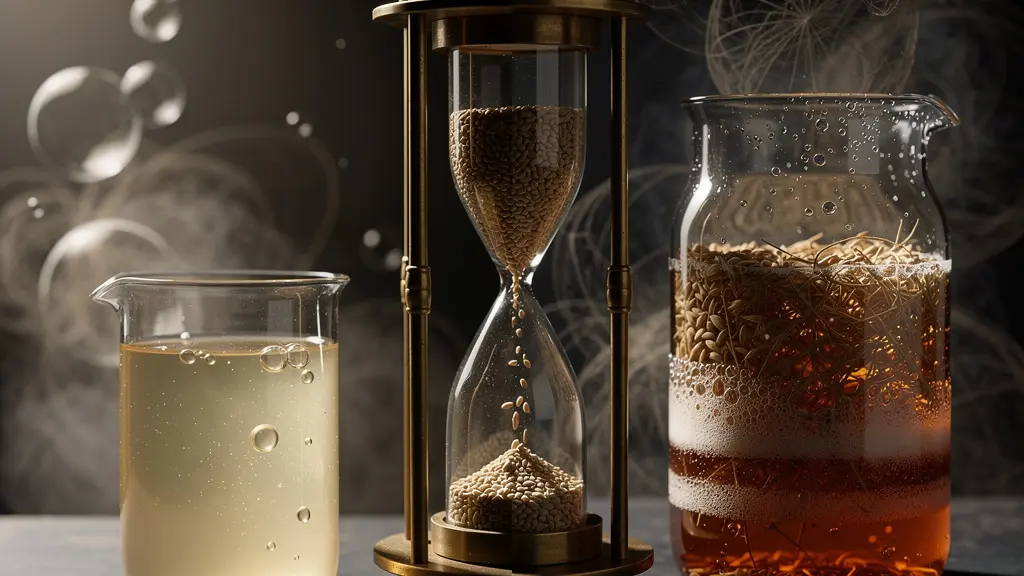
The secret to a spirit’s complex flavor isn’t just time, but the controlled microbial war that unfolds after the primary yeast has finished its job.
- After 48-72 hours, as alcohol levels rise and sugars deplete, pitched yeast growth slows, allowing secondary microbes (wild yeast, bacteria) to begin their work.
- These secondary microbes produce complex organic acids, which then react with alcohol to form the fruity, floral esters that define many aged spirits.
Recommendation: When tasting, think of your spirit not just as a product of distillation, but as the final chapter of a complex biological story written during fermentation.
For any craft beer enthusiast transitioning to the world of spirits, the term “fermentation” feels like familiar ground. You understand that yeast converts sugar into alcohol and CO2. But in distilling, this is merely the opening act. The real magic—or, from a microbiologist’s perspective, the predictable biological cascade—happens when we ask a simple question: what if we just let it sit for another 48 hours? Many distillers will tell you longer ferments create more “flavor,” but this simplification misses the fascinating drama unfolding in the washback. It’s a world beyond simple alcohol production, involving a sequential takeover by different microorganisms.
This isn’t just about giving the yeast more time. It’s about creating an environment where a whole new cast of characters can take the stage. We move from a yeast-dominated monologue to a complex play involving wild yeasts and specific bacteria. These microscopic artisans aren’t creating alcohol; they are building the very flavor precursors—the complex acids and aromatic compounds—that will be transformed into a symphony of flavor during distillation and maturation. The difference between a 72-hour and a 120-hour ferment is the difference between a simple melody and a full-blown orchestra.
This article will deconstruct that microbial succession. We will explore why long fermentations generate stone fruit aromas, how to manage the delicate balance between desired esters and off-flavors, and how this initial stage of flavor creation is intrinsically linked to the final cleanup job performed by copper in the still. Get ready to look at your wash not as a simple sugar beer, but as a living, evolving ecosystem you can guide to create unparalleled depth and complexity.
To fully grasp how these extra hours sculpt the final spirit, this guide breaks down the critical stages and decisions in the fermentation process. The following sections explore each aspect of this microbial journey, from initial ester creation to the final role of the still.
Summary: How Fermentation Dictates a Spirit’s Final Flavor Profile
- Why Long Fermentation Creates More Stone Fruit Aromas than Short?
- When to Stop Fermentation to Maximize Fruity Esters Over Alcohol?
- Light Esters or Heavy Congeners: Which Do You Need for Aging?
- Why Wild Yeast Fermentation Creates Unpredictable but Unique Aromas?
- The Bacterial Infection That Can Ruin a Batch Before Distillation Begins
- How to Control Wash Temperature to Prevent Off-Flavors in Summer?
- Why Your Spirit Tastes like Rubber: The Critical Role of Copper Catalysis?
- How Does Copper Contact During Distillation Remove Sulfurs and Refine Flavor?
Why Long Fermentation Creates More Stone Fruit Aromas than Short?
The conventional wisdom is simple: a short fermentation (48-72 hours) is a race to produce alcohol. The pitched yeast, typically a robust strain of *Saccharomyces cerevisiae*, dominates the wash, rapidly consuming simple sugars. But once this initial frenzy subsides, a critical shift occurs. This is where the extended timeline becomes a distiller’s greatest tool for crafting complexity. In this second act, the wash becomes a different environment; the pH has dropped, and the alcohol level is stressful for the primary yeast.
This new, more acidic environment is the perfect stage for the next wave of microbes. As the Journal of the Institute of Brewing research shows, most key flavor components are synthesized in the latter phase of fermentation, with lactic acid bacteria often becoming dominant. These bacteria are not focused on creating ethanol. Instead, they produce a range of complex organic acids. This is the foundation of the “esterification engine.”
Case Study: Cotswolds Distillery’s 90-Hour Fermentation
A prime example of this philosophy is Cotswolds Distillery, which employs a 90-hour fermentation. For the first 48 hours, their yeast works to produce alcohol, reaching about 8% ABV. After that point, the alcohol production effectively ceases. However, for the next 42 hours, the wash becomes progressively more acidic. This buildup of acid then reacts with the newly formed alcohol to create the esters responsible for their signature ripe tropical fruit and stone fruit flavors.
These organic acids, combined with the alcohols already present, begin to form esters—the chemical compounds responsible for a vast array of fruity and floral aromas. Think of it as a two-step chemical reaction happening right in the wash. A short ferment primarily completes step one (alcohol production). A long ferment allows for the crucial step two (acid production and subsequent esterification), which unlocks notes of apricot, peach, and cherry. It’s not just more time; it’s a fundamentally different chemical process.
When to Stop Fermentation to Maximize Fruity Esters Over Alcohol?
Deciding when to end fermentation is one of the most critical decisions a distiller makes, representing a clear trade-off between yield and complexity. A fermentation is technically “done” when all fermentable sugars have been converted to alcohol, which typically happens within 48 to 96 hours. At this point, the distiller’s beer, or wash, contains its maximum alcohol content, usually around 7-10% ABV. Pumping the wash to the still at this moment maximizes ethanol yield for distillation.
However, as we’ve seen, stopping here means sacrificing the secondary flavor development phase. To maximize fruity esters, distillers must intentionally push past the point of peak alcohol. According to an analysis from Whisky Monkeys, fermentation can range from 50 to over 120 hours, with distilleries like Glen Scotia deliberately fermenting for extended periods specifically to enhance their fruity character. This extended period is when the wash’s pH drops and the esterification engine kicks into high gear.
The decision, therefore, is not based on a hydrometer reading showing sugar depletion, but on a sensory and stylistic target. As the Whisky Advocate Editorial Team notes, the process is highly variable:
The process can take anywhere from 48 to 96 hours, with different fermentation times and yeast strains resulting in a spectrum of diverse flavors. The resulting beer-like liquid—called distiller’s beer or wash—clocks in at around 7%-10% ABV.
– Whisky Advocate Editorial Team, How Whisky Is Made
A distiller aiming for a light, clean vodka or a neutral grain spirit might stop fermentation as soon as the yeast is done. Conversely, a rum or whisky producer seeking a bold, estery profile will see the end of alcohol production as merely the halfway point. The “right” time to stop is when the desired balance of alcohol for yield and acid-driven esters for flavor has been achieved for the target spirit style.
Light Esters or Heavy Congeners: Which Do You Need for Aging?
The term “congeners” often carries a negative connotation, associated with hangovers. But for a distiller, congeners are everything. They are the vast family of non-ethanol chemical compounds produced during fermentation, including esters, fusel oils (higher alcohols), and acids. These compounds are the fundamental building blocks of a spirit’s character. The choice a distiller makes during fermentation is not whether to create congeners, but *which types* of congeners to create.
This choice is dictated by the intended destiny of the spirit. For spirits intended for minimal or no aging, like vodka, gin, or some white rums, the goal is often a profile rich in light, volatile esters. These compounds provide immediate fruity and floral notes (think banana, pear, rose). They are created through specific yeast strains and shorter, cooler fermentations that favor clean alcohol production with a delicate aromatic lift.
For spirits destined for long-term maturation in oak, such as whisky, brandy, or aged rum, the goal is different. Here, the distiller seeks to create a wash rich in heavy congeners, including higher alcohols and complex acids. While less pleasant on their own, these compounds are the essential precursors for the flavors that develop during aging. Over years in a barrel, these heavy congeners interact with oxygen, wood compounds, and each other, transforming into the deep, rich notes of dried fruit, leather, tobacco, and spice. As the research team at MDPI Applied Sciences highlights, esters are the star players from a sensory viewpoint.
Although higher alcohols account for the majority of congeners present, the esters are the most influential congener group formed during fermentation from a flavour perspective.
– MDPI Applied Sciences Research Team, Yeast Fermentation for Production of Neutral Distilled Spirits
Therefore, a long, warm, and often multi-microbe fermentation is employed to build a deep reservoir of these heavy congeners. This creates a more “robust” new-make spirit that can stand up to and evolve with years of barrel aging. The choice is strategic: create for today’s palate or build for the palate of a decade from now.
Why Wild Yeast Fermentation Creates Unpredictable but Unique Aromas?
While most modern distilling relies on carefully selected, commercially grown yeast strains for consistency, some distillers embrace the chaos of the wild. Wild yeast fermentation involves allowing naturally present, airborne yeast to inoculate the wash. This is a deliberate step into the unknown, as the specific cocktail of microbes can vary from batch to batch and season to season. While unpredictable, it is a powerful way to create a spirit with a true sense of terroir—a flavor profile utterly unique to the distillery’s specific environment.
The complexity arises from the sheer biodiversity of wild yeasts. While brewers and distillers typically use a few strains of *Saccharomyces*, recent research from FEMS Yeast Research reveals that there are over 1,500 yeast species currently recognized, and this is just the tip of the iceberg. Each of these strains has a different metabolic pathway, producing a unique signature of esters, phenols, and other aromatic compounds. A wild ferment isn’t a monoculture; it’s a bustling ecosystem where different yeasts compete and contribute, creating layers of flavor that a single strain could never achieve.
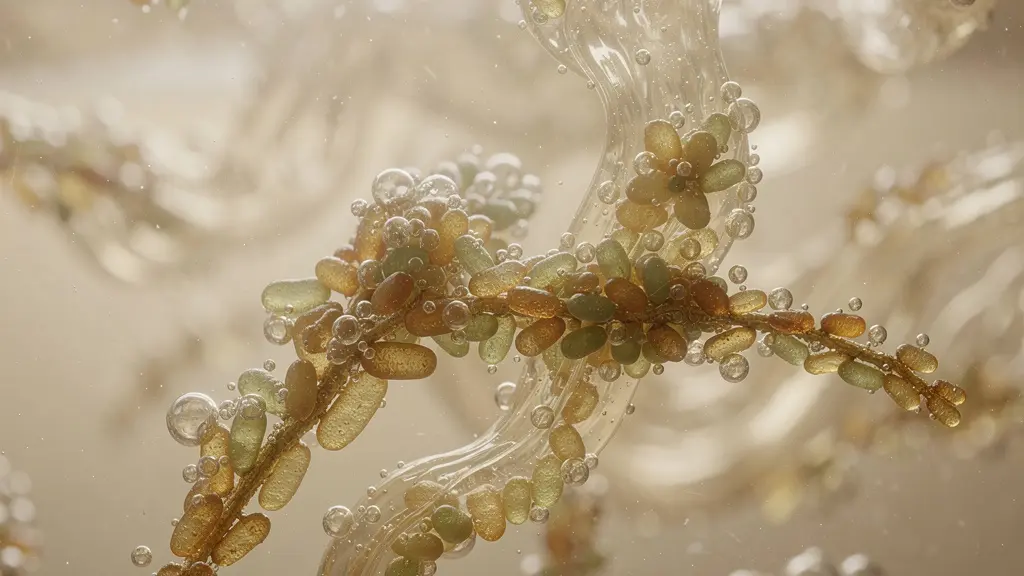
This microscopic view showcases the morphological diversity of wild yeasts. Unlike the uniform cells of a pure lab strain, a wild culture contains a variety of shapes and sizes, each contributing its own unique aromatic signature to the final spirit. Some may produce spicy, phenolic notes (like Belgian beer yeasts), while others create funky, earthy, or intensely fruity aromas.
Case Study: Leopold Brothers’ Living Distillery
In Denver, Leopold Brothers takes this concept to the extreme. They actively cultivate flowering plants along their distillery walls to encourage a healthy local yeast population. For their whiskey, they use a traditional 72-hour fermentation with pitched yeast, but then allow an additional 48 hours for the local wild yeasts to take over. This “microbial succession” adds a profound depth and complexity, creating a profile with savory and estery notes reminiscent of high-ester Jamaican rum production, all tied to their specific location.
The Bacterial Infection That Can Ruin a Batch Before Distillation Begins
In the sanitized world of brewing, a bacterial infection is a catastrophe. In distilling, however, it’s a matter of control and perspective. While a runaway infection can certainly ruin a batch by producing overwhelming sourness or other off-flavors, a controlled bacterial presence is the secret behind some of the world’s most complex spirits. The key is understanding which bacteria you want and when you want them.
Unwanted bacteria, often from insufficiently cleaned equipment or contaminated grains, can compete with yeast for sugars, lowering alcohol yield and producing undesirable compounds. However, the most interesting bacteria are those that become active *after* the primary yeast has done its work. During long fermentations, as the pH drops, certain acid-tolerant bacteria like Lactobacillus and Acetobacter can thrive. Far from being a problem, these are the microbes that fuel the “esterification engine.”
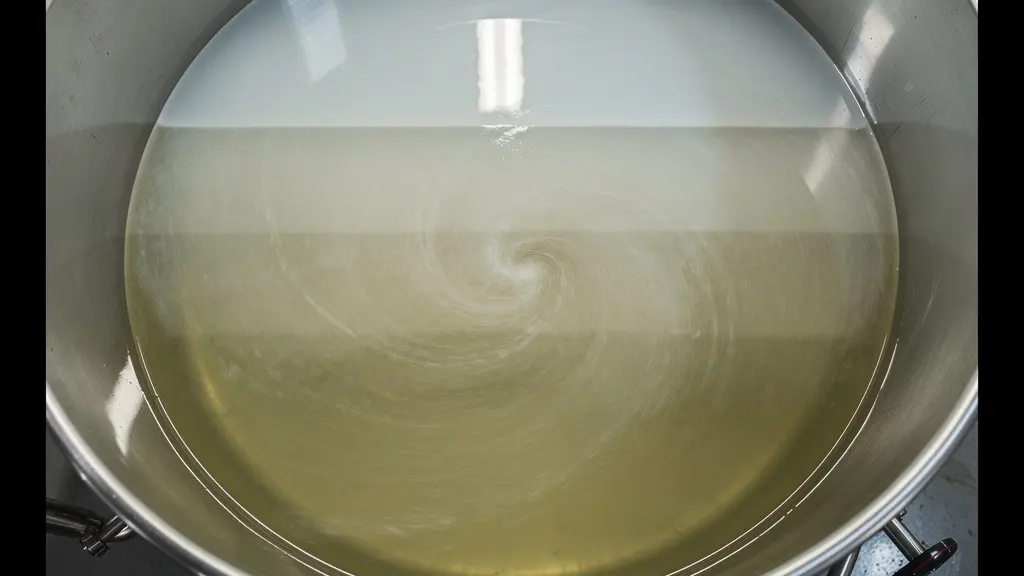
As this visualization of a fermentation vessel suggests, microbial activity is not uniform. After the initial yeast-driven turmoil, stratification can occur, creating different zones where specific microbial populations, including bacteria, can flourish. These bacteria are responsible for producing lactic acid and acetic acid. While unpleasant on their own, these acids are the crucial building blocks for flavor. Indeed, research from Spirits & Distilling demonstrates that complex organic acids produced by these bacteria can be catalyzed into highly desirable fruity and savory esters during distillation and aging.
This is the principle behind Jamaican high-ester rums, which use “muck pits” to cultivate bacterial cultures, or the sour mash process in American whiskey, where a portion of the acidic, bacteria-rich spent mash is added to the next ferment. It’s a tightrope walk. The distiller’s job is not to create a sterile environment, but to manage a healthy ecosystem where beneficial bacteria can contribute complexity without overwhelming the wash. It’s not an infection; it’s a controlled microbial succession.
How to Control Wash Temperature to Prevent Off-Flavors in Summer?
Temperature is the single most important variable a distiller can control during fermentation. Yeast is a living organism with an optimal temperature range for performance. According to technical specifications from Britannica’s distilling experts, this range is typically between 24-29°C (75-85°F). Within this window, yeast works efficiently to produce alcohol. However, fermentation is an exothermic process—it generates its own heat. During summer months, high ambient temperatures combined with the heat from fermentation can quickly push the wash above this optimal range.
When the temperature gets too high, the yeast becomes stressed. A stressed yeast cell produces more than just ethanol; it starts to generate unwanted compounds, particularly fusel oils and sulfurous notes. These can manifest as harsh, solvent-like, or rubbery off-flavors in the final spirit. Furthermore, excessive heat can cause the yeast to work too quickly and die off prematurely, leaving behind unfermented sugars and a “stuck” fermentation. Therefore, managing heat, especially in the summer, is paramount to producing a clean, high-quality spirit.
Modern distilleries rely on sophisticated equipment like glycol-jacketed fermenters to maintain precise control. However, for smaller or more traditional setups, other strategies are necessary. The key is proactive monitoring and having a plan to dissipate heat before it becomes a problem. This involves not just temperature, but also monitoring pH, as a sudden drop can indicate bacterial activity spurred by the heat.
Action Plan: Summer Fermentation Temperature Control
- Invest in Control: If possible, install glycol-jacketed fermenters for precise, automated temperature management between and during batches.
- Schedule Strategically: Use a “drop and hold” technique. Start the ferment slightly warmer (e.g., 28°C) to encourage rapid yeast propagation, then actively cool it down to a stable 22-24°C for the remainder of the process to control ester and fusel oil production.
- Monitor Vitals: Track pH alongside temperature. A rapid drop in pH can be an early indicator of heat-stressed yeast or unwanted bacterial growth, allowing you to intervene sooner.
- Adapt Your Cleaning: Be aware that higher temperatures accelerate microbial growth. Adjust your cleaning-in-place (CIP) regimen accordingly. Some distillers avoid overly aggressive cleaning to maintain a “house character,” but this requires careful management in warmer weather.
- Select the Right Strain: For deliberate tropical ester profiles, consider using heat-tolerant yeast strains like Kveik, which are comfortable at higher temperatures and produce desirable fruity notes without the harsh off-flavors of stressed traditional yeasts.
Key Takeaways
- Short fermentation (48-72 hrs) prioritizes alcohol yield using a single dominant yeast strain.
- Long fermentation (90+ hrs) is a two-act process where secondary bacteria and wild yeasts create complex acids after the primary ferment.
- These acids react with alcohol to form fruity esters (stone fruit, tropical notes), which are the building blocks for flavor in aged spirits.
Why Your Spirit Tastes like Rubber: The Critical Role of Copper Catalysis?
After the intricate biological ballet of fermentation, the wash contains not only the desired ethanol and flavor congeners but also a host of undesirable compounds. One of the most problematic groups is sulfur compounds. These are naturally produced by yeast during fermentation, especially when the yeast is stressed by high temperatures or nutrient deficiencies. If left unchecked, these compounds carry through distillation and result in unpleasant aromas in the final spirit, often described as rubbery, cabbage-like, or eggy.
This is where the material of the still itself becomes a critical player. For centuries, distillers have used copper stills not just for their excellent heat conductivity and malleability, but for a crucial chemical reason: copper is a catalyst. As the Whisky Advocate Technical Team explains, the still’s job is to refine flavor, not just concentrate alcohol.
The process of distilling increases the alcohol content of the liquid and brings out volatile components, both good and bad. Stills are usually made of copper, which helps strip spirits of unwanted flavor and aroma compounds.
– Whisky Advocate Technical Team, How Whisky Is Made – Distillation Process
When the hot vapor of the wash rises inside the still, it comes into contact with the copper surface. The copper acts as a reactive partner, binding with the volatile sulfur compounds. This interaction catalyzes a chemical reaction that transforms these smelly, soluble compounds into non-volatile copper sulfate, which then precipitates out of the vapor. This solid material sticks to the inside of the still and is removed during cleaning. The resulting vapor that continues to the condenser is thus “cleaned” of these heavy, undesirable sulfur notes.
This catalytic action is essential. Without sufficient copper contact, a spirit—especially one made from a long, complex fermentation that might produce more of these by-products—would be dominated by these unpleasant sulfuric notes. The copper doesn’t add flavor; it subtracts off-flavors, allowing the delicate esters and desirable congeners created during fermentation to shine through. The rubbery taste in a poorly made spirit is often the ghost of sulfur that never met a copper surface.
How Does Copper Contact During Distillation Remove Sulfurs and Refine Flavor?
The flavor refinement that occurs inside a copper still is a beautiful example of applied chemistry. It’s more than just a simple filtering process; it’s an active catalytic reaction that selectively targets and removes the most offensive sulfur compounds produced during fermentation. To understand how this works, we need to look at the molecules involved. Yeast produces a variety of sulfur compounds, but one of the most problematic is dimethyl trisulfide (DMTS), which has a low sensory threshold and a potent aroma of cooked cabbage or onions.
When the alcoholic vapor, carrying these volatile sulfur compounds, comes into contact with the heated copper surface of the still, a catalytic reaction occurs. The copper surface effectively “grabs” the sulfur atoms from these molecules. The reaction transforms the volatile, smelly organic sulfur compounds into non-volatile copper sulfide (CuS). This newly formed compound is a solid that has a much higher boiling point than the alcohol and water vapor around it.
Because it is no longer volatile, the copper sulfide cannot travel with the vapor into the lyne arm and condenser. Instead, it plates onto the interior surface of the still, appearing as a dark, flaky residue that distillers must regularly clean away. The result is that the vapor that continues on its journey to become spirit is stripped of these heavy, unpleasant sulfur notes. This “sacrificial” role of the copper is why stills need to be periodically repaired or replaced; the very process that purifies the spirit slowly erodes the still itself.
This process is about subtraction, not addition. Copper contact doesn’t create new, desirable flavors. Instead, it cleans up the spirit by removing the “muddiness” of sulfur, allowing the bright, fruity esters and complex congeners formed during fermentation to be perceived more clearly. It effectively raises the signal-to-noise ratio of the flavor profile, ensuring the beautiful story written during fermentation can be read loud and clear in the final glass.
By understanding fermentation not as a single step but as a managed ecosystem, you can begin to taste spirits in a new light. The next time you nose a whisky and detect notes of apricot, or a rum with a funky, overripe pineapple aroma, you’ll know that flavor wasn’t an accident. It was born from a decision, made days or weeks before distillation, to let the microbial drama play out just a little bit longer. Apply this knowledge to your next tasting; try to identify the signature of a short, clean ferment versus a long, complex one.