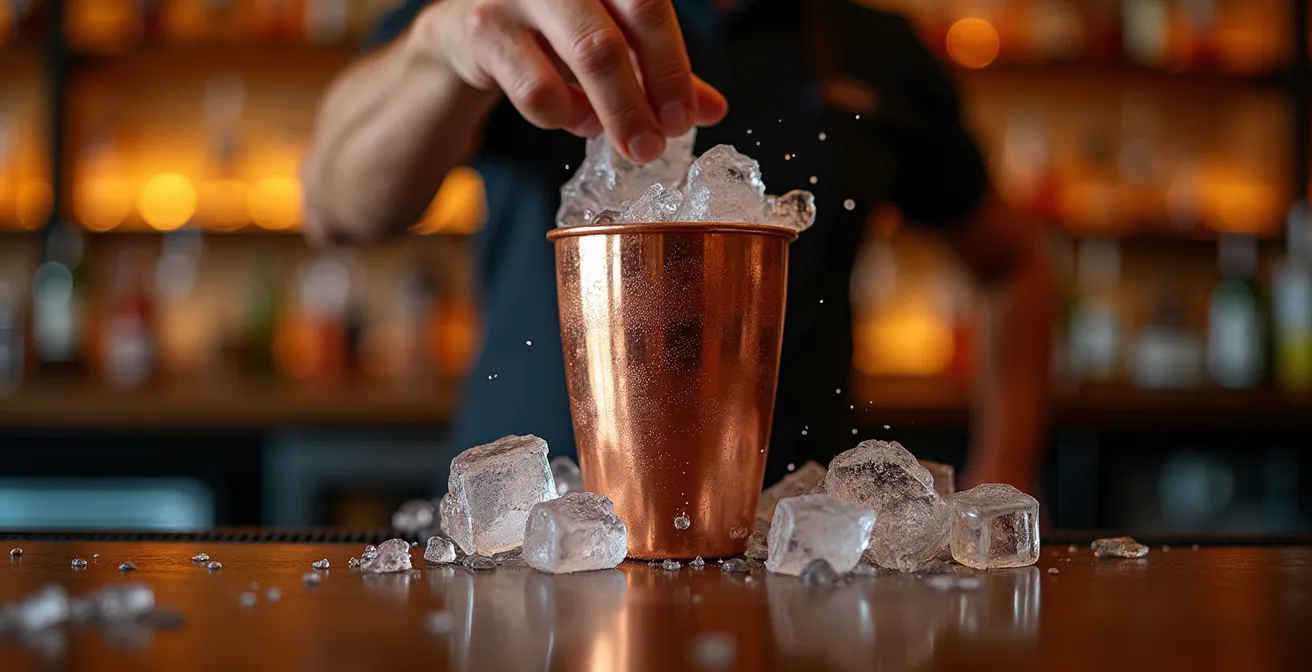
The 2:1:1 “Golden Ratio” is not a fixed rule but the starting point for a dynamic flavor equation.
- True balance requires you to adjust for variables like citrus acidity (lime vs. lemon) and the final alcohol proof of your base spirit.
- The most commonly ignored variable is water from dilution, which functions as a critical ingredient that alters both flavor and texture.
Recommendation: Stop memorizing recipes and start thinking like a mathematician by deconstructing drinks into their core components: spirit, sugar, acid, and water.
There’s a common frustration for any aspiring home bartender: you have a well-stocked bar, but the cocktail you improvised tastes… off. It’s either cloyingly sweet, unpleasantly sharp, or disappointingly watery. The dream of effortlessly whipping up a balanced drink with whatever is in the fridge feels just out of reach, pushing you back to the rigid safety of recipe books. Many guides will point you toward the so-called “Golden Ratio,” typically cited as 2 parts spirit, 1 part sweet, and 1 part sour. This is often presented as the universal key to cocktail harmony.
While this 2:1:1 ratio is a foundational concept, treating it as an immutable law is the primary reason improvised drinks fail. It’s a baseline, not a final solution. But what if the real key wasn’t memorizing a static ratio, but understanding a dynamic formula? What if balancing a cocktail was less like painting by numbers and more like solving an elegant equation, where every ingredient is a quantifiable variable?
This is the mindset of a cocktail mathematician. The true secret to moving beyond recipes lies in deconstructing the components and understanding how they interact. The type of acid in your citrus, the proof of your spirit, the shape of your ice, and even the method you use to chill the drink are all critical variables that alter the final result. Mastering these variables is the key to unlocking creative freedom.
This guide will dissect the core variables of the cocktail equation. We will explore the scientific differences between citrus, quantify the hidden role of water, analyze the physics of chilling, and provide a systematic framework to help you transition from following instructions to creating your own signature drinks with precision and confidence.
Summary: Deconstructing the Cocktail Balance Formula
- Why Lime Requires More Sugar to Balance Than Lemon in Sours?
- How Does Copper Contact During Distillation Remove Sulfurs and Refine Flavor?
- Manhattan or Daiquiri: Which Balance Structure is Harder to Master?
- The “Missing Ingredient” Mistake: Why You Forgot to Count Water as a Sweetener?
- When to Stop Shaking: Listening for the Ice Change?
- How to Prepare a Ti’ Punch Like a Local Without Crushed Ice?
- Why Stirring for 30 Seconds Dilutes Less Than Shaking for 10 Seconds?
- How to Move from Following Recipes to Creating Your Own Signature Cocktails?
Why Lime Requires More Sugar to Balance Than Lemon in Sours?
The first variable in our cocktail equation is acidity. A common mistake is to treat all citrus as interchangeable. While both lemon and lime provide the “sour” component, their chemical compositions are fundamentally different, requiring a mathematical adjustment to the “sweet” variable to achieve balance. The perception that lime is “harsher” or more acidic is a matter of its specific acid profile, not just its overall pH.
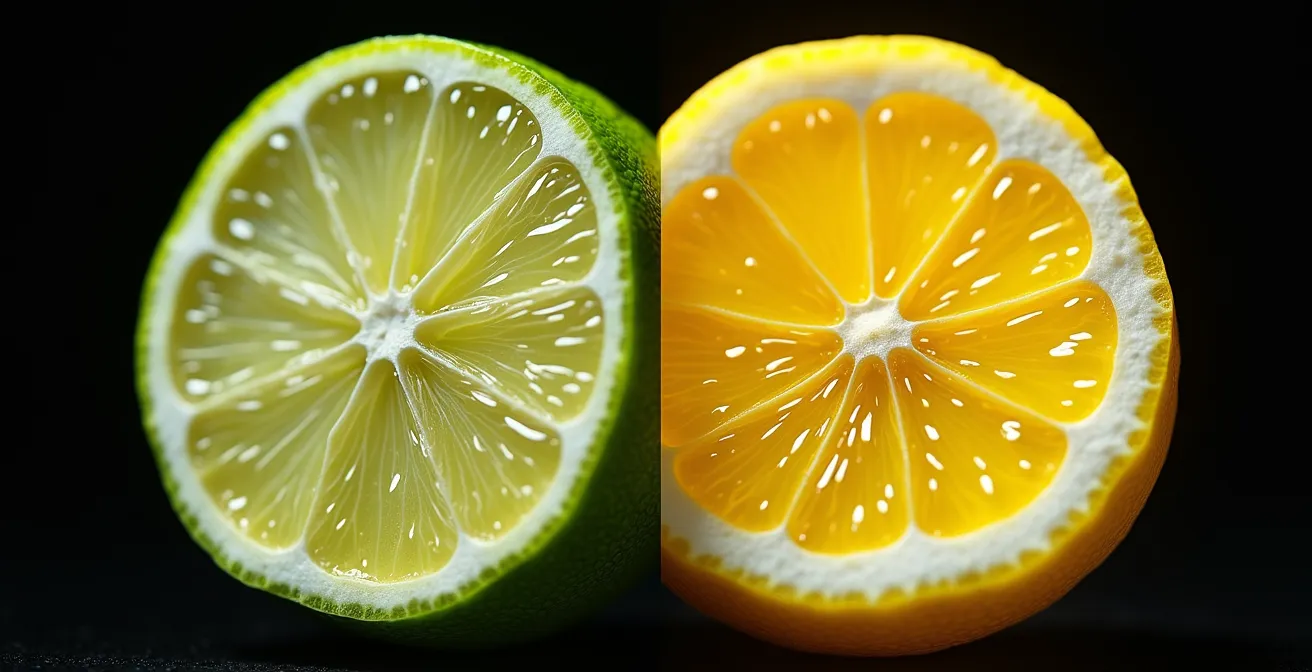
The core difference lies in the types and concentrations of acid they contain. According to acid adjustment specialists, lime juice is comprised of roughly 4% citric acid and 2% malic acid, whereas lemon juice is almost entirely 6% citric acid. Malic acid, while less aggressive on the palate than citric acid, has a more persistent, lingering sourness. This combination in limes creates a more complex and structurally robust acidic profile that demands a greater quantity of sugar to buffer its perceived sharpness.
Therefore, when substituting lime for lemon in a standard 2:1:1 sour recipe, you must increase the sweet component slightly—often moving from 1 part to 1.25 parts—to solve the balance equation correctly. Failing to account for this acid profile variable is a primary reason why a Daiquiri (rum, lime, sugar) and a Gin Sour (gin, lemon, sugar) built with the exact same ratio will taste dramatically different. One is not “wrong,” the equation simply has different values.
How Does Copper Contact During Distillation Remove Sulfurs and Refine Flavor?
Before any ingredient enters your shaker, its quality is predetermined during production. For spirits, the ‘spirit’ variable in your equation is heavily influenced by the distillation process, particularly its interaction with copper. The use of copper in stills is not merely traditional; it is a crucial chemical step that refines flavor by actively removing undesirable compounds. During fermentation, yeast can produce volatile sulfur compounds, which carry unpleasant aromas of rubber or rotten eggs.
When the hot alcoholic vapor rises inside the still, it comes into contact with the copper surface. Copper acts as a catalyst, triggering a chemical reaction with these sulfur compounds. This process forms copper sulfate, a heavy, non-volatile solid that sticks to the inside of the still instead of traveling with the spirit vapor into the condenser. This is, in effect, a purification process that “cleans” the distillate.
By removing these heavy, pungent sulfur notes, the copper allows the more delicate and desirable aromas of the spirit to become prominent. Fruity, floral, and spicy notes, which were previously masked, are now able to define the spirit’s character. This is why spirits distilled in copper stills are often described as “smoother” or “cleaner.” An unrefined spirit with high sulfur content can disrupt a cocktail’s balance, introducing off-flavors that no amount of sugar or citrus can fully mask. A well-distilled spirit provides a clean and stable base for your cocktail equation.
Manhattan or Daiquiri: Which Balance Structure is Harder to Master?
Not all cocktails are built on the same architectural framework. A common misconception is that drinks with fewer ingredients are easier to execute. As cocktail expert Candra Drinks notes, “A broad misconception is that simple sounding recipes are easy to make, when in fact they’re often the hardest.” This principle is perfectly illustrated when comparing the balance structures of a Daiquiri (spirit, sour, sweet) and a Manhattan (spirit, fortified wine, bitters).
A Daiquiri has an acidic balance structure. Its three ingredients create a tripod of balance where any imperfection is immediately obvious. There is nowhere for a flaw to hide. If the rum is low quality, the lime is old, or the sugar-to-acid ratio is off by even a small margin, the drink fails. Its simplicity is deceptive, demanding high-quality components and precise execution.
A Manhattan, conversely, has an aromatic balance structure. It balances a spirit base not with bright acid, but with the complex sweetness, spice, and bitterness of vermouth and bitters. This structure is more forgiving. The inherent complexity of vermouth and bitters can help mask minor imperfections in the base spirit or dilution. However, mastering it requires a different skillset focused on temperature control and subtle aromatic integration.
The following table, based on a comparative analysis of cocktail structures, breaks down the distinct challenges of each.
| Aspect | Manhattan | Daiquiri |
|---|---|---|
| Balance Type | Aromatic (spirit/wine/bitters) | Acidic (spirit/sugar/acid) |
| Dilution Window | Narrow – easily over/under-stirred | Forgiving – shaking provides buffer |
| Flaw Visibility | Complex ingredients can mask imperfections | Three ingredients offer nowhere to hide |
| Temperature Control | Critical – must achieve -5°C without over-dilution | More flexible due to shaking dynamics |
Ultimately, the Daiquiri is often considered harder to master because its transparency is unforgiving. It is a pure test of your ability to balance the fundamental variables of the cocktail equation. The Manhattan’s complexity provides a buffer, making it a different, but not necessarily easier, challenge of nuance and control.
The “Missing Ingredient” Mistake: Why You Forgot to Count Water as a Sweetener?
The most significant error in applying the 2:1:1 ratio is failing to account for the fourth ingredient present in nearly every chilled cocktail: water. Shaking or stirring a drink with ice doesn’t just make it cold; it introduces water through melting, a process known as dilution. This water is not a flaw; it is a critical structural component that binds flavors, tempers the alcoholic burn, and adjusts the texture. Forgetting to control this variable is like forgetting a load-bearing wall in a house.
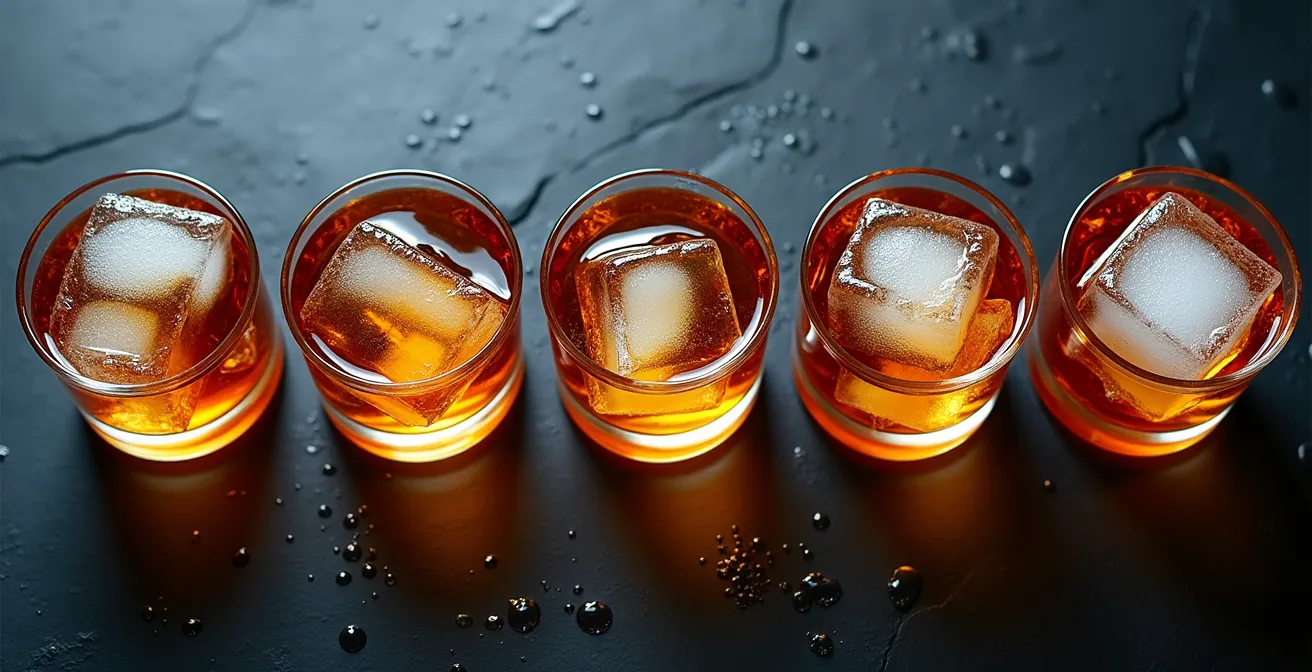
Water functions as a “sweetener” in a perceptual sense. By diluting the alcohol (ethanol), it lowers the overall proof and reduces the burning sensation on the palate. This allows the more subtle sweet and aromatic notes from the other ingredients to become more prominent. An undiluted, high-proof cocktail can taste harsh and “hot,” masking its intended flavors. The right amount of dilution opens the drink up, making it more palatable and balanced.
The amount of dilution is a direct function of the ice’s surface area and the agitation method. The size and shape of your ice are not merely aesthetic choices; they are precise tools for controlling the dilution coefficient. Smaller ice forms like crushed or cracked ice have a massive surface area, leading to rapid chilling but also extremely fast dilution. Conversely, large cubes or spheres have less surface area relative to their volume. They chill a drink effectively while melting much more slowly, giving the bartender precise control over the final water content. This is why a spirit-forward drink like an Old Fashioned is served on a large cube—to keep it cold with minimal dilution over time.
When to Stop Shaking: Listening for the Ice Change?
Once you recognize that dilution is a key ingredient, the next logical step is learning how to control it during agitation. For shaken cocktails, the duration of the shake is the primary control mechanism. Shaking for too long results in a watery, lifeless drink; shaking too briefly yields a harsh, unbalanced one. While a timer is a good starting point (typically 12-15 seconds), the true craftsman learns to use their senses—particularly hearing—to identify the precise moment of perfect balance.
The sound of the ice inside the shaker evolves through distinct phases as it chills and dilutes the drink. Learning to identify these auditory cues allows you to stop shaking at the optimal point, regardless of the initial ice size or room temperature. This sensory feedback provides a more accurate measure of the cocktail’s state than a simple clock.
You can train your ear to listen for the transformation of the ice by following this three-phase guide:
- Phase 1 – The Cracking Phase: The shake begins with loud, sharp, and chaotic cracking sounds. This is the sound of large, solid ice cubes violently colliding with the shaker walls and each other, breaking into smaller pieces.
- Phase 2 – The Sloshing Phase: As the ice breaks down and the liquid chills, the sound becomes more rhythmic and integrated. You’ll hear the fluid and the now-smaller ice pieces moving together in a unified, sloshing motion. This is the primary phase of chilling and dilution.
- Phase 3 – The Hushing Phase: As the ice becomes slushy and the drink approaches its final temperature, the sounds become noticeably quieter, smoother, and higher-pitched. The sharp rattling is replaced by a soft, hissing sound. This is the signal that you have achieved optimal dilution and aeration, and it is time to stop.
In addition to sound, look for a consistent and sharp frost line forming on the shaker’s exterior. This visual cue, combined with the changing sound and the feel of the vibrations in your hands, provides a multi-sensory system for hitting the perfect dilution every time.
How to Prepare a Ti’ Punch Like a Local Without Crushed Ice?
While most cocktail equations seek a harmonious balance, some drinks are designed to challenge it. The Ti’ Punch from the French Caribbean islands of Martinique and Guadeloupe is a prime example. Its preparation defies conventional wisdom, particularly regarding ice and dilution. The local philosophy is perfectly captured by the saying, *”Chacun prépare sa propre mort”*—everyone prepares their own death—meaning each person mixes their own Ti’ Punch to their exact, personal preference.
Chacun prépare sa propre mort (everyone prepares their own death), meaning each person mixes their own drink to their exact taste preferences.
– Curiada
The traditional method is a lesson in minimalism and spirit-forward construction. It is not served over crushed ice like a mainland Daiquiri or Mojito. In Martinique, asking for ice in your Ti’ Punch is a tourist faux pas. The drink is built to be bold, beautiful, and uncompromising. It consists of three ingredients served at ambient temperature: a slice of lime, a scant bar spoon of cane syrup, and a healthy pour of Rhum Agricole—a grassy, funky style of rum distilled from fresh sugarcane juice.
The preparation is a ritual. A small lime disc is squeezed into the glass, the syrup is added, and the mixture is swizzled with a *bois lélé* (a special swizzle stick) before the rum is added. The result is a potent, intensely aromatic drink where the character of the Rhum Agricole is the star. Adding ice would introduce dilution, the very thing the drink’s structure is designed to avoid. It would fundamentally change its character from a powerful sipper to a different, less authentic cocktail. This drink serves as a critical reminder that while balance is a goal, the *definition* of balance is culturally and contextually dependent. The Ti’ Punch equation is intentionally solved to favor the spirit variable above all else.
Why Stirring for 30 Seconds Dilutes Less Than Shaking for 10 Seconds?
The choice between shaking and stirring is not about preference; it is a calculated decision that dramatically impacts two key variables: dilution and texture. The common assumption that a longer stir time equals more dilution is incorrect. The energy transferred during the two methods is so vastly different that shaking is exponentially more efficient at both chilling and diluting.
Shaking is a violent process. The ice is thrown back and forth, shattering into smaller pieces. This massively increases the total surface area of the ice exposed to the liquid, leading to incredibly rapid heat exchange. As cocktail science research demonstrates, shaking can achieve the same temperature drop in 15 seconds that stirring takes over two minutes to accomplish. This violence also introduces air into the mixture, creating a cloudy, aerated, and often frothy texture, which is desirable for cocktails containing juice or egg white.
Stirring, by contrast, is a gentle process. The goal is to move whole ice cubes through the liquid with minimal breakage. This maintains a low ice surface area, resulting in a controlled, gradual heat exchange. It chills the drink efficiently but adds water at a much slower rate. The result is a cocktail with a silky, viscous texture and perfect clarity, which is the ideal for spirit-forward drinks like the Manhattan, Negroni, or Martini. The primary purpose is to chill and dilute just enough to take the edge off the alcohol without compromising the spirit’s weight and mouthfeel.
This table, derived from scientific analysis of ice dynamics, quantifies the physical differences between the two techniques.
| Factor | Shaking | Stirring |
|---|---|---|
| Ice Surface Area | Massively increased through shattering | Minimal increase, whole cubes maintained |
| Energy Transfer | Violent agitation = rapid heat exchange | Gentle movement = controlled heat exchange |
| Time to Equilibrium | 15 seconds | 2+ minutes |
| Texture Result | Aerated, cloudy, frothy | Silky, clear, viscous |
| Final Temperature | -5°C achieved quickly | -4°C after extended stirring |
Therefore, a 30-second stir introduces significantly less water than a 10-second shake because the integrity of the ice remains largely intact. Choosing the correct method is a critical step in solving your cocktail equation for the desired texture and dilution level.
Key Takeaways
- The “Golden Ratio” is a starting point, not a destination. True balance comes from adjusting for the specific variables of your ingredients.
- Water from dilution is the fourth, most critical ingredient in any chilled cocktail. Control it by managing ice size and agitation time.
- Technique dictates outcome. Shaking adds texture and high dilution quickly, while stirring provides clarity and controlled, minimal dilution.
How to Move from Following Recipes to Creating Your Own Signature Cocktails?
The final step in your journey is to synthesize this knowledge into a creative framework. Moving from a recipe follower to a cocktail creator is about adopting a systematic, experimental approach. Instead of seeing a drink as a whole, see it as a collection of interchangeable parts governed by the principles of balance we have discussed. A useful methodology for this is the “Mr. Potato Head” method of cocktail creation.
This method involves starting with a classic template (like the 2:1:1 sour) and systematically swapping one variable at a time to observe its effect on the final equation. For instance, replace gin with mezcal in a sour to see how smoke interacts with acid. Replace lemon with grapefruit to understand a different acid profile. This methodical process allows you to build a “palate library” in your mind, cataloging the characteristics of different spirits, sweeteners, and acids. It turns your kitchen into a laboratory.
As you become more advanced, you can apply more complex techniques. For example, if you want to create a balanced sour using a juice that isn’t very acidic, like orange juice, you can perform an acid adjustment. Based on recommendations from expert bartenders, you can match orange juice to lime’s acidity profile by calculating that for 1kg of orange juice, you need to add 32g of citric acid and 22g of malic acid. This is the epitome of the cocktail mathematician mindset: modifying a base variable to fit the desired equation. The full creative process can be broken down into these steps:
- Start with a classic template: 2 parts spirit, 1 part sweet, 1 part sour.
- Systematically swap one element: Replace the spirit (gin for mezcal) or the sour (lemon for grapefruit).
- Build your palate library: Sample ingredients side-by-side to understand their inherent sweetness, acidity, and bitterness.
- Master the fourth and fifth tastes: Introduce saline solution for brightness or umami ingredients for depth.
- Experiment with acid adjustments: Use pure citric or malic acid to modify the profiles of low-acid juices.
- Document everything: Keep a detailed log of the ratios and modifications that succeed or fail.
- Find your story: Let a personal memory, a favorite flavor, or a unique experience guide your ingredient choices to create something truly personal.
Action Plan: Auditing Your First Signature Cocktail
- Points of Contact: List all components of your drink: spirit, sweet, sour, bitter, and dilution method (shake/stir).
- Collect: Measure and record the exact ratio you used (e.g., 60ml rum, 22.5ml lime, 15ml simple syrup).
- Coherence: Taste the result. Does it align with your goal? If it’s too sweet, is the problem too much sugar or not enough acid?
- Memorability & Emotion: Is there a “wow” factor? Identify what makes it unique versus what makes it generic. Is the smokiness of the mezcal the star, or is it lost?
- Plan for Integration: Based on your audit, create Version 2. Will you increase the acid, swap the sweetener, or add a saline drop to make the flavors pop? Tweak one variable at a time.
Your journey from follower to creator starts now. Take these principles, open your liquor cabinet, and start solving your own flavor equations. The perfect cocktail isn’t found in a book; it’s calculated in your shaker.