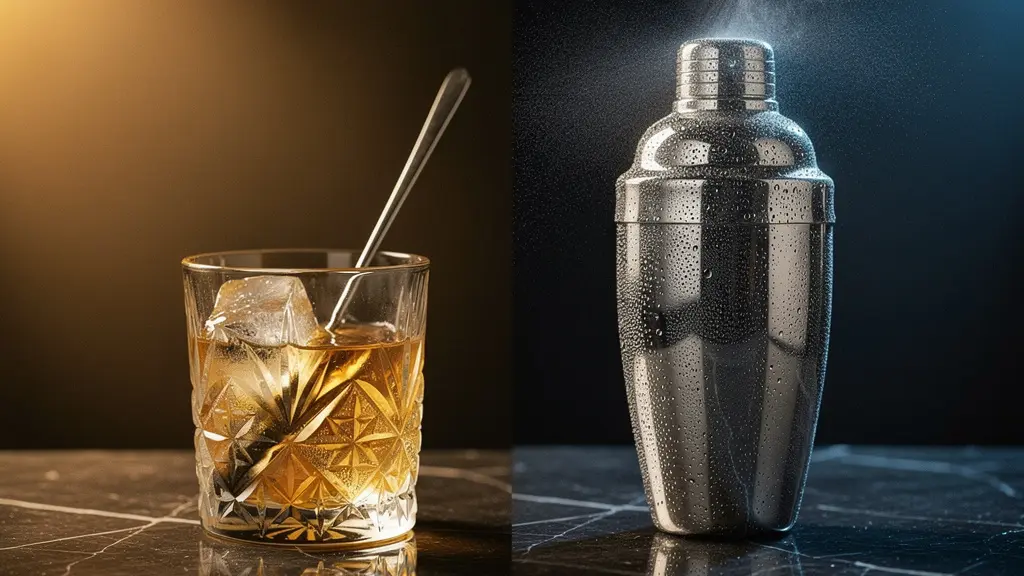
The choice to stir or shake a cocktail is not a matter of preference, but of deliberately engineering its final texture and temperature.
- Stirring is for spirit-only cocktails (like Martinis or Negronis), using controlled motion to achieve chilling and dilution while preserving a heavy, silky mouthfeel.
- Shaking is for cocktails with citrus, dairy, or egg, using violent motion to emulsify ingredients, chill rapidly, and create a lighter, aerated texture.
Recommendation: To master mixology, stop thinking about rules and start thinking about results. Choose your technique based on the specific sensory architecture—the weight, clarity, and feel—you wish to build in the glass.
The iconic image of a cocktail being vigorously shaken is seared into our collective consciousness, a cinematic shorthand for sophistication and style. Yet, for the discerning bartender, the rattle of a shaker is only half the story. The other, a silent ballet of ice and spirit swirling in a crystal glass, is an act of precision often misunderstood. The beginner, perhaps inspired by a certain secret agent’s questionable order, is left to wonder: when is one method correct, and why does it matter so profoundly?
Most will recite the simple rule: shake with juice or cream, stir with spirits. While not incorrect, this advice is superficial. It is the “what,” not the “why.” It fails to convey that the choice is a fundamental act of textural engineering. Shaking is a turbulent, violent process designed to emulsify, aerate, and chill aggressively. Stirring is a patient, controlled method of achieving perfect temperature and dilution while preserving the clarity and viscous, weighty mouthfeel that is the hallmark of a great spirit-forward drink.
The true craft lies not in memorizing rules, but in understanding the physics at play. It is about mastering the transfer of cold, the rate of dilution, and the introduction of air. It is a dedication to the principle that how a drink is chilled and mixed is as important as the ingredients themselves. This is not mere pedantry; it is the foundation of building a balanced, elegant, and texturally perfect cocktail.
This guide will deconstruct the art of stirring, moving beyond simple instructions to explore the science behind the tools, the purpose of the technique, and the common errors that separate an amateur attempt from a professional execution. We will explore the very architecture of a stirred drink, from the glass it is built in to the vessel it is served in.
Summary: The Physics of Texture in Mixology
- Why a Seamless Yarai Mixing Glass Pours Better Than a Pint Glass?
- How to Master the Japanese Barspoon Turn for Silent Stirring?
- Crystal Glass or Stainless Steel: Which Insulates the Cold Better?
- The Safety Hazard: How to Inspect Glassware for Micro-Chips Before Use?
- How Large Should Your Mixing Glass Be to Make Two Drinks at Once?
- Does “Bruising” Gin or Vermouth Actually Change the Chemical Flavor?
- The Temperature Error: Why a Warm Mixing Glass Ruins Dilution Control?
- Why Are Top Sommeliers Serving Aged Rum in White Wine Glasses?
Why a Seamless Yarai Mixing Glass Pours Better Than a Pint Glass?
The choice of a mixing vessel is the first step in successful textural engineering. While a common pint glass might seem sufficient, its design is fundamentally at odds with the goal of a perfectly stirred cocktail. A professional mixing glass, typically a seamless Yarai, is a purpose-built tool designed for control. Its thick, heavy base provides a low center of gravity, offering stability on the bar top—a crucial feature that allows for a smooth, one-handed stir without fear of tipping.
Internally, the seamless construction is critical. The absence of vertical seams, common in cheaper pint glasses, prevents the disruption of the liquid’s rotation. This allows for a smooth, cohesive vortex, ensuring the ice and spirits move as a single body. This creates an efficient chilling and dilution process known as laminar flow, minimizing unwanted aeration. Furthermore, the integrated pour spout of a Yarai glass is geometrically designed to guide the chilled liquid out in a single, clean stream, preventing the turbulent, messy drips characteristic of a flat-rimmed pint glass.
As the Diageo Bar Academy notes, the design is about facilitating grace and stability. The consistent diameter and added weight are not merely aesthetic choices; they are functional elements that enable precision. This is explored in detail in the following comparison, based on an analysis from the Diageo Bar Academy.
| Feature | Seamless Yarai Mixing Glass | Standard Pint Glass |
|---|---|---|
| Spout Geometry | Integrated pour spout for laminar flow | Flat rim, prone to turbulent dripping |
| Interior Surface | Seamless — no vortex disruption | Seams and ridges may trap air |
| Base Weight & Stability | Heavy, weighted bottom — low center of gravity | Light, tapered — prone to tipping |
| Typical Capacity | 500–675 ml | 473 ml (16 oz) |
| One-Handed Stirring | Possible due to stability | Difficult due to light weight |
| Aeration During Stir | Minimal — smooth interior | Higher — seams disrupt flow |
Ultimately, using a Yarai glass isn’t about pretension; it’s about control. It provides the bartender with the stable, predictable environment necessary to execute a flawless stir and pour.
How to Master the Japanese Barspoon Turn for Silent Stirring?
With the proper vessel in hand, the focus shifts to the motion itself. The goal of stirring is not simply to mix, but to chill and dilute with absolute precision while preserving the spirit’s integrity. This is achieved through a technique that prioritizes silence and fluidity. Any aggressive clanking of ice against glass is a sign of failure—it indicates chipped ice, which creates slush that over-dilutes the drink without effectively chilling it, and introduces unwanted air.
As bartender Eben Freeman explains, the core principle is to avoid agitating the spirit unnecessarily. The technique, often called the Japanese barspoon turn, is a subtle movement driven by the fingers, not the wrist or arm. It allows the spoon to orbit the glass’s inner wall, pushing the column of ice and liquid as a single, unified mass. This is the key to creating that coveted silky, heavy texture. The image below illustrates the precise finger placement required to achieve this silent, efficient rotation.
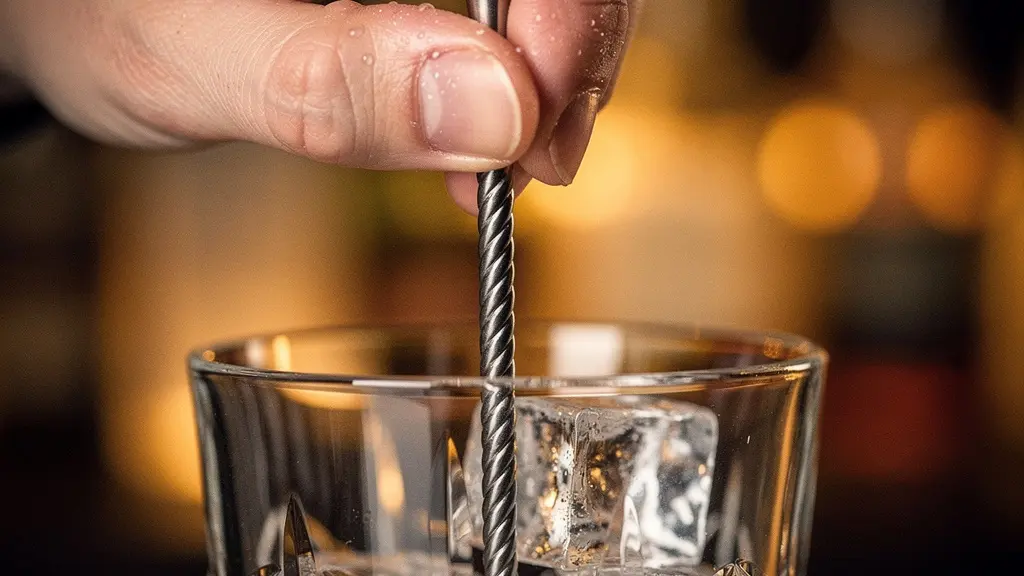
This technique is a skill of finesse, where the sound—or lack thereof—is the primary indicator of success. The almost inaudible whisper of ice gliding against glass is the sound of a cocktail being perfectly chilled, not brutalized. The following steps break down this essential professional movement.
- Grip the spoon: Hold the barspoon between your thumb and your middle and ring fingers, with your palm facing upward.
- Maintain contact: Insert the spoon so the back of its bowl is in constant, gentle contact with the inner wall of the mixing glass.
- Use a finger-driven motion: Employ a subtle push-pull motion from your fingers only. This will cause the spoon to rotate on its own axis as it orbits the perimeter of the glass. The wrist and arm should remain still.
- Listen for silence: The primary goal is a near-inaudible stir. If you hear clinking, you are chipping the ice. Adjust your pressure and speed until the movement is smooth and quiet.
- Stir for time: For a spirit at room temperature, stir for approximately 20–30 seconds. The objective is to move the liquid and ice as one cohesive body, preserving the cocktail’s weight and texture.
This silent ballet is not for show; it is a functional method to ensure the final drink is perfectly cold, correctly diluted, and possesses the luxurious mouthfeel that only a well-stirred cocktail can offer.
Crystal Glass or Stainless Steel: Which Insulates the Cold Better?
While the crystal Yarai is the aesthetic and functional standard for stirring, the debate between glass and stainless steel mixing vessels persists, particularly in high-volume environments. The choice hinges on a fundamental principle of thermodynamics: the difference between conductivity and insulation. Stainless steel is a highly efficient conductor of temperature, while glass is a superior insulator.
This means a stainless steel tin will feel colder to the touch much faster, as it rapidly draws heat away from your hand and the ambient air. This can give the impression of faster chilling. However, this same conductivity is a double-edged sword. The metal not only chills quickly but also absorbs heat from the bartender’s hand just as efficiently, and loses its cold to the room’s temperature more readily. Glass, with its lower thermal conductivity, takes slightly longer to chill initially but, once cold, it acts as a much better thermal ballast. It holds its low temperature for longer and insulates the cocktail from the warmth of your hand and the bar.
Furthermore, as the Diageo Bar Academy points out, glass offers a crucial advantage that metal cannot: visibility. A bartender can visually gauge the rate of dilution by observing the condensation on the outside of the glass and the viscosity of the liquid inside. This real-time feedback is invaluable for crafting a precise, consistent drink, especially in a craft setting where every detail matters. The table below outlines the key properties based on a Diageo Bar Academy comparison.
| Property | Crystal Glass | Stainless Steel |
|---|---|---|
| Thermal Conductivity | Low (~1.0 W/m·K) — insulates well once chilled | High (~16 W/m·K) — chills vessel walls rapidly |
| Thermal Capacity | Moderate — retains cold temperature longer during slow service | Low — loses cold quickly to ambient air |
| Hand Heat Transfer | Minimal — glass prevents bartender body heat from entering drink | Significant — metal conducts hand warmth directly into cocktail |
| Visual Feedback | Full transparency — condensation patterns, viscosity lines, and dilution visible in real-time | Opaque — no visual data on drink state |
| Durability | Fragile — risk of breakage | Virtually indestructible |
| Best Use Case | Precision stirring with visual monitoring during slow craft service | High-volume bars prioritizing speed and durability |
For the traditionalist focused on precision and sensory feedback, crystal glass remains the superior choice. For environments where speed and durability are paramount, stainless steel offers a practical, albeit less nuanced, alternative.
The Safety Hazard: How to Inspect Glassware for Micro-Chips Before Use?
The elegance of a crystal mixing glass comes with a non-negotiable responsibility: ensuring its structural integrity. A micro-chip or a hairline fracture, invisible to a casual glance, poses a critical safety risk. The centripetal force of stirring and the thermal shock of rapidly chilling the glass can cause a compromised vessel to shatter, sending dangerous shards into the drink and onto the bar. A professional bartender’s routine must therefore include a rigorous, multi-sensory inspection protocol before every use.
This is not merely about protecting expensive equipment; it is about protecting the guest. Visual inspection alone is insufficient, as the most dangerous flaws are often too small to see. A tactile check is essential. According to guidelines from the Diageo Bar Academy, hand washing is mandatory, and care must be taken to avoid thermal shock—never fill a room-temperature glass with ice. The smallest imperfection can become a catastrophic failure point under the stress of service.
Adopting a systematic approach to glassware safety is a hallmark of professionalism. It demonstrates a respect for both the tools of the trade and the well-being of the patron. The following checklist outlines the essential steps for a professional glassware audit.
Your Action Plan: Glassware Safety Audit Protocol
- Rim Integrity Check: Run your fingernail slowly and carefully along the entire inner and outer rim of the glass. Your nail will snag or ‘click’ on any micro-chip or crack that is too small to see.
- Visual Fracture Scan: Hold the glass up to a strong, direct light source. Rotate it slowly, looking for thin, bright lines that refract light differently. These are often hairline fractures under the surface.
- Thermal Shock Prevention: Before service, always pre-chill your mixing glasses. Never pour ice directly into a warm or room-temperature glass, as the rapid contraction can turn a tiny flaw into a complete shatter.
- Establish a Routine: Make this inspection a mandatory part of your bar’s opening procedure. Consistency is key to preventing accidents.
- Enforce a Zero-Tolerance Retirement Policy: Any glass that fails the fingernail test or shows any visible damage must be immediately and permanently removed from service. There is no acceptable level of risk when it comes to glass in a drink.
Ultimately, a beautiful cocktail is worthless if it is not a safe one. This protocol is the bartender’s first and most important line of defense.
How Large Should Your Mixing Glass Be to Make Two Drinks at Once?
The question of stirring one versus two drinks at a time touches on a core tension in bartending: the balance between uncompromising craft and the practical demands of service speed. As bartender Eben Freeman notes, while a singular focus on one drink is ideal for precision, the reality of a busy venue often necessitates efficiency. Successfully stirring two cocktails at once is not as simple as doubling the ingredients in a standard glass; it requires a vessel with the correct volume to accommodate the physics of the stir.
The critical factor is space. A proper stir requires enough room for the ice and liquid to move as a cohesive vortex. Overcrowding a small glass creates a ‘static block’ of ice that cannot rotate. This leads to inefficient chilling, uneven dilution, and makes the silent stir impossible. To stir two standard cocktails (approximately 3 oz or 90 ml of liquid each, pre-dilution), you need a glass with sufficient headroom above the combined volume of spirits and ice.
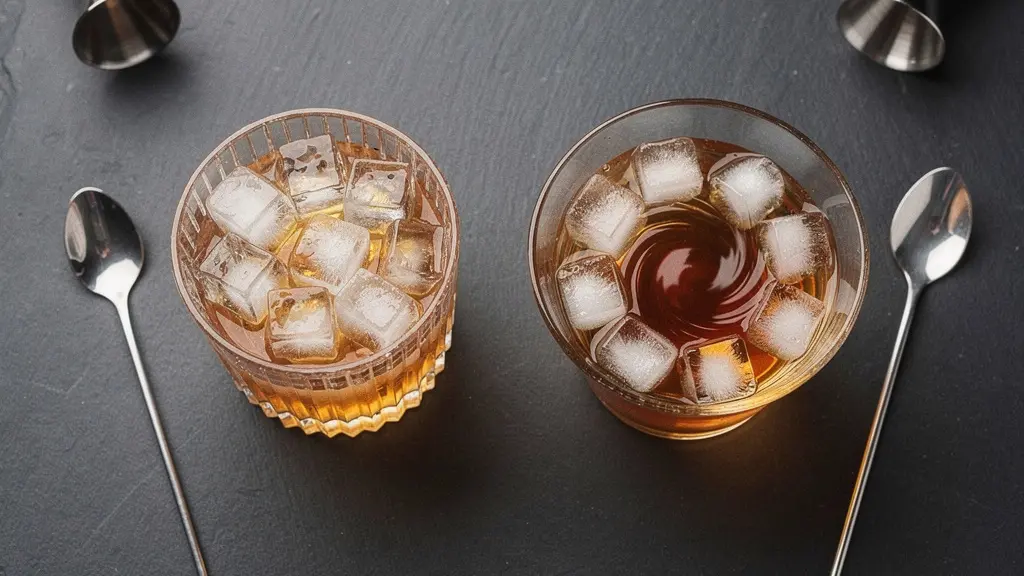
A standard Yarai mixing glass has a capacity of around 500 ml (17 oz), which is generally adequate for one or, at most, two small drinks. For consistently stirring two cocktails, a larger vessel is required. As an example, product specifications from suppliers like Cocktail Kingdom show that large-format options of 675 ml (23 oz) or even 950 ml exist specifically for this purpose. These larger glasses ensure there is enough free path for the ice to circulate freely, allowing for the same efficient, laminar flow you would achieve when stirring a single drink.
The principle remains the same: whether for one drink or two, the goal is controlled movement. The only thing that changes is the scale of the vessel required to achieve it.
Does “Bruising” Gin or Vermouth Actually Change the Chemical Flavor?
The term “bruising” a spirit, particularly gin, is one of mixology’s most persistent and contentious myths. The traditionalist recoils at the thought of a shaken Martini, insisting that the violent agitation damages the delicate botanicals. The question is, does this claim have any scientific basis? Is the spirit’s chemical structure actually altered?
The answer, in short, is no. The notion that shaking “breaks” or “damages” the molecules of gin or vermouth is chemically unfounded. These compounds are stable and not so fragile as to be degraded by a few seconds of movement with ice. This is not just opinion; it is a conclusion supported by scientific analysis.
Case Study: Gas Chromatography of Shaken vs. Stirred Spirits
A gas chromatography analysis of shaken versus stirred Martinis provides clear evidence. The analysis shows no degradation of key gin botanical compounds like α-pinene, limonene, or linalool during either method. No new compounds are formed, and no existing ones are broken down. Chemically, the gin remains intact. What changes dramatically, however, is the drink’s sensory profile. Shaking introduces three key physical changes: more aggressive chilling, greater dilution, and, most importantly, micro-aeration. This process of forcing tiny air bubbles into the liquid alters its texture, making it feel lighter on the palate, and can mute the perception of certain top-note aromas while rounding out bitterness. The flavor doesn’t change chemically, but our perception of it does.
Therefore, “bruising” is a misnomer for a very real phenomenon: textural modulation. Shaking a spirit-forward drink doesn’t ruin it, but it does transform its character from heavy, silky, and clear to brisk, cloudy, and lighter-bodied. The traditionalist’s preference for stirring is a conscious choice to preserve the former texture, not a defense against imaginary chemical damage.
The Temperature Error: Why a Warm Mixing Glass Ruins Dilution Control?
Among the many variables a bartender must control, the starting temperature of the mixing glass is one of the most critical and most frequently overlooked. Attempting to stir a cocktail in a warm or room-temperature glass is a fundamental error that sabotages the entire process from the outset. It introduces a massive thermal variable that makes achieving consistent dilution and chilling nearly impossible.
When ice is added to a warm glass, a significant portion of its cooling energy is immediately wasted on chilling the vessel itself, rather than the liquid. This causes the exterior of the ice cubes to melt rapidly, creating an initial rush of water before the stir has even properly begun. The result is a cocktail that is over-diluted before it has reached its target temperature. As expert Eben Freeman states, consistency is a function of multiple factors, and “whether you chill your mixing glass” is chief among them.
A simple experiment confirms this critical relationship. An analysis reported by Wine Enthusiast tested cocktail dilution over time and demonstrated that the thermal state of the vessel is a crucial variable. By starting with a pre-chilled glass (either from a freezer or by filling it with ice and water for a moment before use), the bartender eliminates this initial energy waste. The ice’s cooling power is applied directly and efficiently to the spirits, allowing for a predictable rate of dilution that can be controlled simply by the number of rotations. A chilled glass acts as a stable thermal foundation for the cocktail.
In essence, pre-chilling your glass is not an optional flourish. It is a mandatory step that transforms the stir from a game of guesswork into a repeatable, precise technique.
Key Takeaways
- Stirring is a technique for chilling and diluting spirit-only cocktails while preserving their clarity and heavy, silky texture.
- The proper tools—a seamless Yarai mixing glass and a barspoon—are designed to facilitate a smooth, silent stir that minimizes unwanted aeration.
- The “bruising” of spirits is a myth; shaking does not chemically damage gin but alters its texture through aeration, making it lighter and cloudier.
Why Are Top Sommeliers Serving Aged Rum in White Wine Glasses?
The principles of textural and aromatic preservation are not confined to the mixing process; they extend to the final presentation in the serving vessel. The choice of glassware is the final step in crafting the drink’s sensory architecture. While a classic rocks glass or tumbler is traditional for many spirits, a growing number of top sommeliers and spirits experts are now serving fine aged spirits, like rum or whiskey, in stemmed white wine glasses. This is not a stylistic whim, but a deliberate choice rooted in the science of aromatics.
A tulip-shaped bowl, which tapers towards the rim, serves two crucial functions. First, it concentrates the spirit’s volatile aromatic compounds, gathering them for the drinker to appreciate. Second, the narrowing opening acts as a “chimney,” channeling the sharp, burning ethanol vapors upward and away from the nose, allowing the more subtle and complex botanical or cask-aged notes to come forward. The image below shows how this style of glass is held to preserve temperature and focus aroma.
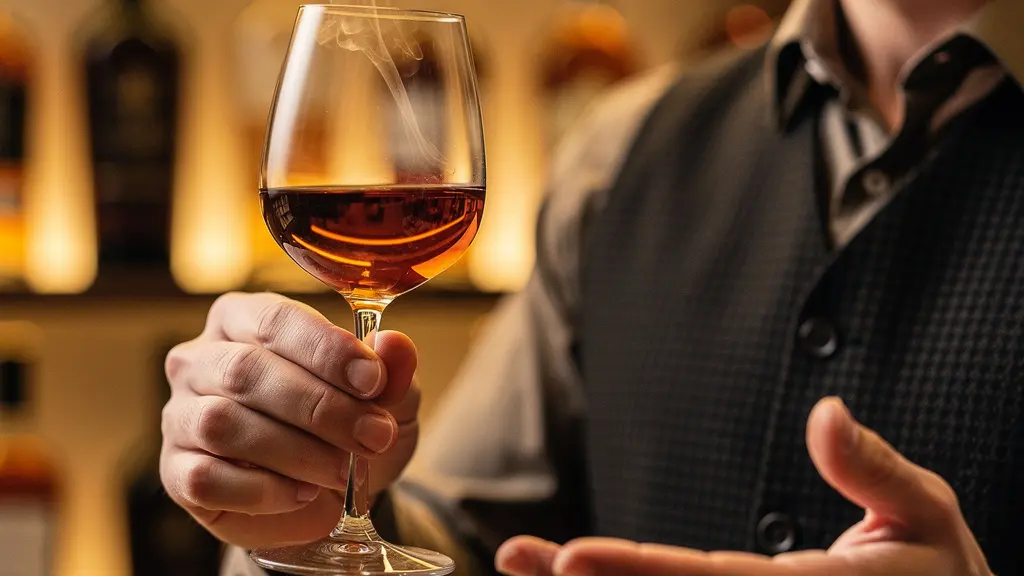
Furthermore, the stem is a critical functional element. As a glassware guide from Brugal Rum explains, holding the glass by the stem prevents the warmth of the hand from transferring to the spirit. This maintains the liquid at its intended temperature, preserving the precise viscosity and mouthfeel that the distiller worked to create and that the bartender strived to achieve through careful chilling. This approach recognizes that a premium aged spirit is as complex as a fine wine and deserves glassware that showcases its full character.
By applying the same principles of temperature control and aromatic focus from mixing to serving, the bartender ensures the integrity of the spirit is honored from the first stir to the final sip. To apply these principles effectively, the next logical step is to build your own toolkit with these considerations in mind.