The signature apricot and peach notes in a whisky are not a random outcome of aging, but a targeted result of specific molecular chemistry that can be controlled during production.
- Long fermentation periods (75+ hours) are essential for creating the fatty acid precursors to stone fruit esters, known as gamma-lactones.
- Serving temperature is critical; these delicate lactones only achieve optimal volatility and express themselves on the palate between 18-22°C (64-72°F).
Recommendation: To fully appreciate a fruity whisky, serve it at a controlled room temperature and pair it with high-fat, low-tannin foods like panna cotta or white chocolate to create a ‘lactone bridge’ that enhances its flavor profile.
That subtle, unmistakable note of ripe apricot or juicy peach in a glass of aged whisky is often chalked up to the mysteries of the cask or the magic of time. For the flavor chaser, it’s a delightful discovery, but one that can feel frustratingly random. The common wisdom points vaguely to “esters” or “the wood,” but this fails to explain why one whisky sings with stone fruit while another, aged similarly, does not. This lack of precision leaves enthusiasts guessing, unable to reliably find or enhance the profiles they love.
The truth, however, is far more scientific and controllable. These specific aromas are not accidents; they are the final product of a precise molecular chain reaction. The journey of these flavors begins long before the spirit ever touches a barrel, rooted in the biochemical decisions made during fermentation. It’s a process where yeast metabolism is deliberately shifted away from pure alcohol production toward the creation of specific flavor precursors. Understanding this chain—from yeast to glass—transforms the tasting experience from a game of chance into an act of chemical appreciation.
This deep dive moves beyond regional stereotypes and aging myths to reveal the specific levers distillers pull. We will dissect the molecular science, from the creation of gamma-lactones during extended fermentation to the principles of volatility that dictate how and when you perceive them. By exploring the chemistry of pairings, you’ll also learn why some combinations amplify these notes while others, like the classic dark chocolate, can chemically erase them from your palate. This is the flavor chemist’s guide to deconstructing and mastering the stone fruit profile in your dram.
To navigate this complex world of flavor chemistry, we will break down the process step-by-step. The following sections will guide you through the entire molecular journey, from creation to perception, providing the knowledge to identify, select, and fully enjoy whiskies rich in apricot and peach notes.
Summary: The Molecular Blueprint of Stone Fruit Notes in Whisky
- Why Long Fermentation Creates More Stone Fruit Aromas than Short?
- How to Match Peach-Noted Whisky with Creamy Desserts Without Clashing?
- Speyside or Highland: Which Region Owns the “Stone Fruit” Profile?
- The Pairing Mistake That Kills Fruitiness: Why Chocolate Is Not Always Right
- At What Temperature Do Stone Fruit Esters “Pop” on the Palate?
- When to Stop Fermentation to Maximize Fruity Esters Over Alcohol?
- How Long Should a Finish Last to Impart Fruit Without Masking the Spirit?
- Why Slow-Moving Legs Indicate Higher Alcohol or Sugar Content?
Why Long Fermentation Creates More Stone Fruit Aromas than Short?
The foundation of a whisky’s stone fruit character is laid not in the barrel, but in the fermentation tank. While a standard fermentation of around 50 hours is ruthlessly efficient at producing alcohol, it’s too brief to allow for the complex secondary reactions that build deep flavor. The real magic happens during extended fermentation, a process that sacrifices some efficiency for immense aromatic gain. According to production science, extended fermentation periods of 75-120 hours are where the genesis of stone fruit truly begins.
During this prolonged period, the yeast’s primary job of converting sugar to ethanol is largely complete. What follows is a “second wave” of biochemical activity. As the legendary whisky consultant Dr. Jim Swan explained, this phase involves both autolysis (the breakdown of dead yeast cells) and the work of secondary microbes like Lactobacillus. This process is crucial as it creates the specific fatty acid precursors, such as decanoic acid, needed to form the key compounds for these notes.
Long fermentations allow for a ‘second wave’ of activity, where autolysis (yeast breakdown) and the work of secondary microbes (like Lactobacillus) create the specific fatty acid precursors (e.g., decanoic acid) for stone fruit lactones.
– Dr. Jim Swan, Virginia Distillery Co. production notes
These precursors are then transformed during distillation into a specific class of compounds called gamma-lactones (like γ-Nonalactone and γ-Decalactone), the molecules directly responsible for the distinct aromas of peach and apricot. Shorter fermentations simply don’t provide the time for this essential precursor development, resulting in a spirit that may be clean but lacks this specific fruity depth.
Case Study: Kilchoman Distillery’s Flavor-Forward Fermentation
Islay’s Kilchoman Distillery intentionally employs an 85-hour fermentation. This extended timeframe is not just for show; it’s a strategic choice to allow amino acids to build within the wash. This process creates a spirit with layers of floral sweetness and fragrant citrus character, which beautifully balances the distillery’s signature peat smoke. It’s a clear example of prioritizing the creation of a complex, fruity spirit base before maturation even begins.
How to Match Peach-Noted Whisky with Creamy Desserts Without Clashing?
Pairing a delicate, peach-noted whisky requires a scientific approach, not just a sweet tooth. The goal is to create synergy, not competition. The key lies in understanding the chemical nature of the whisky’s flavor compounds. The gamma-lactones responsible for peach and apricot notes are fat-soluble. This means they bind to and are carried by fats, a principle that can be leveraged to create a perfect pairing. The ideal partner, therefore, isn’t just any dessert; it’s one with a high cream or fat content and a neutral flavor base.
Enter the world of creamy desserts like panna cotta, crème brûlée, or a simple vanilla bean ice cream. These foods act as a delivery vehicle for the whisky’s fruit esters. When you take a sip of whisky after a bite of the dessert, the fats coat your palate and create a “lactone bridge.” The whisky’s peachy notes, which might have been subtle on their own, are suddenly amplified and carried across the palate, creating a richer, more prolonged tasting experience. The creaminess doesn’t clash with the fruit; it elevates it by providing the perfect molecular carrier.
The visual harmony between the amber liquid and a creamy dessert hints at this underlying chemical compatibility. This is a pairing built on complementary textures and molecular affinities.
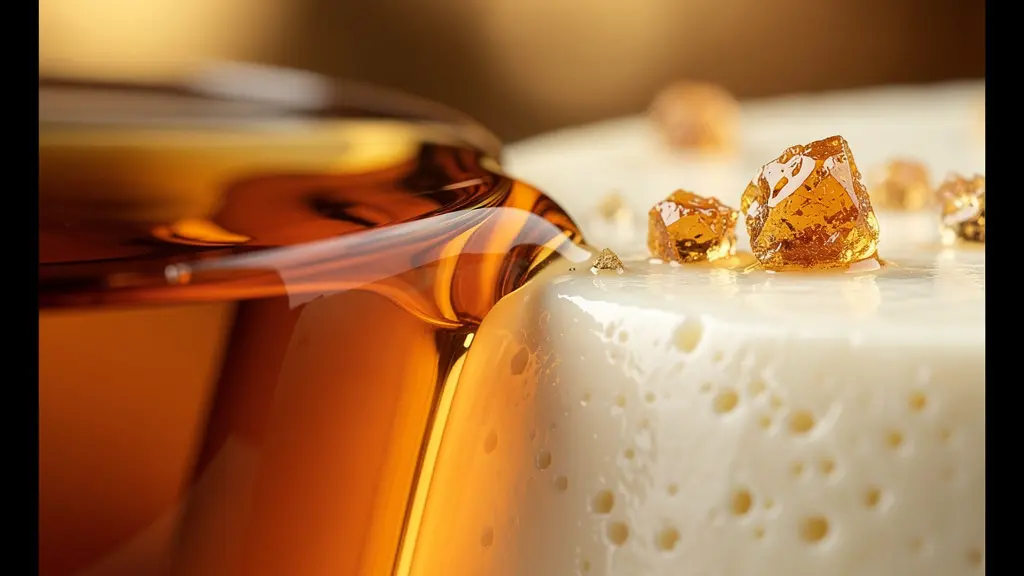
Conversely, a pairing clash occurs when the dessert’s own flavors are too aggressive. Highly acidic fruit tarts or intensely bitter components can overwhelm the delicate lactones, effectively silencing the whisky’s stone fruit character. The secret is to let the dessert’s texture do the work while its flavor plays a supporting role. By choosing a creamy, fatty partner, you are not just adding a food element; you are actively participating in the sensory chemistry of the tasting.
Speyside or Highland: Which Region Owns the “Stone Fruit” Profile?
For decades, Speyside has been stereotyped as the home of “light and fruity” whiskies, while the Highlands are known for more robust profiles. However, when it comes to the specific, coveted notes of apricot and peach, geography is a misleading guide. The presence of these stone fruit lactones is not a regional birthright but a direct consequence of specific, controllable production methods that any distillery, anywhere, can adopt. Factors like still height, fermentation time, and distillation speed are far more influential than a line on a map.
Taller stills, common in some Speyside distilleries, promote more reflux, where heavier compounds fall back and are re-distilled, resulting in a lighter spirit where delicate esters are preserved. However, a Highland distillery can achieve a similar effect through a slower distillation run. Likewise, while some Speyside distilleries favor longer fermentations, many Highland producers also use extended times to build complexity. The idea that a region “owns” a flavor profile is an oversimplification that ignores the deliberate choices of the Master Distiller.
This comparative analysis shows how production variables, not region, dictate the final stone fruit character. These choices are what truly define the spirit’s potential.
| Factor | Speyside | Highland | Impact on Stone Fruit |
|---|---|---|---|
| Still Height | Tall, slender (avg 6m) | Variable (3-7m) | Taller = more reflux = lighter esters preserved |
| Fermentation Time | 60-75 hours average | 48-96 hours range | Longer = more lactone precursors |
| Distillation Speed | Slower, controlled | Variable by distillery | Slower = better ester concentration |
The globalization of whisky production has shattered these regional myths for good. As this analysis of production methods suggests, process trumps place. Furthermore, experts now recognize that over 100 distilleries in Japan, Taiwan, and the US have deliberately engineered their processes to produce world-class stone fruit profiles, often surpassing their Scottish counterparts. They prove that the blueprint for apricot and peach notes is universal, based on a deep understanding of fermentation and distillation chemistry, not Scottish terroir.
The Pairing Mistake That Kills Fruitiness: Why Chocolate Is Not Always Right
The recommendation to pair whisky with chocolate is ubiquitous, but it’s a dangerously broad piece of advice that often leads to flavor destruction. The common mistake is reaching for a high-cacao dark chocolate. While seemingly a sophisticated choice, its chemical composition is the natural enemy of a whisky’s delicate stone fruit esters. The culprit is a bitter alkaloid called theobromine, which is highly concentrated in dark chocolate.
Scientific tasting principles show that dark chocolate with over 70% cacao content contains theobromine levels that can fatigue the taste receptors on your palate. This compound effectively numbs your ability to perceive subtle, nuanced flavors. When you take a sip of a peachy whisky after a piece of intense dark chocolate, the powerful roasted, bitter notes of the cacao and the receptor-dulling effect of the theobromine completely bulldoze the whisky’s delicate gamma-lactones. The fruitiness isn’t just masked; it’s chemically muted.
The solution is not to abandon chocolate entirely, but to choose its opposite: white chocolate. Lacking cacao solids, white chocolate has no theobromine. Instead, its profile is dominated by cocoa butter (fat) and sugar. As we know, fat is the perfect carrier for the whisky’s fat-soluble lactones. The creamy texture and fatty nature of white chocolate create the same “lactone bridge” as a panna cotta, amplifying the apricot and peach notes and creating a harmonious, symbiotic pairing.
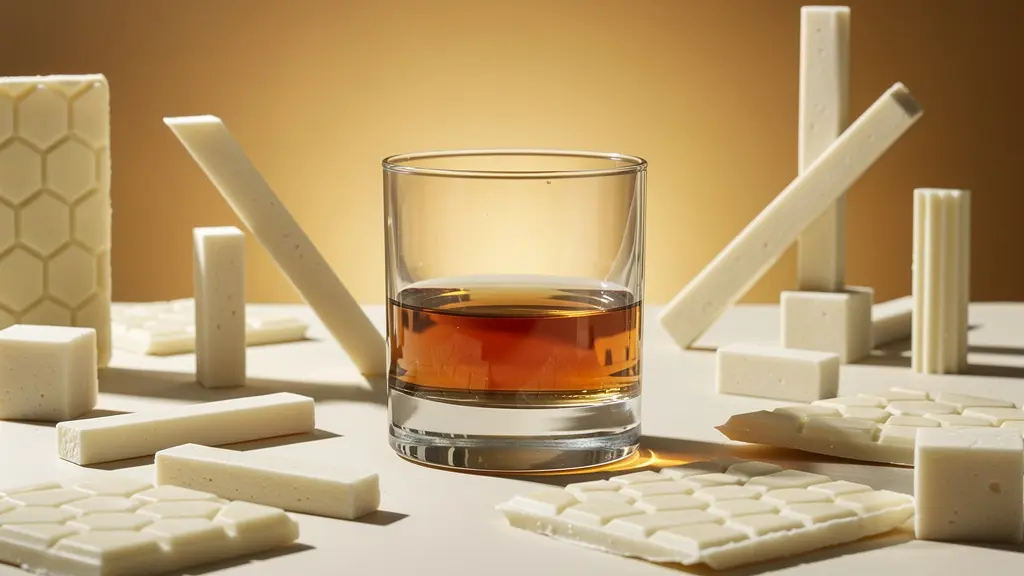
To truly understand this interaction, a systematic approach is needed. The following protocol allows you to experience the chemical clash and the synergy firsthand, turning a simple tasting into a controlled experiment.
Action Plan: The Chocolate-Whisky Flavor Interaction Test
- Establish Baseline: Taste your whisky neat to identify and mentally catalog its primary stone fruit notes. Score its fruitiness on a scale of 1-10.
- The Dark Chocolate Test: Take a small piece of 70%+ cacao dark chocolate and let it melt completely on your tongue. Wait 30 seconds for the flavors and theobromine to coat your palate.
- Observe the Clash: Take another sip of the whisky. Note the immediate transformation. Has the fruitiness diminished or disappeared? Has the whisky’s profile become flatter or more alcohol-forward?
- Cleanse and Reset: Cleanse your palate thoroughly with water and wait a few minutes.
- The White Chocolate Test: Repeat the process with a piece of high-quality white chocolate. After it melts, sip the whisky again and observe how the creamy fats amplify and prolong the stone fruit notes.
At What Temperature Do Stone Fruit Esters “Pop” on the Palate?
Serving temperature is one of the most overlooked yet critical variables in whisky tasting. It’s not a matter of personal preference but of pure physics. The aromatic compounds that define a whisky’s profile, including the gamma-lactones responsible for apricot and peach notes, are volatile. This means they transition from a liquid to a gaseous state to reach the olfactory receptors in your nose, and this transition is highly dependent on temperature.
Serving a fine, fruity whisky too cold is a cardinal sin of flavor chemistry. Chilling the liquid dramatically reduces the kinetic energy of its molecules, suppressing their volatility. The precious lactones remain “locked” in the liquid, unable to leap out of the glass and make their presence known. The result is a muted, dulled whisky where the alcoholic bite may become more prominent while the delicate fruit notes disappear entirely. You’re not tasting the whisky; you’re tasting a cold version of its potential.
Conversely, serving it too warm can also be detrimental, causing the more aggressive ethanol to become overly dominant in the aroma. The sweet spot is a precise window where the desired esters are encouraged to volatilize without being overpowered. In fact, scientific studies confirm that key lactones for peach and apricot notes achieve optimal volatility between 18-22°C (64-72°F). This is standard room temperature in many climates, but it’s a range that must be actively managed, not assumed.
Professional Protocol: Temperature-Controlled Tastings
In professional tasting environments, temperature is never left to chance. Tasters go to great lengths to ensure consistency, often maintaining their whiskies at a precise room temperature, typically between 15-18°C. They understand that even a few degrees of difference can alter the sensory profile. Extreme cold is known to completely obliterate delicate aroma and flavor compounds, which is why a dedicated tasting room is often temperature-controlled to guarantee that every spirit is evaluated at its peak expressive potential.
For the home enthusiast, the lesson is clear: ditch the ice and whisky stones if your goal is to explore fruity notes. Let the bottle sit in the room for at least 30 minutes to acclimate. Cupping the glass in your hands for a few moments can gently raise the temperature, helping those stone fruit esters to “pop” and reveal themselves in all their aromatic glory.
When to Stop Fermentation to Maximize Fruity Esters Over Alcohol?
The decision of when to end fermentation is a master distiller’s balancing act between yield and complexity. From a purely industrial standpoint, the goal is to maximize alcohol production. This peak is reached relatively quickly. However, from a flavor chemist’s perspective, this is precisely when the most interesting work begins. The question is not about stopping fermentation, but about strategically extending it to trigger a crucial metabolic shift in the yeast.
Within the first 48 hours, the yeast works furiously to convert sugars into ethanol. A study in the journal *Metabolites* confirms that fermentation typically reaches its maximum alcohol of 7.5-8% ABV within this timeframe. Halting the process here would produce a high-alcohol wash, but one that is aromatically simple and one-dimensional. The key to developing stone fruit character is to push past this point, into the 72, 85, or even 120-hour range. During this extended period, alcohol production flatlines, but the production of secondary metabolites—including the fatty acid precursors to lactones—skyrockets.
This is the essence of the trade-off: every hour past the 48-hour mark is an investment in flavor at the expense of tank-time efficiency. It’s a conscious decision to prioritize the creation of a complex spirit over the simple manufacturing of alcohol. As Conor O’Driscoll, Master Distiller at Heaven Hill, artfully puts it, the goal is to guide the yeast toward a new purpose.
The goal isn’t to halt fermentation prematurely, but to extend it in a way that shifts the metabolic focus of the yeast from alcohol production to secondary metabolite creation.
– Conor O’Driscoll, Heaven Hill Master Distiller
This metabolic shift is the core principle. The distiller is essentially telling the yeast, “Your work of making alcohol is done; now, begin the work of making flavor.” By allowing the fermentation to run longer in an anaerobic environment, the yeast and other microbes begin to produce the very molecules that will later become the signature notes of apricot and peach in the final, aged spirit.
Key Takeaways
- The distinct notes of apricot and peach are primarily from gamma-lactones, molecules whose precursors are created during long fermentations (75+ hours).
- Serving temperature is crucial; these flavors are most expressive between 18-22°C (64-72°F), as cold temperatures suppress their volatility.
- Pair fruity whiskies with high-fat, low-tannin foods like white chocolate or panna cotta to amplify the notes, and avoid high-cacao dark chocolate which chemically mutes them.
How Long Should a Finish Last to Impart Fruit Without Masking the Spirit?
Cask finishing, or secondary maturation, is a powerful tool for adding layers of flavor, but it’s an art of subtlety, not brute force. When aiming to impart stone fruit notes, often using ex-Sauternes or other sweet wine casks, the danger is overpowering the base spirit’s own character. The perfect finish is a conversation between the wood and the whisky, not a monologue from the cask. The duration should be just long enough to extract the desired lactones and fruity esters without erasing the distillery’s fingerprint.
The time required is not a fixed number; it’s a dynamic variable influenced heavily by climate. The rate of chemical reactions, including flavor extraction from wood, doubles for every 10°C (18°F) increase in temperature. This explains why a finish in a warm climate can be dramatically shorter than one in a cool Scottish warehouse.
Climate’s Impact: The Sauternes Cask Maturation Timeline
The impact of ambient temperature on maturation speed is profound. Due to accelerated chemical reactions, a spirit aging in a warm climate like Taiwan or India can show more flavor development in just 3 years than a spirit aging in a cool climate like Scotland does in 10. For a Sauternes cask finish, this means what might take 6-8 months in Scotland could potentially be achieved in 2-3 months in a warmer region, requiring much more frequent monitoring to prevent over-extraction.
Because of this variability, distillers rely on sensory analysis rather than a calendar. A practical method is to regularly assess the balance between the base spirit and the cask influence. The goal is to find the sweet spot where the finishing notes weave themselves into the spirit’s existing profile. Here are some key checkpoints used to evaluate a finish:
- Initial Impact: If the cask’s flavor is the very first thing you taste and it dominates for more than a few seconds, the finish may already be too aggressive.
- Character Integration: An ideal finish allows the base spirit’s character to appear first, with the finishing notes emerging gracefully on the mid-palate.
- Graceful Transition: The imparted fruit notes from the finish should be present and clear for 5-10 seconds before elegantly fading, allowing the spirit’s original finish to reappear.
A typical finish in an ex-Sauternes cask might last around 6 months, but it must be monitored monthly. The moment the cask’s contribution shifts from an enhancement to a mask is the moment the finish must end.
Why Slow-Moving Legs Indicate Higher Alcohol or Sugar Content?
The slow, viscous “legs” or “tears” that crawl down the side of a whisky glass are more than just a beautiful visual; they are a direct window into the liquid’s chemical composition. While often misinterpreted as a simple sign of quality or age, they are in fact a physical manifestation of a phenomenon known as the Marangoni effect. This effect describes the flow of liquid caused by gradients in surface tension, and in whisky, it’s primarily driven by the differential evaporation rates of alcohol and water.
When you swirl the whisky, a thin film coats the glass. The alcohol in this film, being more volatile, evaporates faster than the water. This creates a surface tension gradient that pulls more liquid up the sides of the glass, forming an arch. As this liquid becomes heavier, gravity wins, and it flows back down in the form of legs. The speed and thickness of these legs are dictated by the whisky’s viscosity. A more viscous whisky will have slower, thicker legs.
This viscosity is influenced by two main factors: alcohol content and, more interestingly for the flavor chaser, glycerol content. Glycerol is a sweet, viscous alcohol produced as a byproduct of fermentation. Critically, the same conditions that favor the creation of fruity esters—namely, longer, warmer fermentations—also tend to produce higher levels of glycerol. Some research suggests that the Marangoni Effect is maximized when fermentation occurs at an optimal temperature of 34°C, where glycerol production peaks. Therefore, pronounced, slow-moving legs can be an indirect indicator that the whisky underwent the type of fermentation known to produce a richer, more complex, and potentially fruitier spirit.
It’s important to note this isn’t a foolproof sign of stone fruit notes, as other factors (like sugar from a wine cask finish) can also increase viscosity. However, it provides a strong clue. When you see those slow, oily legs, you’re not just seeing high alcohol; you’re potentially witnessing the ghost of a long, flavor-focused fermentation—the very process that laid the groundwork for the apricot and peach notes you’re searching for. It connects the entire journey, from the heat of the fermentation tank to the final, elegant tear in your glass.
By deconstructing the journey of a whisky’s flavor from a molecular perspective, you move from a passive drinker to an active, informed taster. Understanding this chain of events—from a strategic, extended fermentation that creates lactone precursors, to the crucial role of temperature in releasing their aroma, to the science of a perfect pairing—empowers you to seek out and amplify the exact flavor profiles you desire. Your next tasting is no longer a guess, but an experiment waiting to happen.