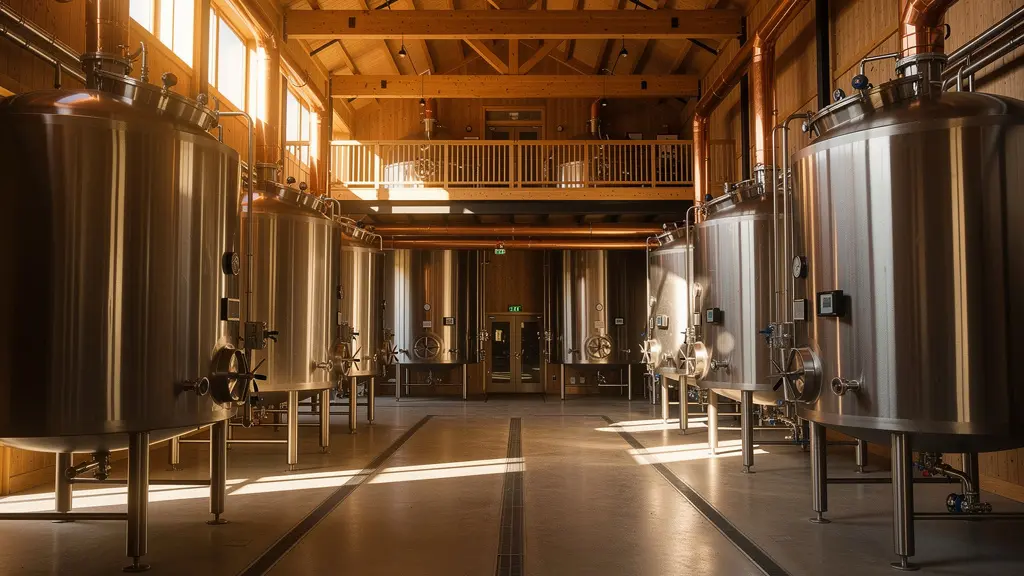
The final ‘marrying’ phase isn’t a romantic art; it’s a series of critical engineering steps that determine a spirit’s final quality and stability.
- Chemical integration of ethanol, water, and flavor compounds requires time to prevent harshness and instability.
- Process variables like water quality, vessel material, and resting duration after transport are non-negotiable control points.
Recommendation: Master these post-production stages to ensure every bottle delivers the intended flavor profile, consistently.
As a bottling line manager, I can tell you the work isn’t over when the still runs quiet. A perfectly distilled spirit is a collection of volatile compounds held in a fragile truce. Rushing it from the still to the bottle is a rookie mistake that compromises all the hard work that came before. The common wisdom is to let the spirit “rest” or “marry” to improve the flavor, but this vague advice misses the point entirely. This isn’t passive waiting; it’s an active and critical stage of quality management.
This process is about achieving a stable chemical equilibrium. It’s about controlled oxidation, esterification, and the physical integration of molecules that are fundamentally different from one another. Skipping or shortening this phase results in spirits that are harsh, unstable, or simply don’t taste as intended. The difference between a good spirit and a great one is often decided in these final, quiet weeks before bottling.
This guide breaks down the science and the standard operating procedures. We will move beyond the romanticism and treat the marrying process for what it is: a series of critical control points. We’ll examine how to soften ethanol’s bite, the correct way to add water, the impact of vessel choice, and why even transportation can temporarily ruin a great whisky. This is the operational playbook for ensuring the quality you craft is the quality the customer tastes.
To navigate this deep dive into the final, crucial stages of spirit production, the following summary outlines the key operational questions we will answer. Each section is designed to provide actionable, science-backed insights for achieving superior quality and consistency.
Summary: The Critical Stages of Post-Production Spirit Stabilization
- Why Resting Spirits in Open Vats Softens Harsh Ethanol Notes?
- How to Add Water Without Creating “Soapy” Flavors in the Bottle?
- Glass Demijohns or Steel Tanks: Which is Best for Resting Unaged Spirits?
- The Transport Mistake That Makes Your Whisky Taste Flat for Two Weeks
- How Long Should You Wait After Filtration Before Bottling?
- Why Does Non-Chill Filtered Whisky Turn Cloudy When You Add Water?
- How to Dilute 60% ABV Spirit Down to 40% for Home Bottling?
- Why Does Adding Water to Whisky Unlock Aromas You Couldn’t Smell Before?
Why Resting Spirits in Open Vats Softens Harsh Ethanol Notes?
The perception of “harshness” in a young spirit is often due to free, unintegrated ethanol molecules overwhelming the senses. The “marrying” process is not just about flavors blending; it’s about achieving molecular integration. When a spirit rests, especially in a vat that isn’t hermetically sealed, several key processes occur. Firstly, a minimal, slow-rate oxidation can help round off sharp edges. Secondly, esters and other congeners begin to form stable bonds with ethanol and water molecules, creating a more cohesive and unified liquid. This is less a “blending” and more a state of reaching chemical equilibrium.
As The GlenAllachie’s master blender, Billy Walker, points out, this period of integration is fundamental to the final product. He states, “Whiskies remain in the blending vat for a couple of weeks, and this period of integration in itself contributes to the final flavour and character.” It’s a deliberate step to ensure that the disparate elements, whether from a single distillation or multiple casks, become a single, harmonious entity. The scale of this operation can be massive; for instance, some operations utilize marrying vats from 2,000 to 200,000 litres, demonstrating its importance at an industrial level.
Essentially, this resting period allows the most volatile and aggressive compounds time to settle down, either by evaporating in tiny amounts or by integrating into the larger molecular structure. This transforms the spirit from a chaotic mixture into a stable solution, resulting in a smoother, more approachable palate. It’s a crucial pause that allows chemistry to do its work.
How to Add Water Without Creating “Soapy” Flavors in the Bottle?
The dreaded “soapy” or “metallic” off-flavor that can appear after dilution is almost always a direct result of poor water quality. Specifically, it’s caused by a reaction between the spirit’s fatty acids and mineral salts in the water, particularly calcium and magnesium. These reactions can form insoluble mineral salts, creating a cloudy haze (flocculation) and imparting unpleasant soapy tastes. This is not a flaw in the spirit; it’s a failure in process control during the dilution stage.
To prevent this, the industry standard is to use demineralized, distilled, or reverse osmosis (RO) water. The goal is to use water that is as pure and inert as possible. This ensures that the only thing you are adding is H₂O, not a cocktail of reactive minerals. The critical control point here is the Total Dissolved Solids (TDS) content of your water. As a hard guideline, distilling experts recommend using water with an absolute maximum of 89.4 ppm calcium carbonate and magnesium to be safe for dilution. Anything higher poses a significant risk to the final product’s stability and flavor profile.
This paragraph introduces the complex concept of water quality. To better understand this precision process, the following image illustrates the controlled addition of pure water to a spirit.
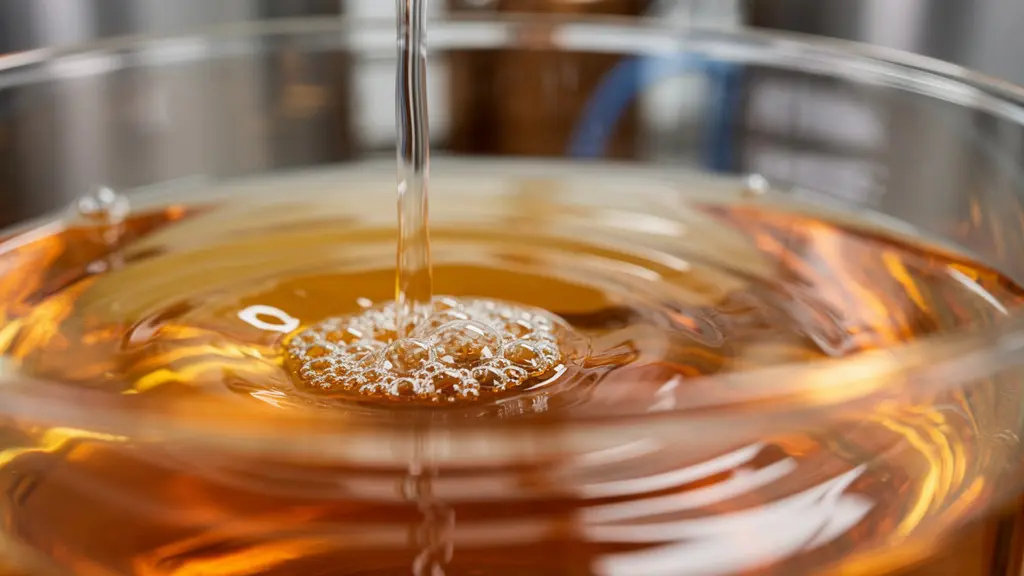
As the visual demonstrates, the process is one of precision. The water must be added slowly, ideally in a fine stream while the spirit is gently stirred. This gradual introduction helps the ethanol and water molecules integrate smoothly, preventing localized pockets of high and low proof that can shock the spirit and cause compounds to fall out of solution. Ensuring both the spirit and water are at the same temperature (ideally 20°C or 68°F) further minimizes this shock.
Glass Demijohns or Steel Tanks: Which is Best for Resting Unaged Spirits?
The choice of vessel for resting spirits is a critical decision driven by production scale, budget, and the desired outcome. For unaged spirits like gin, vodka, or white rum, the goal is to allow the spirit to stabilize without adding any character from the vessel itself. The main contenders are inert materials: stainless steel and glass. Neither imparts flavor, making them ideal for preserving the spirit’s original profile. The decision between them often comes down to practicality and scale.
Stainless steel tanks are the workhorses of the commercial spirits industry. They are durable, easy to clean, completely block UV light (which can damage spirits), and can be built to enormous sizes, making them perfect for large-volume production. Glass demijohns, on the other hand, are the choice for small-batch producers, experimentation, or storing high-value reference samples. While they offer perfect inertness, they are fragile, offer no light protection, and are impractical for large quantities. A third, more traditional option for marrying aged spirits like whisky are old, neutral wood vats, which allow for micro-respiration without adding significant wood flavor.
The following table provides a clear comparison of these options, highlighting how each choice aligns with different production needs. As the data shows, there is no single “best” option; there is only the right choice for a specific application.
| Vessel Type | Light Protection | Scalability | Best For |
|---|---|---|---|
| Stainless Steel Tanks | Complete UV blocking | Large volumes (200,000L+) | Commercial production |
| Glass Demijohns | No protection (dark room required) | Small batches | Experimental batches |
| Old Neutral Wood Vats | Complete protection | Medium volumes | Premium micro-respiration |
Case Study: Chivas Brothers’ Industrial Scale Marrying
The operational complexity at a large producer like Chivas Brothers offers a powerful real-world example. They use vats ranging from 2,000 to 200,000 litres in capacity with varying orientations (horizontal and vertical) and filling methods (top or bottom). This demonstrates that at scale, vessel choice is a complex engineering decision that depends not just on volume but also on the specific requirements of the whisky blend and the logistics of the production facility.
The Transport Mistake That Makes Your Whisky Taste Flat for Two Weeks
The phenomenon known as “bottle shock” or “travel sickness” is real and can temporarily flatten the aroma and palate of a perfectly good spirit. The agitation, vibration, and temperature fluctuations experienced during shipping create a state of sensory shock. This aggressive process can disrupt the delicate molecular equilibrium that was so carefully achieved during the marrying phase, causing some aromatic compounds to become less expressive. The result is a spirit that tastes closed, disjointed, or simply “off” for a period after it arrives.
While this effect is temporary, it can be alarming for consumers who open a prized bottle immediately upon delivery. As one industry expert noted, the bottling and shipping process is a harsh one. “The bottling process is quite aggressive and can literally ‘shock’ a spirit, so if you don’t allow at least the minimum amount of time for the bottles to rest, it will be very noticeable to the consumer.” Ignoring this recovery period is a common mistake that leads to a poor first impression.
Fortunately, the solution is simple: patience. The spirit simply needs time to rest and allow its molecular structure to settle back into equilibrium. For a production manager or a serious connoisseur, having a standard procedure for handling new arrivals is essential for ensuring a consistent tasting experience.
Action Plan: Post-Transport Spirit Recovery Protocol
- Store newly shipped bottles upright in a cool, dark, and stable environment (ideally 18-20°C / 64-68°F).
- Allow a minimum rest period of 7-14 days before opening to allow the spirit to recover from sensory shock.
- Avoid any further agitation or significant movement during this critical resting period.
- For premium, complex, or older spirits, consider extending the rest period to three weeks for optimal recovery and expression.
- If for professional evaluation, test a small sample after the minimum rest period before serving to guests or using in a tasting flight.
How Long Should You Wait After Filtration Before Bottling?
Filtration, whether it’s a simple particulate filtration or a more aggressive chill-filtration, is another process that “shocks” the spirit. It involves forcing the liquid through a medium, which creates turbulence and can agitate the molecules. More importantly, even the finest filtration can allow microscopic, near-colloidal particles to pass through. If the spirit is bottled immediately, these particles can slowly settle in the bottle, creating a fine sediment or “dusting” at the bottom, which is perceived as a quality flaw by consumers.
To prevent this, a post-filtration resting period is a non-negotiable step in any professional bottling operation. The spirit is transferred to a holding tank and left undisturbed. This allows any suspended micro-particulates (often called “fines”) to settle to the bottom of the tank via gravity. After the settling period, the clear spirit is drawn from the top of the tank, leaving the sediment behind. This ensures the final bottled product is brilliantly clear and stable.
The time required for this can vary based on the spirit and the intensity of filtration, but industry best practices dictate a minimum settling time of 24-72 hours. Rushing this step is a false economy; the potential cost of a product recall or damage to brand reputation due to sediment in the bottle far outweighs the cost of holding the spirit in a tank for an extra day or two.
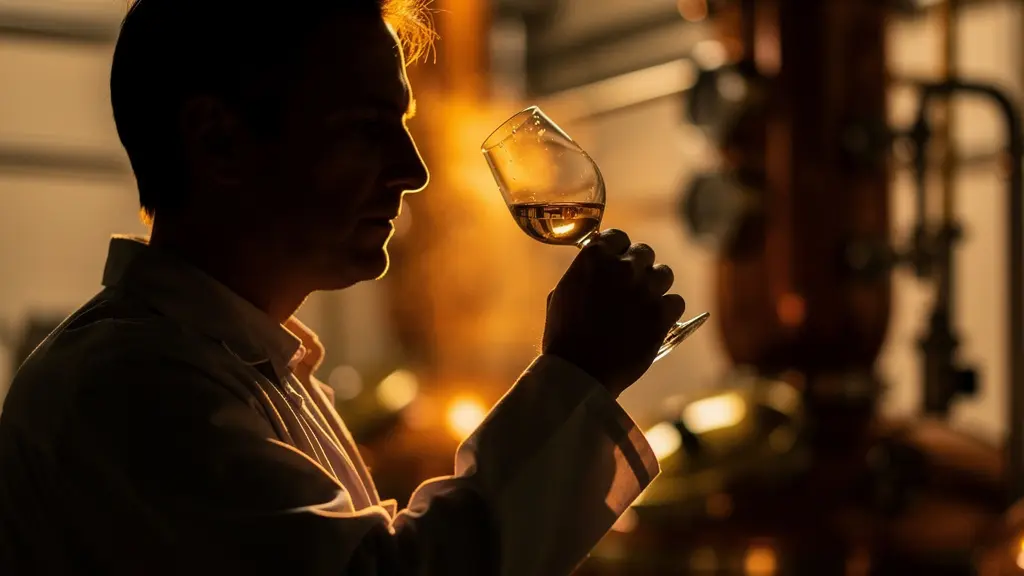
This waiting period is a final, critical quality check. It is the last opportunity to ensure the liquid’s physical clarity before it is sealed in the bottle. As shown, it is a moment where craftsmanship and patience directly translate into the quality of the finished product.
Why Does Non-Chill Filtered Whisky Turn Cloudy When You Add Water?
The cloudiness, or “haze,” that appears in a non-chill filtered (NCF) whisky when water or ice is added is not a flaw; it is a mark of authenticity. This phenomenon, known as flocculation, is a direct result of the presence of natural oils, fatty acids, and esters from the barley and the cask. These compounds are responsible for a significant portion of the whisky’s flavor and mouthfeel. During chill-filtration, these compounds are removed to ensure the whisky remains bright and clear even when cooled, but this comes at the cost of stripping out some of that character.
The Science Behind Spirit Flocculation
In high-proof spirits, ethanol acts as a solvent, keeping these flavor-rich, long-chain fatty acids (particularly ethyl dodecanoate and ethyl hexadecanoate in Scotch) dissolved and invisible. When the alcohol by volume (ABV) drops, the solvent power of the ethanol weakens. These compounds precipitate out of the solution, clumping together to form a visible haze. This is the exact same principle that causes the “louche” effect in absinthe and pastis when water is added, demonstrating a fundamental property of high-quality, minimally processed spirits.
There is a specific threshold for this effect. Generally, cloudiness will not occur in whiskies bottled above a certain strength. According to industry standards, this is why many NCF whiskies are bottled at or above a minimum of 46.3% ABV, as this strength is typically sufficient to keep the crucial congeners in solution at room temperature. The moment you add water or chill the spirit below this threshold, you are witnessing the precipitation of the very compounds that give the whisky its distinctive body and a portion of its flavor.
Therefore, a cloudy whisky should be seen as a sign that the producer has chosen to prioritize flavor and texture over cosmetic appearance. It is an indicator that you are tasting the spirit in a more natural and unaltered state.
How to Dilute 60% ABV Spirit Down to 40% for Home Bottling?
Diluting a spirit from cask strength to bottling strength seems like simple math, but there are critical procedures to follow for an accurate and stable result. The first step is getting a precise reading of your starting ABV. Alcohol hydrometers are calibrated to work at a specific temperature (usually 20°C / 68°F), so you must measure the spirit’s temperature and use a correction table to find the true ABV. Failing to do this is the most common source of error.
Once you have your true ABV and volume, you can use a dilution calculator to determine the exact amount of water needed. However, there’s a fascinating quirk of physics to account for: volume contraction. When alcohol and water are mixed, the total volume is slightly less than the sum of the individual volumes due to the way the molecules fit together. For example, mixing 10 gallons of 95% ABV spirit to dilute it to 40% ABV actually results in 0.696 gallons “missing” from the expected total volume. Professional calculators account for this, but it’s a crucial concept to understand.
Beyond the math, the physical process of mixing is vital. Following a strict protocol prevents shocking the spirit and ensures a stable final product.
- Verify Temperature and ABV: Measure the spirit’s temperature and use a correction chart to determine the accurate starting ABV. Ensure both the spirit and your dilution water are at the same temperature, ideally 20°C (68°F).
- Use Pure Water: Use only demineralized, reverse osmosis (RO), or distilled water with a mineral content below 89.4 ppm to avoid mineral reactions and off-flavors.
- Water into Spirit: ALWAYS pour the water into the spirit, never the other way around. Adding spirit to water can create a temporary, harsh over-proof shock that causes congeners to fall out of solution.
- Slow and Steady: Add the water in a fine, slow stream while gently but constantly stirring the spirit. This promotes gradual and homogenous integration.
- Rest the Spirit: After dilution is complete, allow the spirit to rest for a minimum of 7-10 days in an inert container before bottling. This allows the newly formed mixture to reach chemical equilibrium and for the flavors to “marry” together.
This final rest is not optional. It is the last step of the marrying process, allowing the diluted spirit to stabilize before it is sealed in the bottle.
Key Takeaways
- “Marrying” is a scientific process of reaching chemical equilibrium, not just “letting it sit.”
- Every input is a critical control point: water quality (<90 ppm minerals), vessel material (steel vs. glass), and temperature.
- Spirits experience “sensory shock” from transport and bottling, requiring a minimum 7-14 day rest period to recover their intended profile.
Why Does Adding Water to Whisky Unlock Aromas You Couldn’t Smell Before?
This phenomenon, where a few drops of water can dramatically open up a whisky’s bouquet, is explained by a combination of chemistry and physiology. At high strengths, typically cask strength above 55% ABV, ethanol acts not only as a carrier of flavor but also as a powerful anesthetic. It literally numbs the olfactory receptors in your nose and the taste buds on your tongue. At these high concentrations, the burning sensation of the alcohol can overpower the more subtle and delicate aromatic compounds, effectively hiding them from your senses.
Adding a small amount of water dilutes the ethanol, reducing its numbing effect. As one analysis of whisky science puts it, “At cask strength (>55% ABV), ethanol acts as a powerful anesthetic on the olfactory receptors and taste buds. Dilution reduces this numbing effect, allowing your senses to perceive more subtle and delicate notes that were previously masked.” This simple reduction in alcoholic “noise” allows the underlying aromatic “music” to be heard more clearly.
The Hydrophobic Effect in Spirit Tasting
The deeper science lies in the “hydrophobic effect.” Key flavor compounds like guaiacol (which provides smoky notes) and various esters (fruity and floral notes) are hydrophobic, meaning they are repelled by water. In a high-proof spirit, these molecules are trapped in “cages” formed by the ethanol molecules. When you add water, you disrupt these cages. The flavor molecules, being repelled by the water, are pushed to the surface of the liquid. This concentration at the liquid-air interface allows them to volatilize more easily and travel to your nose. Different aroma families are released at different dilution levels, which is why experimenting with water can reveal layers of complexity in a single glass.
So, adding water does two things: it liberates your senses from the anesthetic effect of high-proof ethanol, and it physically pushes aromatic compounds to the surface of the whisky where they can be more easily detected. It’s a simple action with a profound impact on the tasting experience, turning a static liquid into a dynamic aromatic journey.
Apply these principles as a non-negotiable part of your quality assurance protocol. By controlling these final variables, you ensure that the quality crafted in the still is the quality experienced in the glass.