
Contrary to popular belief, the primary role of cocktail ice isn’t just cooling; it’s controlling dilution. The superiority of clear ice over cloudy ice lies in its near-perfect structural integrity, which prevents it from actively ruining your drink.
- Cloudy ice is riddled with impurities that act as “nucleation points,” causing rapid, uncontrolled fizz loss and dilution.
- The shape of ice (sphere vs. cube) directly impacts its surface area, determining how quickly it melts and alters the spirit’s ABV.
Recommendation: To elevate your cocktails, stop treating ice as a disposable coolant and start crafting it as a primary, foundational ingredient.
For any host dedicated to the craft of a fine cocktail, the pursuit of perfection often focuses on premium spirits, fresh juices, and elegant glassware. Yet, the single most important ingredient is frequently the most overlooked: the ice. It is more than frozen water; it is the silent regulator of temperature, texture, and taste. The common assumption is that ice simply cools a drink. This is a profound misunderstanding. The true art lies in understanding that the quality of your ice—specifically its clarity and structure—dictates the final character of your creation.
The difference between a vibrant, perfectly balanced Old Fashioned and a watery, lackluster version often comes down to the battle between structurally pure, clear ice and its flawed counterpart, cloudy freezer ice. Cloudy ice doesn’t just melt faster; its imperfections actively sabotage the drink. It releases trapped gases that kill carbonation, carries “freezer funk” that taints delicate flavors, and introduces dilution in a chaotic, uncontrolled manner. This guide moves beyond the superficial to explore the physics and chemistry of perfect ice. We will treat ice as an artisan would: with an obsession for purity, temperature, and aesthetics.
This exploration will provide you with the knowledge not just to make your drinks look magazine-ready, but to fundamentally improve their taste by controlling the single greatest variable in mixology. We will dissect how to create flawless ice in your own home, why its shape is a critical decision, and how to master the delicate science of dilution. By the end, you will view that crystal-clear cube or sphere not as an accessory, but as the guardian of your cocktail’s integrity.
Summary: The Expert’s Guide to Cocktail Ice Science
- How to Make Crystal Clear Ice in a Standard Freezer Using a Cooler?
- Why Cloudy Ice Nucleation Points Kill the Fizz in Highballs?
- Cube or Sphere: Which Shape Minimizes Surface Area for Whiskey?
- The “Freezer Funk” Risk: How Ice Absorbs Food Odors and Ruins Drinks
- When to Remove Ice from the Freezer to Prevent Cracking in the Glass?
- Why Does a Thick Base Keep Your Ice Sphere Frozen Longer?
- Tap Water or Spring Water: Which Mineral Content Alters the Flavor?
- How to Calculate Dilution to Hit the Perfect ABV for a Martini?
How to Make Crystal Clear Ice in a Standard Freezer Using a Cooler?
The visual difference between crystalline, clear ice and opaque, cloudy ice is not merely cosmetic; it is the external sign of internal purity. Cloudy ice is riddled with trapped atmospheric gases and impurities that were frozen in place as the water solidified from all directions at once. To achieve aesthetic and structural purity, you must control the freezing process. The technique is known as directional freezing, and it mimics how lakes and ponds freeze in nature: from the top down.
By using a small, hard-sided cooler without its lid inside your freezer, you insulate the water on five of its six sides. This forces the water to freeze slowly from the single exposed surface at the top downwards. As the ice sheet forms, it naturally pushes dissolved gases and impurities down into the remaining unfrozen water. This process results in a top layer of stunningly clear ice, leaving a small, cloudy layer of rejected impurities at the very bottom, which you will discard. With patience, it’s possible to achieve ice that is up to 95% clear of impurities.
The result is a solid block of high-density, structurally sound ice. This block can then be carefully carved into perfect cubes, spears, or any desired shape. It is a testament to the principle that a superior ingredient is not found, but crafted. The following plan outlines the exact steps to transform your standard freezer into a professional-grade ice forge.
Action Plan: The Cooler Method for Perfect Clear Ice
- Prepare the Vessel: Use a small, hard-sided cooler that fits comfortably in your freezer. Remove the lid entirely, as it is not needed.
- Fill with Water: Fill the cooler with 4 to 5 inches of warm (not hot) tap water. Warm water contains slightly fewer dissolved gases, giving the process a small head start.
- Initiate Directional Freezing: Place the uncovered cooler in your freezer for 18 to 24 hours. The exact time will depend on your freezer’s temperature and the volume of water.
- Monitor and Harvest: Remove the cooler when the top is solidly frozen but a small layer of liquid water (typically 1-2 inches) remains at the bottom. This liquid contains the impurities you’ve forced out.
- Extract and Shape: Carefully remove the large ice block from the cooler. Place it on a cutting board and use a serrated knife or ice pick to score and cut the clear portion into your desired shapes. Discard the cloudy bottom layer.
Why Cloudy Ice Nucleation Points Kill the Fizz in Highballs?
The satisfying, persistent fizz of a freshly poured Gin & Tonic or Scotch & Soda is a delicate sensory experience. Dropping a cloudy ice cube into such a drink triggers a violent eruption of bubbles, a spectacle that might seem lively but is, in fact, the sound of your cocktail dying. This rapid degassing is caused by the millions of microscopic imperfections on and within the cloudy ice. These impurities—trapped air pockets and mineral particulates—act as nucleation points.
Each nucleation point is a site that dramatically lowers the energy required for dissolved CO2 gas to escape the liquid and form a bubble. Instead of a slow, elegant release, you get a chaotic fizz-out. As The Daily Meal’s editorial team notes in their analysis of ice science, these impurities are a core problem:
Most ice turns cloudy because of impurities including particulate matter and gases like oxygen that get trapped inside as the ice freezes. They serve as magnets for the formation of larger ice crystals.
– The Daily Meal Editorial Team, The Science Behind Those Fancy Clear Cocktail Ice Cubes
In contrast, the ultra-smooth surface of a pure, clear ice cube offers very few places for CO2 to latch onto. The carbonation is preserved, releasing gently over time for a consistently vibrant drink. This phenomenon is a direct consequence of thermodynamics, where the system seeks a state of higher entropy, a concept explored in detailed cocktail physics research. The rough surface of cloudy ice provides an easy pathway for this to happen, effectively “flattening” your drink in moments.
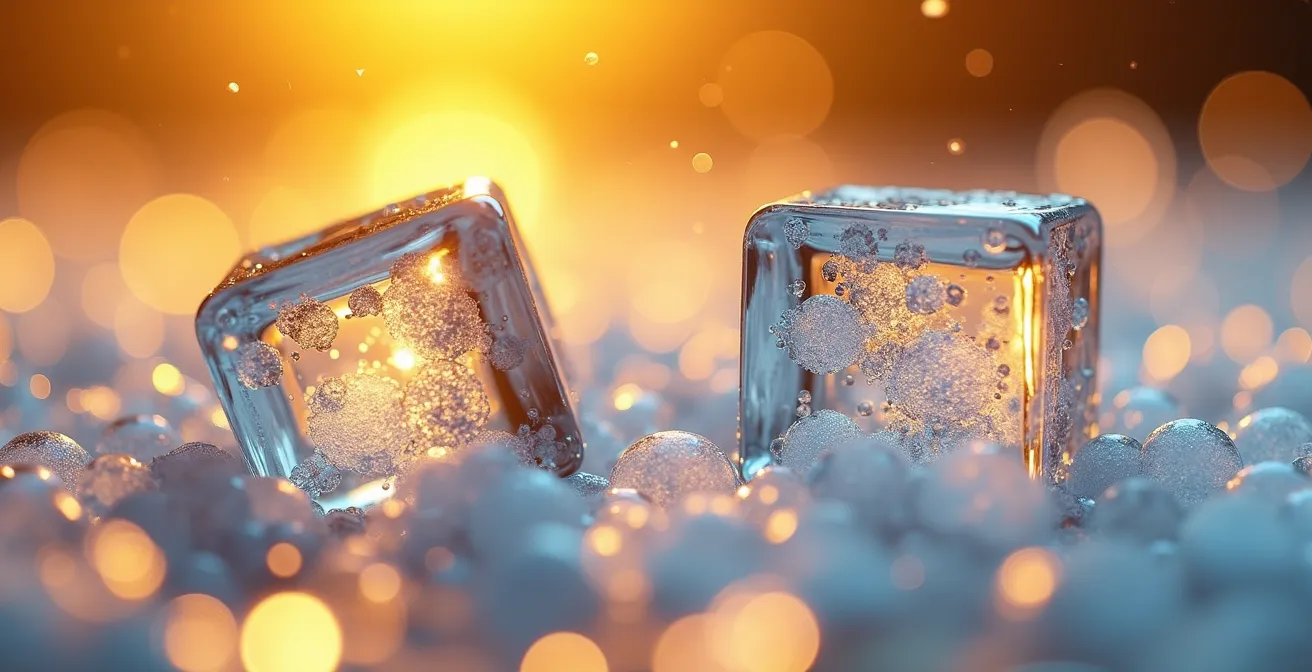
This image perfectly illustrates the assault on your highball. The rough, cloudy sections of the ice are veritable bubble factories, rapidly depleting the drink’s carbonation. The smooth, clear sections remain placid, preserving the fizz and the integrity of the cocktail. Choosing clear ice is choosing to protect the very soul of a carbonated drink.
Cube or Sphere: Which Shape Minimizes Surface Area for Whiskey?
When serving a premium spirit like a single malt Scotch or a fine bourbon, the goal of ice is not rapid chilling but gentle cooling with minimal dilution. This is where the geometry of ice becomes paramount. The rate at which ice melts is directly proportional to its surface area exposed to the warmer liquid. To preserve the spirit’s intended proof and flavor profile for as long as possible, you must choose a shape that has the lowest possible surface-area-to-volume ratio.
Mathematically, for any given volume, the shape with the minimum surface area is a sphere. A large ice sphere exposes significantly less of itself to the whiskey compared to a cube of the same volume, which has corners and flat sides that increase its total surface area. This fundamental difference in geometry is not trivial; research shows that spherical ice melts 20-40% slower than a standard cube of the same volume. This allows the drinker to enjoy their spirit as it slowly evolves with a controlled, “sacrificial dilution,” rather than having it quickly become a watered-down shadow of itself.
The choice of ice shape is therefore a strategic decision based on the desired level and speed of dilution, making it a critical tool for cocktail construction.
| Ice Shape | Surface Area (sq in) | Melting Rate | Best Use |
|---|---|---|---|
| Sphere | 1.74 | Slowest (baseline) | Whiskey, Old Fashioned |
| Cube | 2.16 | 20% faster | Versatile spirits |
| Spear | 2.8+ | 35% faster | Collins glasses |
The “Freezer Funk” Risk: How Ice Absorbs Food Odors and Ruins Drinks
You’ve meticulously crafted a block of crystal-clear ice, carved it into a perfect sphere, and are ready to pour a delicate, floral gin. But as the drink chills, a faint but unmistakable aroma of last week’s garlic bread or frozen fish begins to emerge. This is the “freezer funk,” and it is the bane of any serious cocktail enthusiast. Ice is not an inert solid; it is porous. Like a frozen sponge, it has a remarkable ability to absorb volatile organic compounds (VOCs)—the airborne molecules that carry odors—from its environment.
This is especially true for the ice stored in a typical home freezer, which is a shared space for a wide array of aromatic foods. Industry professionals report that uncovered ice can absorb detectable odors within just 24-48 hours. A few hours are all it takes to compromise the neutral canvas your ice is supposed to be. For a subtle spirit like a high-end vodka or a nuanced vermouth, this contamination is catastrophic, completely overpowering the distiller’s intended flavor profile.
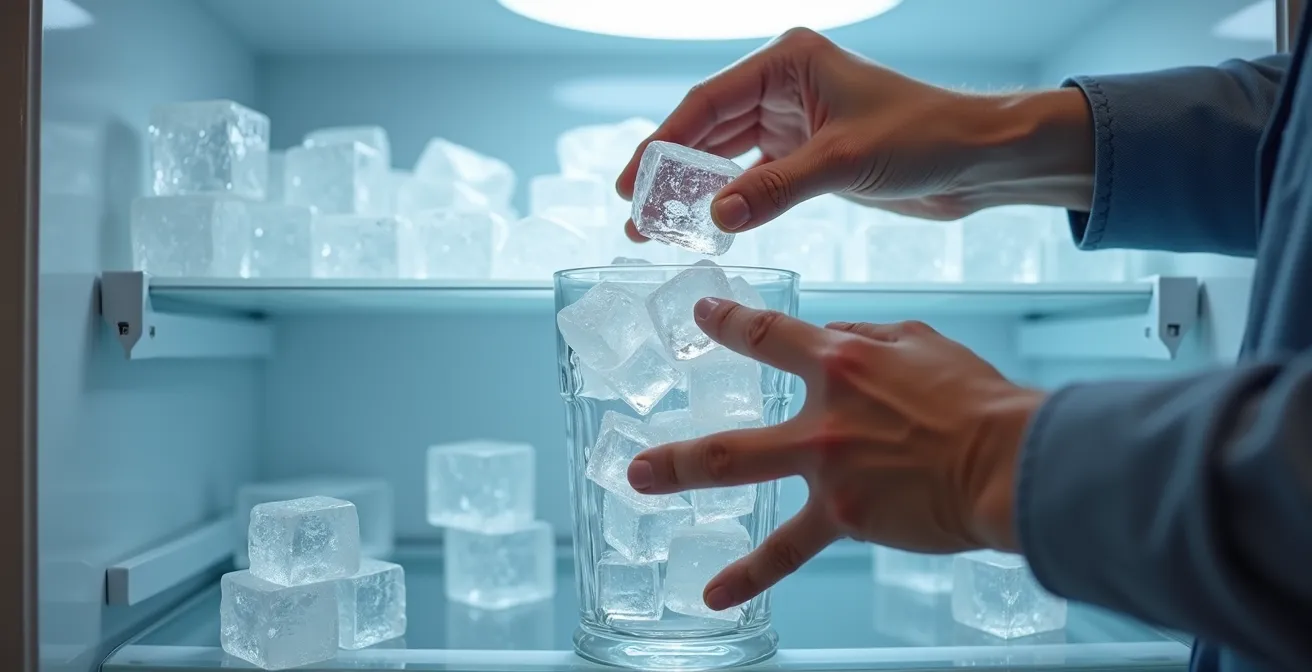
Protecting your ice is as crucial as crafting it. Once your clear ice is harvested and cut, it must be stored in a way that isolates it from the freezer’s atmosphere. The best practice is to use airtight, sealed containers, preferably made of glass or high-quality, non-porous plastic. For your most prized ice destined for premium spirits, a double-container system—placing ice in a sealed bag which then goes inside a sealed container—offers maximum protection against any invasive odors.
When to Remove Ice from the Freezer to Prevent Cracking in the Glass?
You place a flawless, diamond-clear ice cube into a beautiful rocks glass. You begin to pour your cocktail over it, and suddenly, a loud *snap* echoes as the ice violently cracks and shatters. This is thermal shock, a phenomenon that ruins both the aesthetic purity of your ice and its slow-melting properties. A shattered cube now has a massively increased surface area, leading to the very rapid, uncontrolled dilution you worked so hard to avoid.
This cracking occurs when ice that is far below the freezing point is suddenly exposed to a much warmer liquid. A typical home freezer is set to around 0°F (-18°C). Ice at this temperature is brittle. When the relatively warm (even if chilled) cocktail liquid hits its surface, the outer layer expands rapidly while the inner core remains super-chilled and contracted. The resulting stress is too much for the ice’s structure to handle, and it fractures.
The solution is simple: tempering. Before using it, remove your ice from the freezer and let it sit at room temperature for a few minutes. You are not waiting for it to melt, but for its surface temperature to rise closer to the freezing point of 32°F (0°C). The ice will “temper” and become more resilient. A tell-tale sign that it’s ready is when its frosty exterior turns clear and develops a wet sheen. This tempered ice can now accept the liquid without the risk of a catastrophic structural failure. As cocktail science pioneer Dave Arnold explains, the thermodynamics are fascinating:
Ice at 0°C can chill an alcoholic drink well below 0°C – a counter-intuitive but irrefutable consequence of thermodynamics. The universe likes increased entropy.
– Dave Arnold, Cocktail Science Research – Cooking Issues
This simple act of tempering is a small but critical step that separates the amateur from the specialist. It shows a deep respect for the ingredient and an understanding of the physical forces at play, ensuring the ice remains a perfect, solid guardian of your drink.
Why Does a Thick Base Keep Your Ice Sphere Frozen Longer?
The life of your perfect ice sphere doesn’t just depend on its own properties; it is heavily influenced by its environment, most notably the vessel that holds it. You can have the densest, coldest sphere, but if you place it in a thin-walled metal cup, you will watch it melt with astonishing speed. This is because of heat transfer. Your hand, at a warm 98.6°F (37°C), and the ambient air are constantly trying to transfer thermal energy into the colder cocktail.
The glassware acts as the primary barrier. Different materials conduct heat at vastly different rates. Metal is an excellent conductor, which is why metal tumblers feel so cold to the touch—they are rapidly pulling heat from your hand and transferring it directly to the drink, accelerating dilution. Standard glass is a better insulator, but the best defense is a heavy, thick-based crystal or glass tumbler. The sheer mass and low thermal conductivity of a thick base act as a heat sink, absorbing energy from your hand and the surface it rests on before it can reach the cocktail.
This choice of glassware is not just about aesthetics or heft; it is a functional decision to insulate the drink. The material science is clear: a thick, low-conductivity material will preserve your ice and your cocktail’s integrity for the longest possible time, ensuring the first sip is as good as the last.
| Material | Thermal Conductivity | Ice Retention | Hand Heat Transfer |
|---|---|---|---|
| Crystal (thick) | Low | Excellent | Minimal |
| Glass (standard) | Medium | Good | Moderate |
| Metal tumbler | High | Poor | Rapid |
Tap Water or Spring Water: Which Mineral Content Alters the Flavor?
In the quest for perfectly clear ice, a common debate arises: what is the best water to use? Many guides insist on using expensive distilled or filtered spring water, claiming that the minerals (Total Dissolved Solids or TDS) in tap water are the primary cause of cloudiness and off-flavors. While it’s true that a high mineral content can contribute to cloudiness and potentially impart a slight taste, this concern is largely overstated and misses the bigger picture.
The primary culprit behind cloudy ice is not minerals, but trapped atmospheric gases like oxygen and nitrogen. Minerals play only a secondary role. As a case study on clear ice formation methods reveals, the choice of water source is far less important than the technique used to freeze it. Many experts find that boiled tap water can produce clear ice just as effectively as distilled water when subjected to directional freezing.
Case Study: The Water Source Myth
Tests comparing clear ice made from tap water, boiled tap water, and distilled water using the directional freezing cooler method reveal a surprising result. While distilled water produces a slightly higher yield of perfectly clear ice, the difference is often negligible for home use. The key finding is that directional freezing is the dominant factor. It successfully removes both trapped gases and the vast majority of mineral impurities, pushing them down into the discardable bottom layer. The myth that one *must* use distilled water is largely debunked; a good technique is far more impactful than a “pure” water source.
For the home enthusiast, your standard tap water is more than sufficient, provided you employ the directional freezing method. Boiling the water once or twice before freezing can help release some dissolved gases as a preliminary step, but it is the slow, top-down freezing that does the real work. Focus your energy on perfecting your technique, not on sourcing expensive water.
Key Takeaways
- The superiority of clear ice stems from its structural integrity, which provides slow, controlled dilution, unlike cloudy ice that sabotages drinks.
- Directional freezing is the essential technique to create pure ice by forcing impurities and trapped gases into a discardable bottom layer.
- The shape of the ice (sphere vs. cube) is a critical choice that directly controls melting speed by altering the surface-area-to-volume ratio.
How to Calculate Dilution to Hit the Perfect ABV for a Martini?
The final frontier of cocktail mastery is not just minimizing dilution, but controlling it with scientific precision. For stirred drinks like a Martini or a Manhattan, dilution is not the enemy; it is a crucial ingredient that softens the alcoholic bite, opens up aromatic compounds, and brings the drink to its optimal alcohol by volume (ABV) and temperature. A Martini served at full proof straight from the bottle would be harsh and unbalanced. The goal is to achieve the perfect “sacrificial dilution.”
This can be calculated. Experts like Dave Arnold have done extensive research on the thermodynamics of chilling and dilution. Shaking is an extremely efficient but violent method, achieving equilibrium in about 15 seconds. Stirring, however, is a more gentle and controllable art. It is, as Arnold puts it, a form of “inefficient shaking.”
Think of stirring as inefficient shaking. It can take over 2 minutes of constant stirring to do what shaking accomplishes in 15 seconds. No one stirs for 2 minutes, so the drink never reaches equilibrium.
– Dave Arnold, Liquid Intelligence – Cocktail Science
This “inefficiency” is a feature, not a bug. It gives the bartender precise control. By weighing the mixing glass with ingredients before and after stirring, one can measure the exact amount of water added from the melting ice. A common target for a Martini is around 25-30% dilution by weight. By stirring for a set time (e.g., 30-40 seconds) with consistent ice and technique, you can reliably hit this target every time, ensuring your Martini is not just cold, but perfectly balanced to your exact specifications.
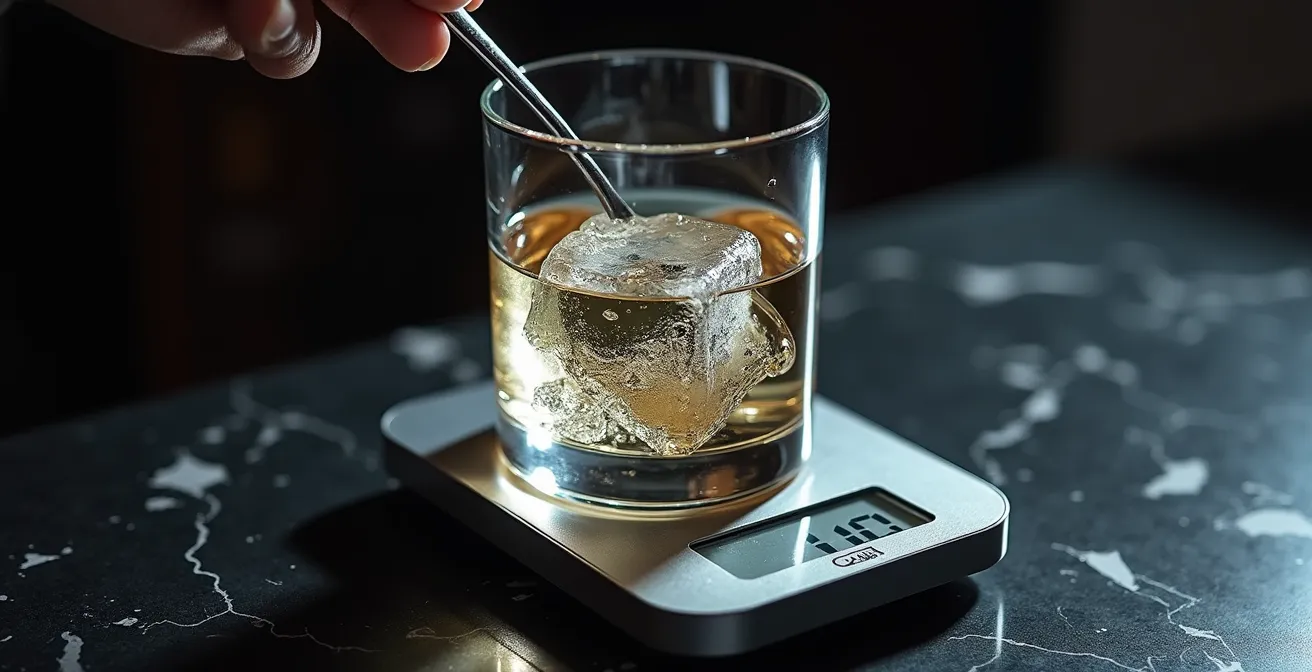
This level of precision—using a scale to measure water content—may seem obsessive, but it is the essence of the craft. It transforms bartending from guesswork into a science, guaranteeing a flawless, repeatable result that honors the quality of the spirits you are using.
Begin your journey to cocktail perfection by treating ice not as an afterthought, but as your most crucial and controllable ingredient. Embrace the science, master the technique, and transform every drink you serve into a masterpiece of balance and beauty.