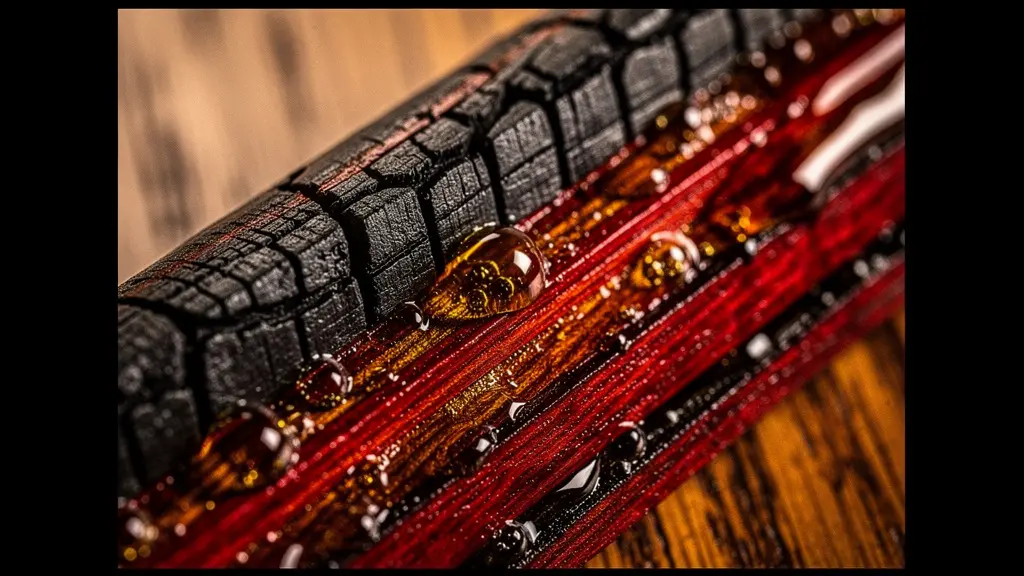
Heavy charring transforms a barrel into a high-performance bioreactor, excelling at both subtractive and additive maturation where light toasting falls short.
- The deep pyrolytic layer creates activated carbon, which chemically scrubs sulfur compounds and other impurities from the new make spirit.
- Intense heat breaks down wood polymers like hemicellulose and lignin into desirable flavor compounds, including toffee, caramel, and vanilla.
Recommendation: For a cleaner, more complex spirit, prioritize a heavy char level (#3 or #4) to maximize both the filtration capacity and the generation of flavor precursors.
The image of a whiskey barrel set ablaze is an iconic part of spirits production. But this dramatic process is far from simple arson; it’s a precise application of thermal chemistry. While many understand that charring “adds flavor” and “filters the spirit,” this explanation barely scratches the surface. The real distinction between a heavy char and a light toast lies in a fundamental transformation of the wood itself. Heavy charring initiates a deep pyrolytic reaction, turning the interior of the barrel into a dual-function engine: a powerful activated carbon filter for subtractive maturation and a thermal catalyst for complex additive maturation.
A lightly toasted barrel, by contrast, primarily caramelizes the most superficial wood sugars, offering a gentle, additive-only enhancement without the profound filtering capabilities of a true char layer. For a distillery owner, understanding this distinction is critical. You are not merely choosing a color or a simple flavor profile; you are selecting a specific chemical reactor for your spirit. This guide delves into the wood chemistry that explains why a heavily charred surface is structurally and functionally superior for creating a clean, complex, and mature spirit, moving beyond the common platitudes to provide a technical foundation for your maturation strategy.
To fully grasp the chemical processes at play, this article breaks down the distinct roles of the char layer, from sulfur removal to flavor creation. The following sections will provide a detailed roadmap into the science of barrel maturation.
Summary: The Science of Barrel Char and Spirit Maturation
- How Activated Carbon in Charred Wood Removes Sulfurs from the Spirit?
- Char Level 3 or Alligator Char: Which Adds More Color in 6 Months?
- Why Does the “Red Layer” Under the Char Create Toffee Notes?
- The “Ash Tray” Flaw: How to Identify Spirits Aged in Burnt-Out Casks?
- When to Empty a Heavy-Char Cask Before Bitterness Sets In?
- Why Your Spirit Tastes like Rubber: The Critical Role of Copper Catalysis?
- Why Charring Oak Barrels Unlocks More Intense Vanilla Flavors?
- American Oak or European Oak: Which Wood Profile Suits Your Palate?
How Activated Carbon in Charred Wood Removes Sulfurs from the Spirit?
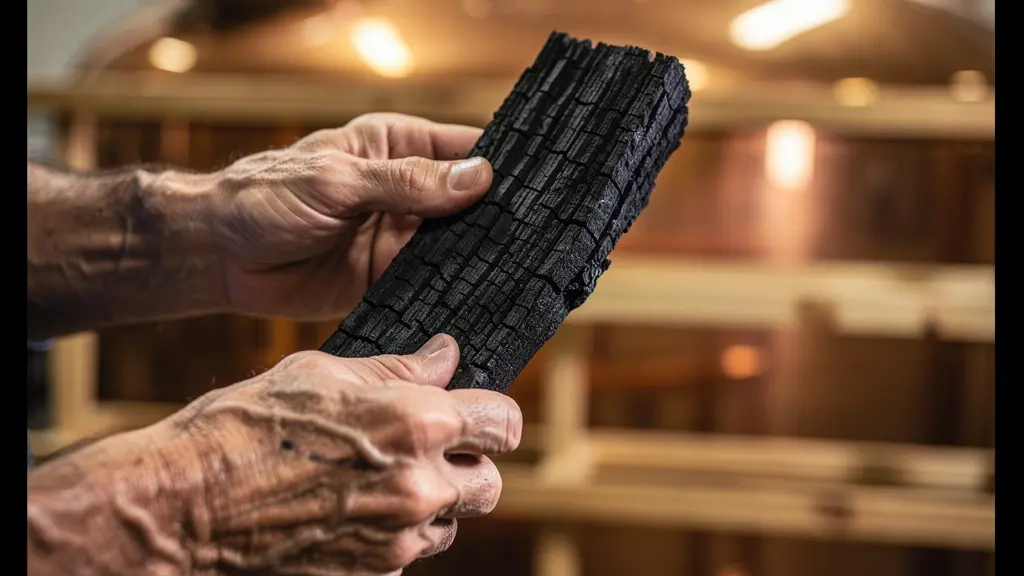
The primary advantage of a heavy char is its creation of an ‘activated carbon’ layer. This is not merely burnt wood; it’s a porous, high-surface-area material engineered for filtration. During pyrolysis, the intense heat vaporizes organic molecules within the oak, leaving behind a carbon structure riddled with microscopic pores. This process is the core of subtractive maturation—the removal of undesirable compounds from the new make spirit. The vast network of pores acts like a chemical net, trapping large, off-flavor molecules, particularly volatile sulfur compounds.
The effectiveness of this layer is immense. Research shows that sugar maple charcoal, similar in function to barrel char, can have a surface area of 300 square meters per gram. This massive surface provides countless bonding sites for impurities. As the spirit penetrates the wood, compounds like dimethyl trisulfide—responsible for rubbery or cabbage-like off-notes—are adsorbed onto the carbon surface and effectively removed from the liquid. This is precisely the principle behind the famed Lincoln County Process used in Tennessee Whiskey.
Scientific analysis of this process confirms its efficacy. Studies have demonstrated that charcoal filtration removes a significant portion of fusel oils and esters, but its most critical role is scrubbing the spirit clean of sulfurous elements that copper distillation may have missed. This chemical ‘cleaning’ is a function that a simple toasted barrel cannot perform, making heavy char essential for producing a smooth and refined final product.
Char Level 3 or Alligator Char: Which Adds More Color in 6 Months?
When choosing between a heavy char (#3) and the heaviest “alligator” char (#4), the impact on color is often a key consideration. While it seems intuitive that more char equals more color, the reality is more nuanced, especially over a six-month period. Alligator char (#4), created by a longer, more intense burn, produces a thick, fractured layer of carbon. This provides a rapid, initial burst of dark color as loose carbon particles dissolve into the spirit. However, this color is often superficial and can lack depth.
A char level #3, while still deep, leaves the wood structure slightly more intact beneath the surface. This allows the spirit to interact more effectively with the caramelized “red layer” just below the char. Over a period of three to six months, this interaction pulls out deeper, more complex color compounds, resulting in a rich amber-red hue rather than the simple dark brown from a char #4. The following comparison illustrates this timeline.
The table below, based on data from an in-depth guide to char levels, outlines how color extraction evolves over time.
| Char Level | Char Time | Initial Color (0-3 months) | 6-Month Color | Characteristics |
|---|---|---|---|---|
| Char #3 | 35 seconds | Moderate amber | Deep amber-red | Steady extraction, complex hue |
| Char #4 (Alligator) | 55 seconds | Dark amber burst | Very dark brown | Rapid initial extraction, surface-level darkness |
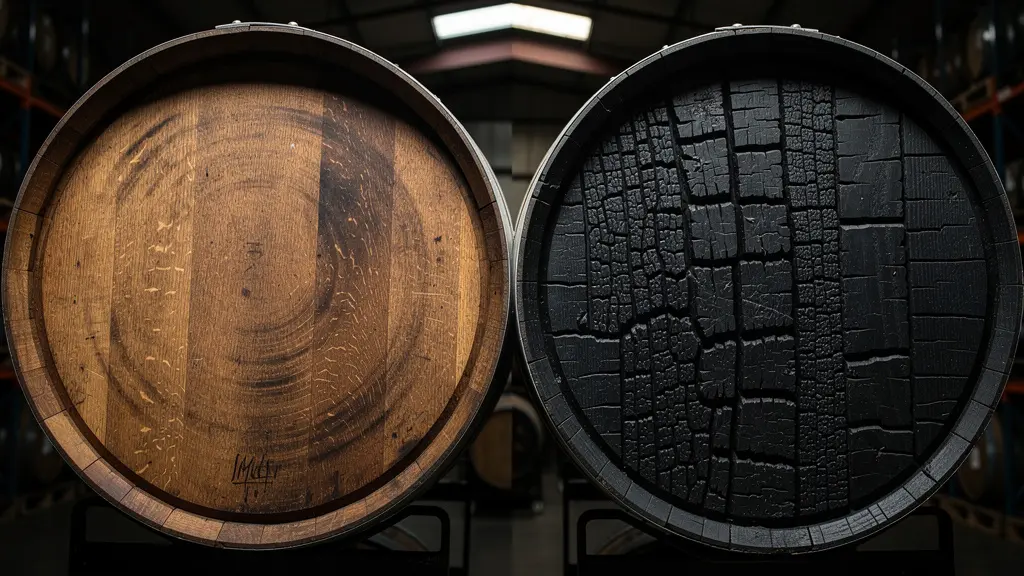
As the visual evidence and data suggest, for distillers seeking a rich and complex color profile within the first six months, a char #3 often outperforms a char #4. The alligator char provides immediate darkness, but the char #3 facilitates a more gradual and ultimately more rewarding extraction of color and flavor from the deeper layers of the wood.
Why Does the “Red Layer” Under the Char Create Toffee Notes?
Beneath the black, carbonized char lies the most important zone for flavor development: the “red layer.” This thin, reddish-brown band of thermally degraded wood is where the magic of additive maturation truly begins. It is not burnt, but intensely heated, causing the wood’s structural polymers to break down and transform into a rich source of flavor. The primary contributor to the signature toffee and caramel notes is the thermal degradation of hemicellulose.
Hemicellulose is a complex wood sugar polymer. When subjected to intense heat, it depolymerizes into simpler sugars like xylose and glucose. According to technical analyses, this critical transformation happens as hemicellulose breaks down at temperatures of 284°F and above. These newly freed sugars then undergo caramelization and Maillard reactions, creating a host of flavor compounds.
This process generates key molecules responsible for the sweet, confectionary notes in aged spirits. Furfural, a product of hemicellulose breakdown, imparts almond and caramel notes. Simultaneously, the Maillard reaction contributes to the formation of maltol, which provides flavors of toasted bread and toffee. This layer is a flavor factory, and its proper formation—achieved through a sufficiently heavy char—is essential for developing a spirit with depth and a rich, sweet character.
The “Ash Tray” Flaw: How to Identify Spirits Aged in Burnt-Out Casks?
While the char layer is a powerful tool, it has a finite lifespan. When a cask is overused or improperly re-charred, its filtration capacity becomes exhausted. This leads to one of the most unpleasant maturation flaws: the “ash tray” taste. This defect is not a desirable smoky note but a dry, acrid, and metallic flavor reminiscent of cold cigarette ash. It’s a clear signal that the barrel’s subtractive maturation capabilities have failed.
This flaw arises from the formation of Polycyclic Aromatic Hydrocarbons (PAHs). As explained in a detailed analysis of barrel char, while a healthy char layer removes sulfurs, an exhausted or compromised one can begin to leach these undesirable PAHs into the spirit. This is especially common in barrels that have been re-charred multiple times, as the process can destroy the underlying wood structure and create a brittle, ineffective carbon layer.
A healthy char layer typically has a thickness ranging from 1/8 to 1/4 inch. When this layer is depleted, the spirit’s interaction with the wood becomes unbalanced, leading to the extraction of these acrid compounds instead of desirable flavors. For a distiller, identifying this flaw early is crucial to prevent the ruin of a batch. Sensory analysis—nosing and tasting for that signature cold, metallic ash note—is the primary method of detection.
Action Plan: Sensory Audit for Burnt-Out Cask Flaws
- Visual Inspection: Before filling, check the char. Is it brittle, flaky, or unusually thin? Look for exposed, uncharred wood where the char should be deep.
- Nose the New Make: After a few weeks of aging, draw a sample. Nose specifically for sharp, acrid, or chemical notes that are distinct from clean wood or grain aromas. The “cold ash” smell is a major red flag.
- Palate Test: Taste the sample. The flaw manifests as a drying, metallic, and bitter sensation on the mid-palate and finish, completely overpowering any sweetness. It is distinctly different from tannic bitterness.
- Compare to a Control: Always compare a suspect cask’s sample against a sample from a new, trusted barrel aged for the same duration. The difference will be stark.
- Document and Isolate: If the flaw is detected, immediately document the cask number and isolate it. The spirit may be unrecoverable or require significant remediation.
When to Empty a Heavy-Char Cask Before Bitterness Sets In?
Aging in a heavy-char cask is a race against time. The goal is to maximize the extraction of positive flavor compounds from the red layer while minimizing the extraction of harsh tannins from the raw wood beneath. The moment when bitter and astringent notes begin to overpower the desirable sweetness is the “tipping point.” Knowing when this will occur is crucial for deciding when to empty the cask.
This timeline is governed by two primary factors: barrel size and entry proof. Smaller barrels have a much higher surface-area-to-volume ratio, leading to dramatically accelerated maturation. A spirit can extract as much flavor from a 5-gallon barrel in months as it would from a 53-gallon barrel in years. A case in point, data shows that 5 gallon barrels extract 4-5 times faster than their 53-gallon counterparts. A lower entry proof also changes the extraction dynamics, as the higher water content interacts differently with the wood’s chemistry, often leading to a slower, more delicate extraction.
The key for a distiller is to sample frequently and understand the typical maturation curve for their specific barrel type and warehouse conditions. The tipping point from optimal flavor to excessive bitterness can arrive quickly, especially in smaller format casks.
| Barrel Size | Entry Proof | Optimal Extraction | Tipping Point |
|---|---|---|---|
| 5 Gallons | 62.5% ABV | 3-6 months | 8-10 months |
| 15 Gallons | 62.5% ABV | 6-12 months | 15-18 months |
| 53 Gallons | 62.5% ABV | 2-4 years | 5-7 years |
| 53 Gallons | 50% ABV | 3-5 years | 7-10 years |
This timeline serves as a general guide. Regular sensory analysis is non-negotiable to determine the precise moment your spirit has reached its peak and must be removed from the cask before the aggressive wood tannins take over.
Why Your Spirit Tastes like Rubber: The Critical Role of Copper Catalysis?
If a new make spirit has a distinct rubbery or sulfuric off-note, the problem often originates long before it enters the barrel. These flavors are caused by volatile sulfur compounds, such as dimethyl trisulfide, which are natural byproducts of fermentation. The primary line of defense against these compounds is not the barrel, but the still itself—specifically, if it is made of copper.
Copper acts as a crucial catalyst during distillation. As the hot alcoholic vapor rises and makes contact with the copper surfaces of the still pot, helmet, and lyne arm, a chemical reaction occurs. The copper binds with the sulfur compounds, forming copper sulfate, a non-volatile solid that is left behind in the still. This process effectively ‘cleans’ the spirit before it even reaches the condenser. A lack of sufficient copper contact is a common reason for sulfuric notes in the final new make.
The barrel char serves as the vital secondary, and final, filtration step. While the copper still should remove the majority of these compounds, some inevitably pass through. The activated carbon layer in a heavily charred barrel then works to adsorb these remaining off-notes. This dual-stage purification—copper catalysis followed by carbon filtration—is essential for producing a clean, high-quality spirit. If the spirit tastes like rubber even after aging, it may indicate an issue at the distillation stage that the barrel is struggling to correct.
Why Charring Oak Barrels Unlocks More Intense Vanilla Flavors?
Beyond caramel and toffee, the most sought-after flavor from oak maturation is vanilla. This signature note is derived from the thermal degradation of lignin, one of the main structural polymers in wood, second only to cellulose. Lignin’s complex structure acts as a binder, holding the wood fibers together. When heated during the charring process, it breaks down into a range of aromatic compounds, the most notable of which is vanillin—the primary chemical component of natural vanilla.
The intensity of the char plays a direct role in the amount of vanillin produced. A light toast may not generate enough heat to effectively break down the lignin. A heavy char, however, creates a ‘sweet spot’ in the layer of wood just behind the char. In this zone, the wood is super-heated but not incinerated, creating the perfect conditions for lignin pyrolysis. This process breaks the complex lignin polymer into smaller, more volatile aromatic aldehydes, including vanillin and syringaldehyde (which imparts a smoky, spicy note).
The results are quantifiable. Depending on the specifics of the wood and the charring process, heavy charring can increase vanillin extraction by up to 25% compared to lighter treatments. This is because the intense heat makes the lignin more accessible to the spirit. For a distiller looking to create a bourbon or whiskey with a pronounced, sweet vanilla backbone, a heavy char level is not just an option; it’s a necessity for unlocking the full potential of the oak’s lignin.
Key Takeaways
- Heavy char creates an activated carbon layer that filters out sulfur compounds (subtractive maturation).
- The “red layer” beneath the char is where heat breaks down hemicellulose into caramel and toffee flavors (additive maturation).
- Lignin degradation from intense heat is the primary source of vanillin, a key flavor unlocked by heavy charring.
American Oak or European Oak: Which Wood Profile Suits Your Palate?
While the char level is a critical variable, the underlying chemistry of the wood itself is equally important. The two most common species used in cooperage, American White Oak (Quercus alba) and European Oak (Quercus robur/petraea), have fundamentally different chemical profiles that make them suitable for different spirits and maturation strategies.
American Oak is the mandatory choice for bourbon for a reason: it is rich in cis-oak lactones. These compounds are responsible for the powerful notes of coconut, vanilla, and sweet spices that define the bourbon profile. American oak is also less dense, with a wider grain, which allows for deeper spirit penetration and faster extraction of flavors. This structure makes it exceptionally well-suited to heavy charring, as the heat can more easily access the hemicellulose and lignin within the staves.
European Oak, in contrast, is much denser with a tighter grain. It has significantly lower levels of lactones but is higher in tannins. This results in flavors of dried fruit, leather, and savory spice rather than overt vanilla and coconut. Its dense structure makes it less ideal for heavy charring and better suited to toasting, which gently coaxes out its spicy, tannic character. It is the preferred wood for many Scotches, sherries, and wines where a slower, more oxidative maturation is desired.
| Characteristic | American Oak (Quercus alba) | European Oak (Quercus robur/petraea) |
|---|---|---|
| Lactone Content | High cis-oak lactone | Lower lactone levels |
| Primary Flavors | Vanilla, coconut, caramel | Spice, dried fruit, leather |
| Wood Density | Less dense, wider grain | Denser, tighter grain |
| Char Response | Exceptional for heavy charring | Better with toasting |
| Maturation Speed | Faster extraction | Slower, more oxidative |
For a distiller, the choice is clear. If your goal is to produce a spirit with the bold, sweet, and vanilla-forward character typical of American whiskey, the high-lactone profile of American Oak combined with a heavy char is the ideal chemical pairing.