
Contrary to popular belief, the PPM number on a whisky label is a poor predictor of perceived smokiness. This is because a significant majority of peat phenols are lost during production, cask aging fundamentally alters the smoke profile, and other dominant flavors from the wood can mask what remains. True smokiness is the result of specific, quantifiable production choices, not a simple raw material metric.
You’ve done the research. You’ve hunted down a bottle boasting a massive Parts Per Million (PPM) count, expecting a bonfire in a glass. You pour a dram, anticipate the wave of medicinal, tarry smoke, and instead… it’s there, but it’s muted, reserved, perhaps even overshadowed by vanilla and spice. The confusion is common among even the most dedicated peat enthusiasts: why doesn’t the number on the spec sheet consistently translate to the sensory experience? The typical answer, that “PPM is measured on the malted barley, not the final liquid,” is correct but incomplete. It’s the beginning of the story, not the end.
The reality is a complex journey of chemical loss, transformation, and sensory competition. The number printed on the tin of malt is a starting potential, a theoretical maximum that is immediately and drastically reduced. To truly understand the smokiness in your glass, you must stop thinking like a consumer and start thinking like a distillery chemist. We must follow the phenols—the class of chemical compounds responsible for peaty flavours—on their violent journey from the peat bog to the bottle, analyzing where they are lost, how they are changed, and why they are sometimes silenced.
This article will deconstruct that journey. We will move beyond the marketing and into the hard science of peat, examining the critical points in distillation, maturation, and even food pairing that dictate the final smoky character of a whisky. This is not about opinion; it is about the data and processes that shape the spirit you love.
Contents: Decoding the Journey of a Phenol
- Why Do You Lose 60% of Peat Phenols During the Distillation Cut?
- How to Read a Spec Sheet: Malt PPM vs Liquid PPM Explained
- Islay Peat or Highland Peat: Which Source Creates the “Band-Aid” Note?
- The Dark Color Trap: Why Pale Whiskies Are Often the Smokiest?
- When Is the Best Season to Cut Peat for Maximum Combustion Efficiency?
- Salty or Smoky: Which Element Should Lead in a Dinner Pairing?
- Why Does Salty Prosciutto Enhance the Sweet Notes in Rye Whiskey?
- How Does Sea Air Penetrate Casks to Create Saline Whisky Profiles?
Why Do You Lose 60% of Peat Phenols During the Distillation Cut?
The single greatest loss of smokiness occurs in the still house, a direct result of fundamental physics. Phenols, the compounds that give us flavours of smoke, tar, and iodine, are large, heavy molecules. Compared to the much lighter ethanol and water molecules, they have a very high boiling point. This means they are reluctant to vaporize during distillation. They prefer to stay behind in the liquid wash rather than rise with the alcohol vapour that will eventually become the spirit.
As the distillation run progresses, the temperature in the pot still gradually increases. The lighter, more volatile alcohols (the “foreshots”) come off first. It is only towards the end of the run, as temperatures climb higher, that the heavy phenols begin to vaporize in significant quantities. These come through in the “tails” of the distillation. The distiller’s job is to make a “cut”—to decide precisely when to start and stop collecting the spirit. A distiller seeking a heavily peated spirit will make a later, wider cut to capture more of these late-arriving phenols.
However, this is a balancing act. The tails also contain undesirable, oily compounds (fusel oils) that can make the spirit unpleasant. Therefore, a distiller can never capture all the phenols. As Scotch Whisky Magazine notes when explaining this process:
Phenols are big molecules with a high boiling-point which are only released as vapour towards the end of the distillation cycle. Their capture will therefore depend on the cut points set by the distiller.
– Scotch Whisky Magazine, The truth about peated whisky and phenols
This explains why two distilleries, like Lagavulin and Caol Ila, can start with the exact same peated malt and produce whiskies with vastly different smoke profiles. Caol Ila’s taller stills and different cut points result in a lighter, less phenolic spirit. Overall, research indicates that 40-80% of phenolic content can be lost during the total production process, with the distillation cut being the most significant point of loss.
How to Read a Spec Sheet: Malt PPM vs Liquid PPM Explained
The number you see on a label—for instance, “55 PPM”—refers to the phenol level of the malted barley before it is ever mashed. It is a measurement of the raw material, not the finished product. As we’ve established, a huge percentage of these phenols are lost during production. The “Liquid PPM” or “New Make PPM” is the far more relevant, but rarely disclosed, number representing the phenolic content of the spirit coming off the still.
The drop-off can be staggering. For example, distillation data shows that Ardbeg’s 54 PPM malt typically yields a new make spirit with a Liquid PPM between 17 and 24. That’s a reduction of over 50% before the spirit even touches a cask. This difference between “Malt PPM” and “Liquid PPM” is the first and most critical piece of data to understand when trying to predict a whisky’s character. The initial number is a ceiling, not a guarantee.
The illustration below helps conceptualize this drastic reduction from the solid raw material to the final liquid spirit. It’s a process of extraction and loss, where only a fraction of the original smoke potential makes it through.
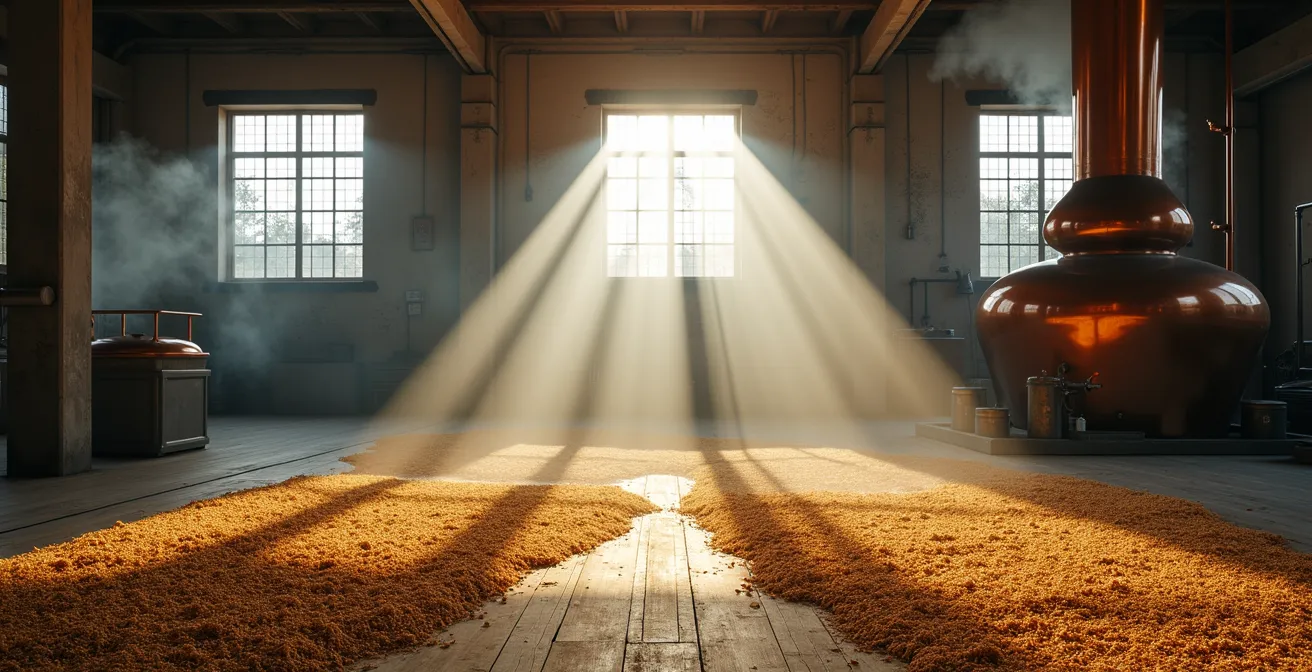
Understanding this distinction is key to decoding a spec sheet. Instead of taking the Malt PPM at face value, you must learn to see it as an indicator of a distillery’s *intent*. A high Malt PPM signals an intent to create a smoky whisky, but the final expression is dictated by the efficiency of their process in retaining those phenols.
Action Plan: Reading a Whisky Spec Sheet Like a Pro
- Initial PPM: Note the malt PPM but treat it as a maximum potential, not a final value. This is your starting point.
- Distillery Process: Research the distillery’s cut points and distillation speed. A slower distillation and later cut will generally retain more phenols.
- Cask Type: Identify if it’s first-fill (more cask influence, which can mask smoke) or refill (less cask influence, allowing the smoke to be more prominent).
- Age Statement: Factor in the age. A younger whisky will be closer to its post-distillation smokiness than an older one, where phenols have had time to degrade.
- Predicted Profile: Synthesize these points to build a sensory profile prediction that is far more accurate than relying on the initial PPM number alone.
Islay Peat or Highland Peat: Which Source Creates the “Band-Aid” Note?
Not all smoke is created equal. The characteristic “Band-Aid,” iodine, or medicinal note so often associated with Islay whiskies is not a product of smoke in general, but of a specific type of smoke. This is a direct result of the composition of the peat itself. The geographical origin of the peat determines its chemical makeup, which in turn dictates the profile of the smoke it produces when burned.
Islay’s environment is largely treeless and coastal. Its peat is composed almost entirely of decayed sphagnum moss, heather, and coastal vegetation, including seaweed. This composition is low in a compound called guaiacol (which produces woody, spicy smoke notes) and high in another group of phenols called cresols. It is these cresols that are responsible for the distinctive antiseptic or medicinal aromas. As Alcohol Please HK clarifies:
The ‘Band-Aid’ or medicinal note is primarily caused by cresols (a type of phenol), which are more abundant in the peat from Islay due to its composition of sphagnum moss and coastal vegetation.
– Alcohol Please HK, Peated Whisky Guide 2026
In contrast, peat from the mainland Highlands or islands like Orkney contains more decomposed wood and forest debris. When this peat is burned, it releases more guaiacol and syringol, resulting in a smoke profile that is more akin to a campfire, with notes of woodsmoke, clove, and a more “earthy” character, largely free of the sharp medicinal notes. Indeed, chemical analysis reveals that up to 40% of total phenolics in some peats can be cresols, making their impact on the final flavor significant. The “Band-Aid” note is therefore a chemical fingerprint of Islay’s unique, marine-influenced terroir.
The Dark Color Trap: Why Pale Whiskies Are Often the Smokiest?
A common assumption is that a dark, rich colour in whisky equates to a rich, powerful flavour, including smokiness. This is a logical fallacy. A whisky’s colour comes almost exclusively from the cask it was matured in. A dark colour indicates an “active” cask—typically a first-fill sherry or bourbon barrel—that is imparting a high degree of wood-derived compounds like vanillins, tannins, and fruity esters into the spirit.
These powerful flavours from the cask do not add to the smokiness; they compete with it. This phenomenon is known as sensory masking. The bold notes of sherry, dark chocolate, and oak spice can overwhelm or hide the more delicate phenolic compounds. Conversely, a pale whisky often indicates maturation in a less active, second or third-fill “refill” cask. These casks impart far less colour and flavour, allowing the original character of the new make spirit—including its smokiness—to remain at the forefront.
As master blender Gordon Motion states, this effect is a simple matter of flavour dominance:
Second and third fill casks contribute a lower level of flavour compounds, such as vanilla, compared to a first fill, which also means the phenolic notes will be more dominant.
– Gordon Motion, Whisky Magazine – Smoke and Phenolic Compounds
Furthermore, time in the cask actively reduces smokiness. Through processes like esterification and oxidation, phenolic compounds degrade over time. A 25-year-old whisky, no matter how peaty its new make was, will be significantly less smoky than its 3-year-old version, as the phenols have chemically broken down. Therefore, a young, pale whisky from a refill cask is often the most ferociously, purely smoky experience you can find, as the smoke has neither been masked by cask influence nor diminished by age.
When Is the Best Season to Cut Peat for Maximum Combustion Efficiency?
The potency of peat smoke is not just about its chemical composition, but also about the efficiency of its combustion in the distillery’s kiln. The key variable here is moisture content. Wet peat produces more steam and less smoke, delivering a less intense phenolic charge to the barley. Dry peat combusts more efficiently at higher temperatures, generating dense, phenol-rich smoke. The entire traditional process of peat harvesting is engineered to maximize this dryness.
Traditionally, peat is cut in the late spring, typically around April and May, after the last of the winter frosts have passed. Using a tool called a ‘tarsgeir’ (peat iron), the peat is cut into brick-sized blocks from the bog. These wet, heavy blocks are then laid out on the ground or stacked in latticed patterns to allow air to circulate. They are left to dry naturally in the wind and sun throughout the summer months. The goal is to reduce the water content from nearly 90% down to around 20-30%.
By early autumn, the peat is sufficiently dry and hardened to be gathered and stored for use in the kiln during the malting season. This seasonal cycle ensures that the peat used for smoking barley is at its peak combustion efficiency. Attempting to cut and burn peat in the wet winter months would be highly inefficient, producing a wispy, steamy smoke that would fail to properly infuse the barley with the desired level of phenolic compounds. The season, therefore, is critical not for the peat’s intrinsic quality, but for preparing it for its job.
Salty or Smoky: Which Element Should Lead in a Dinner Pairing?
When pairing peated whisky with food, a central question arises: should the food complement the smoke or contrast it? The answer depends entirely on your objective for the pairing. There is no single correct approach, only different strategies to achieve different sensory outcomes. The two primary elements to consider are smoke (phenols) and salt.
If your goal is to showcase the whisky’s smoke, the pairing should be a neutral partner. Foods that are high in fat but low in aggressive flavor, such as a mild, creamy cheese or a simple piece of seared scallop, work well. The fat coats the palate, softening the alcoholic prickle and allowing the complex, layered smoke profile of the whisky to take center stage without competition. Here, smoke is the leader, and the food is the supporting act.
This macro image of salt crystals and whisky highlights the intimate interaction between these two powerful sensory elements.
Alternatively, if the goal is to create a complex and integrated new flavor experience, then salt should take the lead. Salty foods, like oysters, cured meats, or smoked salmon, have a fascinating effect on our perception of whisky. Salt is a natural flavor enhancer that can also suppress our perception of bitterness. By introducing a salty element, you can dial down any bitter or overly aggressive notes in the whisky, while simultaneously amplifying its underlying sweetness and fruity esters. This creates a dynamic contrast where the saltiness of the food makes the whisky seem sweeter, and the smokiness of the whisky complements the savory food. In this strategy, salt and smoke are equal partners in a complex dance.
Why Does Salty Prosciutto Enhance the Sweet Notes in Rye Whiskey?
While the H2 title specifies Rye, the scientific principle of flavor interaction applies to all whiskies, including peated Scotch. The ability of a salty food like prosciutto to enhance the perception of sweetness in a whisky is rooted in the basic science of our taste receptors. It’s not magic; it’s chemosensation. Our tongues are mapped with receptors for five basic tastes: sweet, sour, salty, bitter, and umami.
Crucially, these tastes do not exist in isolation. They interact with each other. The most significant interaction in this context is that salt suppresses our perception of bitterness. Many whiskies, particularly those with a strong oak influence or certain phenolic compounds, have a bitter component. When you introduce salt from a food like prosciutto, it effectively blocks some of the bitterness receptors on your tongue. With the bitterness muted, other flavors that were previously in the background—namely sweetness and fruitiness—are able to come forward and be perceived more clearly.
Furthermore, prosciutto is not just salty; it’s also rich in fat and umami. The fat coats the palate, smoothing out the alcoholic heat of the whisky. The umami, a savory taste found in cured meats, creates a deep, satisfying foundation that complements the complex grain notes in the spirit. In essence, the salt in the prosciutto is not adding sweetness; it is removing the barrier (bitterness) that was preventing you from fully perceiving the sweetness already present in the whisky. This principle is why salted caramel is so popular—the salt intensifies the perception of the caramel’s sweetness by reducing any associated bitterness.
Key takeaways
- Phenol loss is massive: A significant percentage of phenols from the malt are lost before the spirit is even bottled, primarily during distillation.
- Cask is a filter: Active, first-fill casks add flavors that can mask smoke, while less active refill casks allow the spirit’s smoky character to be more prominent.
- Perception is reality: Your palate is the final judge, and external factors like aging, food pairings, and even a whisky’s salinity can fundamentally alter the experience of smokiness.
How Does Sea Air Penetrate Casks to Create Saline Whisky Profiles?
The subtle, sought-after saline or briny note in many coastal whiskies is a subject of much debate, but the mechanism is based on the simple fact that a cask is not an airtight container. A whisky cask “breathes.” Throughout the day and across the seasons, temperature and atmospheric pressure fluctuations cause the wooden staves to expand and contract. This process forces air exchange: as the cask cools and contracts, it draws in air from its surrounding environment. In a coastal warehouse, that air is laden with microscopic, salt-laden water droplets from the sea spray.
There are two main theories for how this saline character integrates into the spirit. The first is that this salty air is drawn directly into the cask and interacts with the whisky over years of maturation. The small quantities of salt and other marine compounds dissolve into the spirit, imparting a subtle briny character. The second theory, which likely works in tandem with the first, is that the salt-laden sea spray settles on the outside of the cask. Over decades, this salt can slowly be absorbed and transported through the porous oak staves to eventually reach the liquid within.
It is critical to understand that this is a subtle and long-term effect. The resulting salinity is not like adding a pinch of salt to a glass; it is a delicate, integrated background note that adds complexity rather than overt saltiness. It is one final piece of the puzzle, proving that everything in the warehouse environment, from temperature to the very air itself, plays a role in shaping the final profile of the spirit in your glass, contributing nuances that no spec sheet can ever capture.
Armed with this analytical knowledge, your next step is to test these principles for yourself. Re-evaluate a familiar peated whisky not by its label, but by analyzing its color, researching its production process, and trusting your own refined sensory experience.